
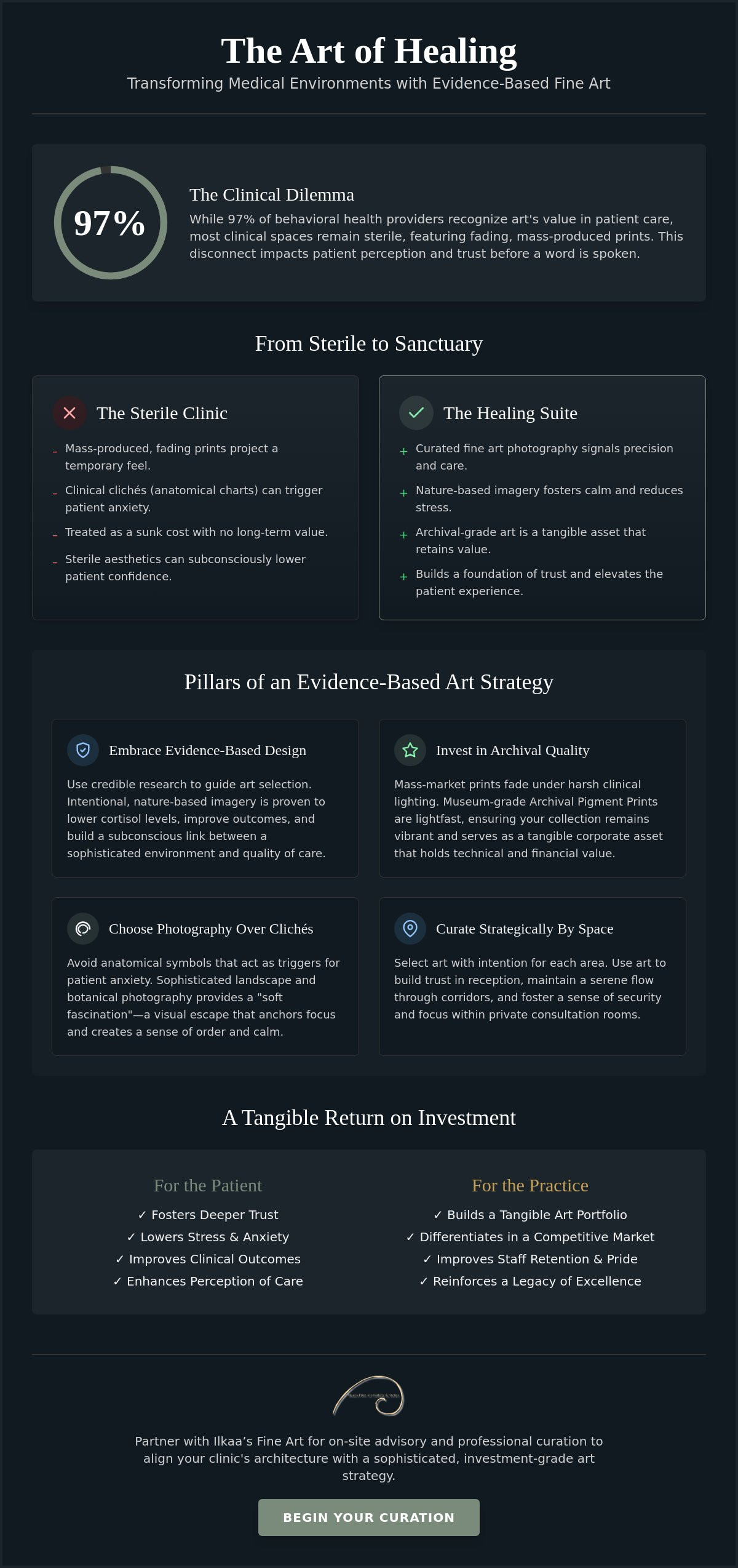
A clinical environment often speaks before the practitioner does. Research indicates that 97% of behavioral health providers recognize the value of art in patient care, yet many offices remain trapped in a cycle of sterile aesthetics and fading, mass-produced prints. You likely understand that your physical space is an extension of your professional reputation. It's the first point of contact for a patient seeking solace and the last thing they see before they depart. This guide serves as a curator's roadmap to transforming your practice into a sanctuary of healing and prestige. By integrating investment-grade fine art photography, you can foster deeper patient trust and improve clinical outcomes through evidence-based design. We will examine the selection of art for medical office Columbus environments, focusing on the technical mastery of archival pigment prints and the enduring value of a curated collection. From the biophilic influence of nature-themed works to the quiet confidence of The Atelier Collection, you'll discover how to build a tangible art portfolio that honors both the patient experience and your professional legacy.
Key Takeaways
- Learn how Evidence-Based Design principles transform a sterile clinic into a prestige medical suite that actively supports patient recovery and staff retention.
- Discover why biophilic photography serves as a superior alternative to literal clinical clichés, using nature-based imagery to anchor patient focus.
- Understand the technical necessity of museum-grade archival pigment prints to ensure your collection remains lightfast and vibrant under bright clinical lighting.
- Master the nuances of spatial curation to select art for medical office Columbus environments that builds trust in reception areas and maintains flow through private corridors.
- Explore the advantages of on-site advisory services to align your clinic's unique architecture with a sophisticated, investment-grade art strategy.
The Strategic Role of Fine Art in Columbus Healthcare Environments
The medical landscape in Columbus is undergoing a quiet transformation. The era of the sterile, white-box clinic is ending. It's being replaced by hospitality-inspired suites that prioritize the psychological well-being of the patient. In this environment, choosing art for medical office Columbus locations is a strategic decision rather than a decorative afterthought. It's an opportunity to define a practice through visual excellence. Fine art photography provides a non-verbal cue of clinical precision. It suggests that if a practitioner cares this deeply about the light and texture on their walls, they'll apply that same attention to detail to their patients. This shift toward hospitality-inspired design is a response to a more discerning patient base. These individuals expect their healthcare environments to mirror the high-end spaces they frequent in their daily lives. By curating a prestigious visual identity, a practice can also improve staff retention. Healthcare professionals spend significant time in these offices. A calm, beautiful environment reduces workplace fatigue and fosters pride in the professional home.
Defining Evidence-Based Design for Modern Clinics
Evidence-Based Design is the practice of using credible research to influence the design of healthcare environments to improve patient outcomes. Integrating Evidence-Based Design principles allows a practice to move beyond subjective taste. Research shows that intentional, nature-based imagery can lower cortisol levels in patients facing high-stress procedures. This isn't merely about aesthetics. It's about biology. A sophisticated visual environment bridges the gap between clinical expertise and patient comfort. It builds a foundation of trust before a single word is spoken. Sophisticated aesthetics create a subconscious link to the quality of care. If the environment is handled with technical mastery, patients assume the clinical practice follows that same standard.
Art as a Tangible Asset for Private Practices
Traditional office decor is often treated as a sunk cost, but fine art serves as a corporate asset. Transitioning to Limited Edition Prints or Archival Pigment Prints provides a practice with pieces that hold their technical integrity and financial value. Mass-market posters often fade under the harsh ultraviolet output of clinical lighting. They look cheap over time. Conversely, a collection from The Atelier Collection represents a commitment to craftsmanship. It reflects the longevity of the practice. Building a tangible art collection allows a private firm to differentiate itself in the competitive Columbus market. It projects an image of stability and prestige. When you invest in art for medical office Columbus suites, you aren't just decorating walls. You're building an archive of clinical excellence that grows with your practice.
Beyond Anatomy: Why Photography Outperforms Clinical Clichés
Literal symbols like anatomical hearts or stethoscopes often serve as triggers for patient anxiety. They act as constant reminders of illness. In contrast, sophisticated photography offers a window out of the clinical setting. High-net-worth clinics are increasingly moving toward minimalist, museum-grade works that prioritize emotional resonance over anatomical accuracy. This shift reflects a deeper understanding of the patient experience. Avoiding the "textbook" aesthetic is essential for creating a space of prestige. When selecting art for medical office Columbus suites, the goal is to provide a visual escape rather than a clinical diagram.
According to research from Penn State, the presence of specific artwork can significantly improve how patients perceive their overall experience. Photography, particularly in its representational or semi-abstract forms, anchors the viewer's focus. It provides a sense of order and calm that literal medical clichés simply cannot achieve. Choosing the right art for medical office Columbus practices requires a move away from the kitsch and toward the atmospheric. It's about replacing the expected with the exceptional.
The Calm of the Natural World in High-Stress Spaces
Landscape and botanical photography offer more than just decoration. They provide what environmental psychologists call "soft fascination." This is a state where the mind is gently engaged by natural patterns, allowing the nervous system to recover from the stress of a medical consultation. In Columbus, selecting works that evoke the regional landscape without descending into generic imagery creates a sense of place. The play of light across an Archival Pigment Print of a local woodland or the intricate texture of a botanical study can serve as a meditative anchor in a treatment room. These pieces invite the patient to linger and reflect, reducing the perceived passage of time during a wait.
Matching Art to Medical Specialties
A curator's approach ensures the visual tone aligns with the clinical mission. Every specialty requires a unique atmospheric weight.
- Surgical Centers: These spaces benefit from structured architectural photography. High-contrast lines. Clear perspectives. These elements signal precision, order, and technical mastery.
- Pediatric or Family Practice: Soft, evocative botanical pieces work best here. These images inspire warmth and a sense of organic growth, making the environment feel more approachable for younger patients.
- Executive Health and Concierge Medicine: These environments require rare, investment-grade Limited Edition Prints. These works signal exclusivity and a commitment to heritage.
Archival Standards: Museum-Grade Quality for Clinical Longevity
Clinical environments present a unique set of challenges for visual media. Constant exposure to high-intensity lighting, rigorous cleaning protocols, and the movement of people in high-traffic corridors can quickly degrade inferior materials. Selecting art for medical office Columbus practices requires a commitment to archival integrity. Mass-market prints often utilize dye-based inks that fade within years when exposed to ultraviolet light. In contrast, Archival Pigment Prints represent the pinnacle of technical durability. These prints utilize mineral-based pigments suspended in a high-quality resin, ensuring the work retains its chromatic depth and detail for decades. This isn't merely a matter of aesthetics; it's a protection of a corporate asset. Every piece in a professional collection should be accompanied by a Certificate of Authenticity. This document's essential for insurance valuations and establishes the provenance of the work as an investment-grade Limited Edition Print.
Understanding Museum-Grade Archival Pigment Prints
The distinction between standard inkjet output and museum-grade pigment processes is found in the chemistry of the medium. Pigment particles are solid and physically larger than dye molecules, making them inherently more stable. This stability provides a lightfastness rating that often exceeds 100 years under gallery conditions. For a permanent clinical collection, this longevity ensures the office maintains its prestigious atmosphere without the need for frequent replacements. Acid-free, pH-neutral materials are non-negotiable for medical office art to prevent the chemical yellowing and structural breakdown that occurs when paper fibers react with acidic environments. By prioritizing these standards, a practice ensures its visual legacy remains as clear as the day it was installed.
Framing for Healthcare: Aesthetics and Utility
Framing serves as the primary barrier between the artwork and the clinical environment. In a space defined by sanitization, the choice of glazing is critical. Anti-reflective, museum-grade acrylic or glass reduces the glare from overhead surgical or office lighting, allowing the patient to engage with the image without distraction. Beyond the visual, security mounting is a practical necessity for art for medical office Columbus installations. Using specialized hardware ensures pieces remain safely fixed to the walls in public-facing hallways, preventing accidental damage or shifting. This approach balances the warmth of The Atelier Collection with the exacting requirements of a sterile medical suite. The result is a professional environment that feels both curated and controlled.
Curation by Space: From the Waiting Room to Private Consults
Every medical office is a series of emotional thresholds. Effective curation follows the patient's journey from initial apprehension to clinical resolution. When planning art for medical office Columbus practices, one must consider the specific psychological needs of each zone. The goal isn't merely to occupy empty wall space. It's to create a cohesive spatial narrative. This narrative begins at the entrance and continues through the corridors into the treatment suites. Each piece should serve a purpose, whether it's establishing authority or offering a moment of quiet reflection.
The Reception: The First Impression of Care
The waiting room is where trust is established. A single, large-format landscape print often carries more authority than a cluttered gallery wall. It provides a singular point of focus; it anchors the room's architecture. Selecting a palette of muted earth tones or deep botanical greens promotes tranquility. This is the definitive statement of professional confidence. It signals that the practice is stable, intentional, and refined. Positioning the work to be the first thing a patient sees upon entry creates an immediate sense of order.
Hallways and corridors represent the transition from public to private care. Utilizing pieces from The Atelier Collection ensures a consistent visual flow. These transitional spaces benefit from smaller, related works that maintain a rhythmic pace. It prevents the "clinical tunnel" effect, replacing it with the feeling of walking through a quiet exhibition. This continuity reduces the anxiety often associated with moving toward a treatment area.
Treatment Suites: Distraction as Therapy
Inside the exam room, the scale must shift for intimate, close-proximity viewing. Art should be placed in the patient's direct line of sight during procedures. Detail-rich photography serves as a form of visual therapy. It provides a "soft fascination" that allows the mind to drift away from physical discomfort. Archival Pigment Prints in these smaller formats reveal intricate textures that reward close proximity. Proper lighting is essential here to ensure the print's depth is visible without creating distracting glare for the clinician or the patient.
The well-being of the healthcare professional is equally vital. A 2026 survey of healthcare staff revealed that 67% felt environmental art improved their workplace experience. The staff lounge should offer a complete mental break. Images here can be more evocative or abstract, serving as a visual palate cleanser between high-stakes consultations. It's a small but significant investment in the mental health of the team. To begin planning your practice's spatial narrative, you can view the full gallery collection online.
Partnering with Ilkaa’s Fine Art for Professional Curation in Columbus
Selecting art for medical office Columbus suites requires a partner who understands the intersection of clinical standards and artistic legacy. A curated environment isn't built through a catalog; it's developed through a deep understanding of space, light, and patient psychology. Ilkaa's Fine Art Gallery & Atelier, located within the historic Joseph-Cherrington House in Olde Towne East, serves as a local anchor for this process. We provide on-site advisory services that allow our curators to assess your clinic's floor plan in person. This ensures that every piece from The Atelier Collection is scaled correctly to your architecture. Our expertise bridges the gap between the photographer's vision and the practitioner's professional home. We oversee every technical detail. This includes the selection of Archival Pigment Prints, museum-grade framing, and professional installation. The result is a seamless transition from a blank clinical space to a prestigious sanctuary of healing.
Bespoke Art Advisory for Columbus Healthcare
Our curators translate your practice's core values into a sophisticated visual portfolio. We don't merely provide decor. We source rare, investment-grade Limited Edition Prints that satisfy the specific requirements of your medical specialty. This bespoke approach involves close collaboration with your interior design team. We ensure aesthetic harmony between your office's textures, colors, and the final photographic works. Whether you require structured architectural studies for a surgical center or soft botanical textures for a family practice, we align the art strategy with your clinical mission. This level of intentionality creates a unified environment that projects authority and calm.
The Gallery Experience: An Invitation to Columbus Professionals
Digital previews cannot convey the tactile depth of a physical print. Viewing archival photography in person is essential for selecting the correct textures and tonal ranges for your office. At our gallery, you can witness how light interacts with the paper fibers of our museum-grade collections. This sensory experience is vital for choosing pieces that will anchor your practice for decades. A local partnership also offers the advantage of long-term collection management. As your practice grows or your facility expands, we provide the continuity needed to maintain a cohesive visual identity. We invite you to experience the quiet confidence of our works firsthand. You may schedule a private curation consultation for your Columbus medical office to begin the transformation of your space.
Elevating the Clinical Narrative
The transition from a clinical environment to a sanctuary of healing is achieved through intentionality and craft. By prioritizing Evidence-Based Design and museum-grade archival pigment prints, a practice secures both patient trust and a tangible corporate asset. We've explored how moving beyond literal clichés toward biophilic photography anchors the patient experience in a state of calm. When you curate art for medical office Columbus environments, you're establishing a visual legacy that mirrors your clinical excellence. Located in the historic Joseph-Cherrington House, our atelier provides expert art advisory for corporate and medical collectors seeking to refine their professional space. This partnership ensures that every technical detail, from lightfastness to security mounting, is handled with technical mastery. Your space has the potential to become a quiet exhibition of prestige and restoration. We invite you to explore our curated photography collections for healthcare spaces and begin the process of redefining your environment. Your patients, your staff, and your professional legacy deserve a space that inspires confidence.
Frequently Asked Questions
Why is fine art photography better than traditional medical art for a clinic?
Fine art photography offers a window out of the clinical setting, whereas literal medical art can act as a trigger for patient anxiety. Representational photography provides a meditative anchor through natural patterns and light. This soft fascination allows patients to disengage from their surroundings, fostering a sense of tranquility that anatomical diagrams or clinical clichés simply cannot provide.
What are the specific archival standards required for medical office art?
Archival standards for clinical spaces prioritize lightfastness and chemical stability. Archival Pigment Prints utilize mineral-based pigments that resist fading under intense clinical lighting for over 100 years. It's essential to use pH-neutral, acid-free mounts and museum-grade glazing to prevent yellowing or degradation caused by environmental pollutants or ultraviolet exposure.
How do I choose art that reduces patient anxiety in the waiting room?
Selecting art for medical office Columbus waiting rooms involves prioritizing biophilic imagery and muted, natural color palettes. Large-format landscapes provide a singular, grounding point of focus that anchors the room's architecture. These works should evoke a sense of order and serenity, helping to lower cortisol levels and reduce the perceived wait time for patients.
Does Ilkaa’s Fine Art provide on-site consultations for Columbus healthcare facilities?
Yes, Ilkaa’s Fine Art Gallery & Atelier provides bespoke on-site consultations for healthcare facilities throughout the Columbus region. Our curators visit your clinic to evaluate floor plans, lighting, and spatial flow in person. This tailored approach ensures that your collection aligns perfectly with your practice's physical environment and clinical values.
What is the difference between an open edition and a limited edition archival print?
Limited Edition Prints are produced in a restricted, finite quantity and are accompanied by a Certificate of Authenticity. This scarcity creates long-term value and exclusivity for the collector. Open editions are produced indefinitely and lack the investment potential and provenance associated with the curated works found in The Atelier Collection.
How should we clean and maintain fine art prints in a medical environment?
Maintenance in a clinical setting is handled through the protective glazing rather than the print itself. Museum-grade acrylic or glass should be cleaned with a soft, non-abrasive microfiber cloth and specialized cleaners designed for optical surfaces. Professional framing ensures the Archival Pigment Prints remain sealed against dust and sanitization chemicals used in the broader office environment.
Can photography prints be customized to fit the specific wall dimensions of our clinic?
Photographic works can be scaled and curated to meet the specific architectural dimensions of your medical suite. During the advisory process, we determine the ideal proportions for each space, whether it's a large-scale statement piece for a reception area or intimate works for treatment rooms. This ensures the art feels integrated into the building's design.
Is photography considered a tangible financial asset for a medical corporation?
Investment-grade fine art photography is recognized as a tangible corporate asset for medical practices. Unlike mass-market decor, Limited Edition Prints hold their value and can be appraised for insurance or corporate valuation. Building a curated collection serves as a strategic investment in the practice's brand equity and physical assets.
Disclaimer
Information is provided for general editorial and educational purposes. Artwork availability, pricing, dimensions, framing, edition details, exhibition information, and event schedules are subject to change. Please contact Ilkaa’s Fine Art Gallery & Atelier for the most current information.
© 2026 Ilkaa’s Fine Art Gallery & Atelier. Article text, gallery photographs, graphics, and other original gallery content may not be copied, reproduced, republished, distributed, modified, or used for commercial purposes without prior written permission. Copyright in individual artworks, artist photographs, and other third-party materials remains with the respective artists, photographers, estates, or rights holders. Brief quotations and links may be used with appropriate attribution where permitted by law.