
Does the value of a fine art photograph reside in its finality, or in the quiet, iterative moments of its creation? For many collectors, the distinction between an artist proof vs limited edition is often the difference between owning a finished result or a piece of the artistic process itself. You likely recognize the weight of this decision. Selecting a high-value print requires more than an appreciation for light and shadow; it demands a clear understanding of archival standards and market rarity.
This guide provides the clarity required to understand these terminology nuances, ensuring you build a photography collection with absolute confidence. We explore the historical significance of the artist proof, the structural integrity of limited editions, and how to align your next acquisition with your investment goals. By the end, you'll understand why the global prints market, which reached a record $526 million in 2025, now places such high value on these specific, curated designations.
Key Takeaways
- Distinguish between the standardized numbering of a limited edition and the exclusive, archival nature of an artist’s proof.
- Assess the pricing nuances of an artist proof vs limited edition to make an informed, high-value investment in your collection.
- Understand how the editioning process ensures scarcity and protects the long-term integrity of fine art photography.
- Gain a curated framework for selecting prints that meet museum-grade archival standards and satisfy your personal acquisition goals.
The Fundamentals of Limited Edition Photography Prints
A limited edition photography print represents a deliberate restriction of supply, curated to ensure both rarity and artistic integrity. In the sphere of fine art, the print is not merely a reproduction; it is the definitive expression of the artist's intent. By capping the number of prints produced, the creator establishes a clear boundary of scarcity. This process, known as editioning, transforms a digital or film capture into a tangible, investment-grade asset. It’s a commitment to the collector that the work will never exist in an unregulated, infinite capacity.
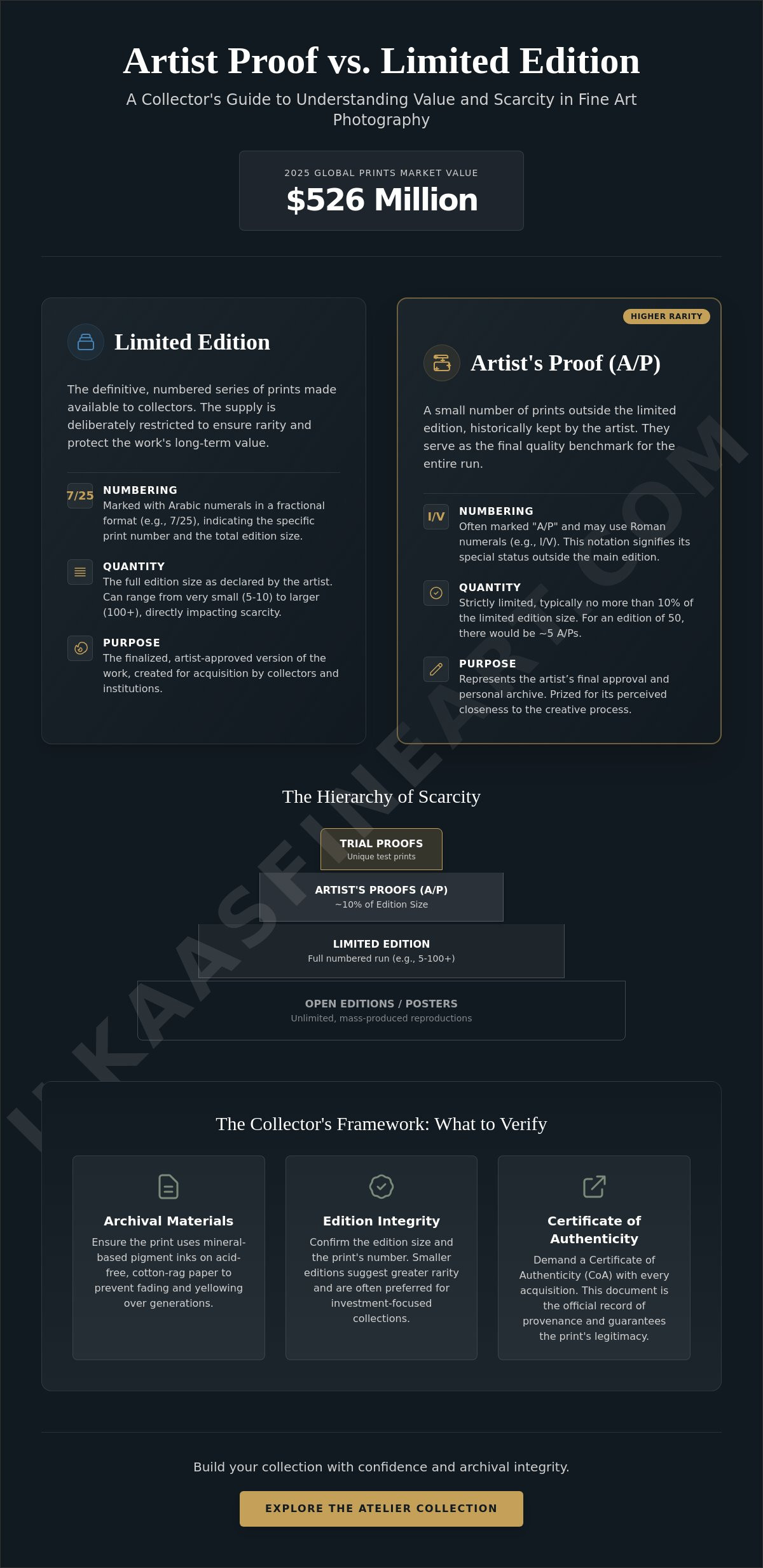
The technical execution of these works relies heavily on the master printer. This specialist works in close tandem with the artist to maintain absolute consistency across the entire run. Every shadow, highlight, and tonal gradation must remain identical from the first print to the last. Once the run is finalized, each work is hand-signed and numbered using a fractional system, such as 7/25. This notation signifies that the piece is the seventh of only twenty-five in existence. This structured scarcity is a primary factor when collectors weigh the choice of an artist proof vs limited edition, as both classifications exist far beyond the realm of open-edition, mass-produced imagery.
The Mechanics of Scarcity in Fine Art
Edition sizes dictate the market positioning and exclusivity of a photograph. A run of five prints suggests extreme rarity, often reserved for institutional collections or seasoned investors. Conversely, an edition of 100 provides a more accessible entry point for those beginning their journey. The psychological impact of scarcity is profound; knowing a work has a finite physical existence elevates it from a mere image to a historical artifact. In the fine art market, these limited runs are essential for maintaining the work’s status. They ensure that the photograph remains a disciplined asset rather than a common commodity.
Archival Standards and the Physical Print
The distinction between a fine art print and a mass-market poster lies in the chemistry of the medium. Serious artists utilize archival pigment prints, which pair mineral-based inks with acid-free, cotton-rag papers. These materials are designed to endure for generations, resisting the yellowing or fading common in commercial reproductions. To verify these standards, every acquisition should be accompanied by a Certificate of Authenticity. This document serves as the official record of the print's provenance, confirming its place within the limited run and its specific relationship to any Artist's Proof copies that may exist alongside the main edition. This documentation is the cornerstone of a secure and transparent collection.
Decoding the Artist’s Proof: Scarcity and Purpose
The Artist’s Proof (A/P) occupies a singular space in the hierarchy of fine art photography. Historically, these prints weren't intended for the public market. They served as the artist’s personal record, kept for archival purposes or as gifts for close associates. While a numbered edition represents the completed vision, the A/P represents the artist’s final approval of the master print’s technical execution. It is the bridge between the fluid creative process and the static final run.
In a disciplined studio environment, the 10% rule typically governs these runs. If a limited edition consists of 50 prints, the artist will generally produce no more than five A/Ps. This restraint preserves the integrity of the market and ensures the work's long-term value. It’s also vital to distinguish between a 'Working Proof' and a 'Final Artist Proof.' A working proof is a trial iteration used to test ink saturation or paper texture. These often bear the marks of the process, such as handwritten notes or slight tonal shifts. In contrast, the final A/P is identical to the numbered edition, serving as the benchmark for the entire run. This distinction is a key factor when evaluating an artist proof vs limited edition print for a growing collection.
The Allure of the A/P Designation
Collectors are often drawn to the A/P for its perceived intimacy. There is a quiet prestige in owning a work that was traditionally reserved for the artist’s private collection. To maintain this exclusivity, artists frequently use Roman numerals (such as I/V) instead of standard Arabic numerals. This visual shift subtly signals that the print belongs to a more restricted tier of production. It suggests a closer proximity to the creator’s hand, making it a favored choice for those seeking a deeper connection to the Atelier Collection and the heritage of the medium.
Trial Proofs vs. Hors d’Commerce (H/C)
The lexicon of printmaking extends to even rarer designations. Trial Proofs are unique, often containing subtle variations in light and shadow as the artist dials in the final aesthetic. They are the artifacts of the creative struggle. Conversely, prints marked H/C (Hors d’Commerce) are 'Not for Sale.' These are typically used for gallery archives or as tokens of gratitude for the master printer. While H/C prints occasionally enter the secondary market, they remain some of the most elusive captures in photography. These rare marks add layers of narrative to a collection, offering a glimpse into the private world of the studio.
Artist Proof vs Limited Edition: Value and Investment
The acquisition of fine art photography is an exercise in discerning value. In the primary market, collectors often encounter a pricing disparity between an artist proof vs limited edition. Typically, an Artist’s Proof (A/P) commands a premium of 20% to 30% over its numbered counterparts. This isn't a reflection of physical quality. Instead, it's a recognition of extreme scarcity. With photography accounting for 6% of the global art market's sales share in 2025, the demand for these exclusive designations has reached a record high.
A common misconception involves the perceived superiority of the first print in an edition. While 1/50 might feel more significant than 50/50, modern archival pigment printing ensures absolute tonal consistency throughout the run. The value of the "first" is purely symbolic. However, if a collector possesses 1/50 and the artist's reputation surges, that specific number may occasionally attract a higher premium at auction simply due to its perceived position in the archive. Investment grade status is rarely about the sequence; it's about the discipline of the edition.
True investment value rests on the bedrock of provenance. Beyond the signature on the paper, the documentation of a work's history is vital. As the proposed Art Market Integrity Act of 2025 suggests a future of increased scrutiny on transactions over $10,000, clear records are becoming essential. A print with a verified chain of ownership and a formal Certificate of Authenticity is a more liquid asset than one with ambiguous origins. This transparency is what separates a casual purchase from a professional acquisition.
The Price of Rarity
Gallery curators often utilize tiered pricing to manage the availability of a work. As an edition nears sell-out, the final remaining prints see measured price adjustments. This reflects the market's willingness to pay for the last opportunity to own a specific vision. The reputation of the atelier and the photographer’s historical auction performance further solidify these premiums. For many, the A/P mark is worth the extra investment for its narrative weight alone.
Secondary Market Liquidity
During periods of market correction, A/Ps often demonstrate greater resilience. Their limited volume makes them less susceptible to the price fluctuations that can affect larger editions. For collectors in Columbus or international hubs, tracking the "sold" history via auction databases is the most reliable way to gauge real-time value. In 2025, the segment for works under $50,000 accounted for 87% of sales, proving that disciplined, research-oriented collecting is a viable path for portfolio diversification.
The Collector’s Framework: How to Choose Your Next Acquisition
Building a collection is a transition from passive appreciation to active curation. It requires a disciplined approach that balances emotional resonance with technical scrutiny. When you evaluate an artist proof vs limited edition, the decision should reflect your long-term objectives for the work. Whether you are acquiring your first piece or expanding a sophisticated portfolio, following a structured framework ensures that each addition maintains its integrity and value over time.
The first step involves defining your primary goal. Are you seeking a centerpiece for a private space, or are you focused on portfolio diversification? While these goals often overlap, identifying your priority helps narrow the field. Next, you must inspect the archival quality of the print. A true investment-grade photograph utilizes archival pigment prints on acid-free, cotton-rag paper. These materials are designed to resist the degradation that affects commercial alternatives. You should also evaluate the edition size with care. A run of 25 prints offers significantly more protection for your investment than a run of 500. Finally, verify the provenance. A clear, authenticated history is the soul of a high-value print; without it, the work lacks the transparency required for the modern market.
Trusting the tactile experience is the final, essential step. Fine art is meant to be experienced in person. The way light interacts with the texture of the paper and the depth of the mineral-based inks cannot be fully captured on a digital screen. If you're ready to experience this technical mastery firsthand, you can explore the Atelier Collection to see how these standards are applied in practice.
Aesthetic vs. Asset: Finding the Balance
You should never acquire a print solely for its potential appreciation. If the work does not move you, the "A/P" mark or the low edition number becomes secondary. A successful collection is one that reflects the owner's taste while adhering to market discipline. If your budget is a constraint, a higher-numbered print from a small limited edition often provides the same aesthetic joy as an artist’s proof at a more accessible price point. Many collectors utilize an art advisor to navigate these subtle trade-offs between rarity and cost.
Red Flags for New Collectors
The market contains several pitfalls for the unwary. Be cautious of "Open Editions" that are marketed with the language of scarcity but lack a capped run. These works do not hold investment value. Additionally, avoid prints that lack a physical signature or rely solely on digital-only certificates. These are often signs of mass-market production. Remember that the term "limited" loses its meaning if the run extends into the thousands. True scarcity is found in the disciplined, small-batch runs of a dedicated studio.
The Ilkaa's Atelier Approach: Authenticity and Archival Standards
Ilkaa's Fine Art Gallery & Atelier operates with a profound reverence for the physical photograph as a permanent object. In a landscape often dominated by digital transience, we center our practice on the tactile reality of the print. This approach transforms the act of collecting into a guardianship of artistic legacy. We facilitate a seamless transition from the photographer’s initial capture to the final, framed work in your private collection. By maintaining strict curatorial control over the Atelier Collection, we ensure that every work meets the highest standards of technical and artistic mastery.
The decision between an artist proof vs limited edition is often clarified when you engage with the physical medium. At Ilkaa's Fine Art Gallery & Atelier, we utilize archival pigment prints that rely on mineral-based inks and acid-free, cotton-rag papers. These materials don't just capture light; they hold it for generations. While previous sections explored the market mechanics of these designations, our atelier focuses on the physical stability that underpins that value. A work's scarcity is only as meaningful as its ability to survive the passage of time without fading or degradation.
Authenticity is the bedrock of every acquisition we facilitate. We understand that a high-value print is both an emotional centerpiece and a disciplined asset. Therefore, we provide comprehensive documentation that verifies the provenance and technical specifications of every work. This transparency ensures that collectors possess a clear, authenticated record of their print's history within the edition. By adhering to these rigorous standards, we protect the integrity of the artist’s vision and the collector’s investment.
Curating the Historic Joseph-Cherrington House
The environment of our Columbus gallery plays a vital role in our curatorial process. Located within the historic Joseph-Cherrington House, Ilkaa's Fine Art Gallery & Atelier provides an intimate setting where the history of the architecture complements the heritage of the photography. We invite local collectors to step away from the screen and experience the depth of archival collections in person. Viewing these works in a physical space allows for a deeper appreciation of the subtle textures and tonal ranges that define high-level craftsmanship.
Building Your Legacy with Ilkaa's Fine Art Gallery & Atelier
We act as an authoritative guide for those navigating the complexities of the fine art market. Our commitment is to provide authenticated, high-value works that collectors can acquire with absolute certainty. We assist in decoding the nuances of each acquisition, ensuring that the provenance and archival standards are transparent and documented. By prioritizing these rigorous standards, we help you build a collection that serves as a lasting legacy. To begin your journey, you may Explore our current Limited Edition and Atelier collections.
Refining Your Curatorial Vision
The choice between an artist proof vs limited edition is the final act of discernment in the curation process. It represents a transition from observing a work to stewarding its legacy. You now understand the structural differences in scarcity and the quiet narrative weight carried by the artist’s personal archive. Both designations require a disciplined eye for archival integrity and a commitment to verified provenance to ensure the work’s enduring value within your collection.
Ilkaa's Fine Art Gallery & Atelier serves as a guardian of these standards within the historic Joseph-Cherrington House. By focusing on museum-grade materials and works curated by internationally respected photographers, we offer a sanctuary for the serious enthusiast. We invite you to Browse the Curated Atelier Collection at Ilkaa's Fine Art Gallery & Atelier to discover a piece that aligns with your aesthetic and investment goals. Your collection is the ultimate expression of your unique perspective.
Frequently Asked Questions
Is an artist proof the same quality as a limited edition print?
Yes, a final Artist's Proof is identical in physical quality to a print from the standard limited edition. Both utilize the same museum-grade archival pigment and acid-free cotton-rag paper. While working proofs may show the artist's iterative adjustments, the final A/P serves as the technical benchmark for the entire run. It ensures the collector receives a work of absolute tonal precision and archival longevity.
Why is an artist proof more expensive than a numbered print?
The higher cost of an artist proof vs limited edition print is driven by extreme scarcity and historical prestige. Because A/Ps are traditionally reserved for the artist’s private archive, they represent a more intimate tier of the edition. This restricted supply often results in a market premium of 20% to 30% over standard numbered prints. Collectors pay for the narrative weight of owning a work closer to the creator’s personal collection.
How many artist proofs are usually made for a photography edition?
Most photography editions follow a disciplined 10% rule for proofing. If a limited edition consists of 50 prints, the artist will typically produce only five artist proofs. This ratio preserves the integrity of the market and ensures that the A/P remains a rare designation. Maintaining these small numbers is essential for protecting the long-term investment value for all collectors involved in the edition.
Does a lower number in a limited edition make the print more valuable?
A lower edition number doesn't technically increase the print's quality or inherent value. In modern archival pigment printing, the 50th print is identical to the first. While some collectors find symbolic value in owning "1/50," the market prioritizes the overall condition and provenance of the work. The technical mastery remains consistent throughout the entire restricted run, regardless of the fractional number assigned.
Can an artist proof be sold on the secondary market?
Yes, artist proofs are frequently traded on the secondary market and are often highly sought after by seasoned collectors. Their limited volume can make them more resilient during market fluctuations compared to larger editions. In 2025, the secondary market for prints and multiples saw record activity, with A/Ps often leading in terms of liquidity and price retention due to their exclusive nature.
What does 'H/C' mean on an art print?
The mark 'H/C' stands for Hors d’Commerce, which translates to "Not for Sale." These prints are intended for the artist’s personal use, gallery archives, or as gifts for the master printer. While they aren't meant for initial commercial release, they occasionally enter the market through private sales. They represent one of the most exclusive designations in the world of fine art photography and carry significant narrative value.
Should I buy a limited edition print if the artist proof is unavailable?
You should certainly acquire a limited edition print if the artist proof is no longer available. Numbered prints represent the definitive, completed vision of the artist and hold significant investment-grade status. They offer the same tactile depth and archival longevity as any other designation in the run. The aesthetic experience of the work remains the most important factor in any high-value acquisition.
How do I verify if a print is a genuine artist proof?
Verification requires a formal Certificate of Authenticity and a physical inspection of the work’s markings. A genuine artist proof will typically be hand-signed and marked with 'A/P' or Roman numerals like 'I/V'. You should also examine the provenance to ensure a clear chain of ownership from the artist or an authorized gallery. This documentation is vital for confirming the print's status within the artist proof vs limited edition hierarchy.
Disclaimer
Information is provided for general editorial and educational purposes. Artwork availability, pricing, dimensions, framing, edition details, exhibition information, and event schedules are subject to change. Please contact Ilkaa’s Fine Art Gallery & Atelier for the most current information.
© 2026 Ilkaa’s Fine Art Gallery & Atelier. Article text, gallery photographs, graphics, and other original gallery content may not be copied, reproduced, republished, distributed, modified, or used for commercial purposes without prior written permission. Copyright in individual artworks, artist photographs, and other third-party materials remains with the respective artists, photographers, estates, or rights holders. Brief quotations and links may be used with appropriate attribution where permitted by law.