
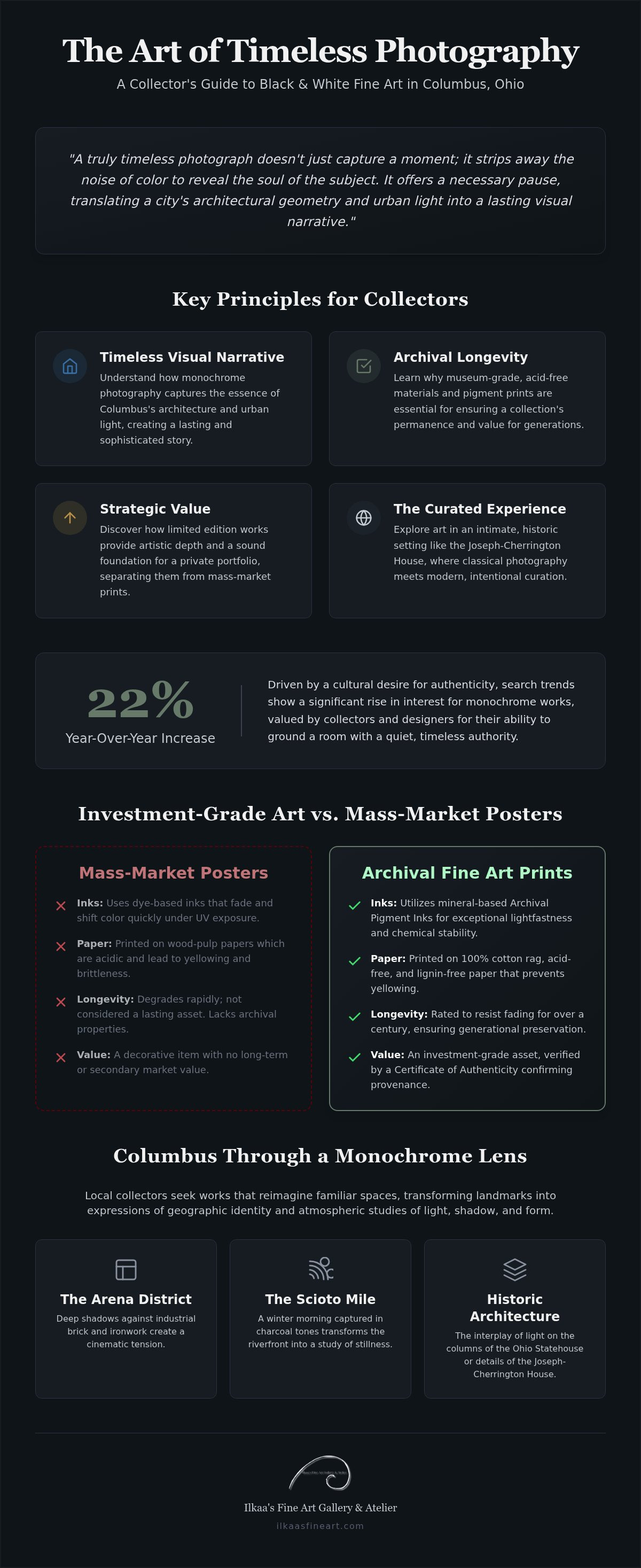
A truly timeless photograph doesn't just capture a moment; it strips away the noise of color to reveal the soul of the subject. In a city defined by its rapid evolution, the quiet permanence of black and white photography in Columbus Ohio offers a necessary pause. You've likely felt the exhaustion of browsing through saturated markets filled with generic, mass-produced posters that lack both technical mastery and emotional depth. It's often difficult to find pieces that carry the weight of history while meeting the rigorous archival standards required for a lasting collection.
This guide explores the sophisticated world of monochrome fine art within our city. You'll discover the significance of archival pigment prints and the value inherent in limited edition works. We invite you to step inside the historic Joseph-Cherrington House, where the Atelier Collection provides an intimate gallery experience far removed from the cold, commercial spaces of the mainstream. From technical longevity to the nuances of local curation, you'll gain the clarity needed to acquire a piece of Columbus history that resonates for a lifetime.
Key Takeaways
- Understand how black and white photography Columbus Ohio translates the city’s architectural geometry and urban light into a timeless visual narrative.
- Learn the technical requirements for archival pigment prints and why museum-grade materials are essential for ensuring the longevity of a fine art collection.
- Discover the strategic value of limited edition works and how these exclusive pieces provide both artistic depth and a sound foundation for a private portfolio.
- Explore the curated experience within the historic Joseph-Cherrington House, where the traditions of classical photography meet modern, intentional curation.
The Allure of Black and White Photography in Columbus, Ohio
In the vibrant pulse of a modern city, color can often act as a distraction. It's a surface layer that masks the structural integrity of a scene. To choose Monochrome photography is to make a deliberate decision to look deeper. By removing the spectrum of color, the artist forces the viewer to engage with the raw elements of composition: the curve of a limestone arch, the harsh geometry of a skyscraper against a midday sky, or the soft gradation of light across a brick facade. This is the foundation of black and white photography in Columbus Ohio, where the city's unique blend of historic charm and glass-and-steel modernity becomes a playground for the discerning eye.
The 2026 landscape for fine art in our city is defined by a return to the tactile. Collectors are moving away from hyper-saturated digital imagery in favor of the "cream-and-charcoal" tonality found in archival pigment prints. This shift represents a broader cultural desire for authenticity. According to search trends from April 2026, there's been a 22% year-over-year increase in interest for monochrome works, largely driven by interior designers who value the medium's ability to ground a room.
Monochrome as a Timeless Aesthetic
Black and white imagery possesses a quiet authority that color rarely achieves. It simplifies the visual field, allowing the emotional core of a photograph to resonate without the noise of current trends. For the collector, this medium offers a sense of permanence. High-contrast compositions integrate seamlessly into both the historic residences of German Village and the minimalist lofts of the Short North. It's a medium that doesn't demand attention but rather commands it through a refined, understated presence.
For those who appreciate the precision of modern design, the architectural photography of Jim Signorelli provides a compelling example of how monochrome prints can highlight the geometric beauty of contemporary structures.
The Local Perspective: Columbus Through the Lens
Local collectors often seek works that transcend mere documentation. They look for the atmospheric quality of a familiar space reimagined. The city offers several iconic subjects for this exploration:
- The Arena District: Deep shadows against industrial brick and ironwork create a cinematic tension.
- The Scioto Mile: A winter morning captured in charcoal tones transforms the riverfront into a study of stillness.
- Historic Architecture: The interplay of light on the columns of the Ohio Statehouse or the intricate details of the Joseph-Cherrington House.
These aren't just landmarks; they're expressions of a geographic identity. By focusing on black and white photography in Columbus Ohio, collectors can build a narrative that is both deeply personal and universally sophisticated. It's about finding the extraordinary within the familiar, using a medium that has stood the test of time to capture a city that is constantly in motion.
Beyond the Frame: Archival Standards and the Monochrome Medium
For the serious collector of black and white photography in Columbus Ohio, the value of a piece extends far beyond the visual image. It's found in the chemistry. Mass-market posters often rely on dye-based inks and wood-pulp papers that degrade rapidly under UV exposure. Fine art, conversely, is an exercise in intentional preservation. Every material choice is made with the passage of time in mind.
True excellence requires strict adherence to archival standards for photographs to ensure the work remains unchanged for generations. This process involves the use of 100% cotton rag mats and acid-free, lignin-free papers. These materials are naturally pH neutral. They prevent the brittle texture and yellowing common in lesser prints, maintaining the pristine whites and deep charcoals that are essential to monochrome aesthetics.
Archival Pigment Prints vs. Giclee
While the term "giclee" is frequently used as a marketing catch-all, the discerning collector prioritizes archival pigment prints. These utilize mineral-based pigments rather than liquid dyes. Museum-grade works are defined by their exceptional lightfastness and chemical stability, often rated to resist fading for over a century. This technical rigor separates a decorative item from an investment-grade asset. The depth of the blacks and the subtle gradations of gray depend entirely on the quality of these stable pigments.
The Importance of Authentication
Provenance is the cornerstone of a meaningful portfolio. A Certificate of Authenticity acts as the legal and historical record of the work. It confirms the edition number, the artist's signature, and the specific archival materials used. In the 2026 market, these documents are vital. They ensure that your acquisition carries its value into the secondary market, providing certainty that the work is a genuine artifact of artistic legacy. Provenance doesn't just begin at the point of sale; it's a commitment that starts at the gallery level.
Achieving the perfect tonality requires a profound mastery of the medium. Whether produced in a traditional darkroom or through high-end digital output, the artist must manage the density of the shadows and the clarity of the highlights with surgical precision. When you view the Atelier Collection, the tactile quality of the heavy-weight paper and the physical presence of the ink become immediately apparent. It's a sensory experience that mass production simply cannot replicate.
Curating a Local Collection: Why Monochrome Appeals to Discerning Collectors
Curation is a deliberate practice of selection and arrangement. It transforms a group of disparate images into a unified statement. For those investing in black and white photography Columbus Ohio, the goal is often to balance personal resonance with professional-grade curation. A well-constructed portfolio doesn't just display art; it tells a story through contrast, texture, and light. It requires a discerning eye to move beyond individual images toward a cohesive narrative that reflects both the collector's taste and the city's heritage.
Local institutions provide a blueprint for this level of intentionality. For instance, The Ohio State University's Picturing Black History project illustrates how photography serves as a bridge between the past and the present. By observing how these academic archives are managed, private collectors can learn to select works that capture the essence of the city while maintaining a sophisticated, abstract edge. This approach ensures that a collection remains relevant as the 2026 art market continues to favor works with deep historical and technical roots.
Limited Edition vs. Open Edition
The distinction between these formats is the primary driver of long-term value. Open editions are produced without a set limit, often leading to market saturation and diminished prestige. Conversely, Limited Edition Prints are restricted to a specific number of impressions. This scarcity creates a natural appreciation in value as the edition nears completion. Discerning collectors also look for Artist Proofs. These are the initial prints used by the photographer to perfect the tonality and are often considered the most desirable pieces in a series due to their proximity to the artist's original vision.
Strategic Placement in the Home
Living with fine art requires as much consideration as the acquisition itself. Large-scale monochrome works function effectively as singular focal points, especially in minimalist environments. They anchor a room without overwhelming the existing decor. When creating a gallery wall, the key is to mix textures. A high-contrast architectural study can sit comfortably beside a soft, silver-toned landscape, provided the framing remains consistent.
Displaying these works also demands technical care. To meet archival standards, use LED lighting that doesn't emit heat or UV radiation. For glazing, ensure frames include 99% UV filtration to protect the pigments from the shifting light of Ohio seasons. This level of attention ensures your collection remains a source of inspiration for decades. Art advisory services can further simplify this process, offering guidance on everything from thematic selection to the final installation within a private residence.
Exploring Columbus Through a Lens: Iconic Scenes and Hidden Perspectives
The pursuit of black and white photography in Columbus Ohio requires an eye for the unseen. While standard digital captures often favor the familiar skyline, fine art photography seeks the quiet tension between shadow and structure. It's a deliberate move away from the literal. Instead of a broad cityscape, the artist might focus on the rhythmic repetition of a limestone cornice or the stark, high-contrast silhouette of a bridge against the Scioto River. These hidden perspectives transform the city into a series of abstract forms, revealing a depth that color often obscures.
The Joseph-Cherrington House stands as a primary example of this artistic depth. It's more than a gallery; it's a subject of significant architectural character. The way the light rakes across its historic facade provides an endless study in silver-toned gradations. For the collector, owning a piece that captures this specific heritage offers a connection to the city that transcends simple decoration. It's a sanctuary for the medium, where the building itself serves as a muse for the works housed within its walls.
Historic Architecture as Art
Columbus's historic districts provide a rich tapestry of stone and shadow. In areas like German Village or the Arena District, the interplay of textures becomes the true subject. Archival-style photography documents the evolution of these spaces, preserving the tactile quality of aged brick and wrought iron. Local history adds a layer of intrinsic value to a photographic print, turning a visual record into a cultural artifact. It's a documentation of time, rendered through the permanent medium of monochrome pigment.
The Atmosphere of the City
Night photography in Columbus offers a different tonal language. The 'Electric' monochrome style utilizes the city’s artificial glow to create deep, velvet-like blacks and piercing highlights. This high-contrast approach is particularly effective in capturing downtown urban geometry. Conversely, the local landscape allows for minimalist interpretations. The Olentangy Trail and various nature preserves offer scenes of stark simplicity, where a single tree or a bend in the river becomes a study in form. The light of an Ohio autumn, filtered through a low-hanging sun, creates a silver-etched clarity that defines the monochrome landscape.
Acquiring these rare perspectives allows a collection to breathe with the life of the city. To explore these works in person, we invite you to view the Atelier Collection at our historic gallery, where each piece is curated to honor the architectural soul of Columbus.
Ilkaa’s Fine Art: A Sanctuary for Fine Art Photography in Columbus
The acquisition of fine art is an intimate process. It requires a space that respects both the creator's vision and the collector's journey. At Ilkaa’s Fine Art Gallery & Atelier, we provide an intentional environment designed for reflection. Located within the historic Joseph-Cherrington House at 785 E. Broad St., our gallery serves as a sanctuary for black and white photography in Columbus Ohio. Unlike the fleeting nature of digital storefronts, this physical atelier invites you to experience the weight, texture, and silver-etched depth of a physical print in person.
Our commitment to museum-grade production is unwavering. Each piece in the Atelier Collection represents a mastery of the medium, ensuring that every shadow and highlight is rendered with absolute precision. For residents and professional firms seeking to build a meaningful portfolio, we offer dedicated art advisory services. We act as a bridge, guiding you through the nuances of curation to ensure each acquisition aligns with your aesthetic and investment goals. Private viewings are conducted by appointment; this allows for a quiet, uninterrupted engagement with the works.
A Curated Roster of Talent
Selection is the soul of a gallery. Under the direction of curator Ilkaa Amalia and photographer Millie Franz, we maintain a rigorous standard for the artists we represent. Our roster features a balance of internationally recognized masters and local talent, creating a diverse dialogue within the monochrome medium. You'll find works from renowned figures such as Kim Weston, Roman Loranc, and Cristina Mittermeier, alongside emerging voices who capture the specific architectural spirit of the Midwest. This careful curation ensures that every Limited Edition Print we offer carries both artistic integrity and historical significance.
Your Next Steps in Collecting
Building a collection is a gradual, rewarding endeavor. Whether you're a seasoned collector or just beginning to explore the world of fine art, the process starts with a conversation. We invite you to browse our digital platform to familiarize yourself with our current offerings, though we believe the true power of a photograph is best felt in its presence. Scheduling a private consultation allows us to understand your space and your vision. This ensures a tailored experience that respects your time and your passion for the arts.
The journey toward a lasting legacy begins with a single, intentional choice. We welcome you to step inside our historic space and discover the quiet power of the monochrome image. Explore the Atelier Collection at Ilkaa’s Fine Art Gallery and begin your next chapter in collecting.
Refining Your Artistic Legacy in Columbus
Collecting fine art is a journey toward permanence. It requires a commitment to museum-grade archival standards and an appreciation for the technical mastery found in limited edition works. By focusing on black and white photography Columbus Ohio, you choose a medium that transcends temporary trends. You move beyond decorative prints and toward the creation of a sophisticated, personal archive that honors the city's unique architectural heritage.
This level of intentional curation is best explored within a space that respects the artistic process. We invite you to experience the Atelier Collection firsthand at the historic Joseph-Cherrington House. Under the expert curation of Ilkaa Amalia, our gallery offers a quiet, exclusive environment for discerning collectors to discover their next acquisition. Visit Ilkaa’s Fine Art Gallery & Atelier in Columbus to begin or expand your collection with confidence. Your pursuit of a timeless aesthetic deserves a sanctuary that values integrity as much as you do.
Frequently Asked Questions
What makes black and white photography 'fine art' compared to standard prints?
Fine art status is defined by the intersection of artistic intent, technical mastery, and the use of museum-grade materials. Unlike mass-market prints, fine art black and white photography in Columbus Ohio utilizes archival pigment inks on 100% cotton rag paper. This ensures the work remains a stable, long-term asset. The artist's vision is preserved through high-contrast tonality and a limited production run, elevating the piece from a decorative image to a collectible artifact.
Are the photography prints at Ilkaa’s Fine Art Gallery limited edition?
Yes, the gallery specializes in Limited Edition Prints and the Atelier Collection. Each work is restricted to a specific number of impressions, which creates the scarcity necessary for long-term value. Once an edition is closed, no further prints are produced. This practice protects the integrity of the work. It ensures that collectors acquire a piece of unique artistic heritage that isn't available in the mass market.
How do I care for an archival pigment print in my Columbus home?
Proper care involves maintaining a stable environment and utilizing UV-protective glazing. You should display your archival pigment prints under LED lighting to avoid heat damage and ultraviolet radiation. In a city like Columbus, where seasonal light shifts are common, ensuring your frames have 99% UV filtration is essential. Always use pH-neutral, cotton rag mats to prevent chemical degradation of the paper over time.
Does the gallery offer art advisory services for corporate offices in Columbus?
Yes, we provide professional art advisory and curation services for both private residents and corporate firms. We assist organizations in building a cohesive visual narrative that reflects their brand's sophistication and values. Our team manages the selection process, ensuring the works meet museum-grade standards. This service simplifies the acquisition of black and white photography in Columbus Ohio for professional environments that demand an air of quiet confidence.
What is the significance of the Joseph-Cherrington House for the gallery?
The Joseph-Cherrington House serves as a historic sanctuary and an architectural muse for our gallery. Located at 785 E. Broad St., this 19th-century structure provides an intimate, intentional environment that mirrors the heritage of the works on display. The building's limestone details and classic proportions offer a physical bridge between the city's past and the contemporary fine art photography we curate within its walls.
Can I buy signed limited edition prints online from the gallery?
Yes, our digital platform allows collectors to browse and acquire signed limited edition prints from our curated collection. Each purchase includes a Certificate of Authenticity to verify the work's provenance and edition number. While we encourage private gallery visits for a tactile experience, our online presence ensures that discerning collectors can secure exceptional works from the Atelier Collection with confidence, regardless of their location.
What is the difference between a silver gelatin print and an archival pigment print?
The primary difference lies in the chemistry and the medium of application. Silver gelatin prints rely on light-sensitive silver salts suspended in a gelatin layer on paper. Archival pigment prints use mineral-based pigments applied to cotton rag paper with surgical precision. While both offer exceptional tonality, archival pigment prints are often preferred in the modern market for their superior lightfastness and stability over a century of display.
How do I value a black and white photograph for my art portfolio?
Valuing a photograph requires an assessment of scarcity, provenance, and technical execution. You should prioritize works with a clear Certificate of Authenticity and a low edition number. The reputation of the artist and the use of archival standards significantly impact the secondary market value. A piece's value is also tied to its historical relevance and the mastery of its tonal range, from deep charcoals to pristine whites.
Disclaimer
Information is provided for general editorial and educational purposes. Artwork availability, pricing, dimensions, framing, edition details, exhibition information, and event schedules are subject to change. Please contact Ilkaa’s Fine Art Gallery & Atelier for the most current information.
© 2026 Ilkaa’s Fine Art Gallery & Atelier. Article text, gallery photographs, graphics, and other original gallery content may not be copied, reproduced, republished, distributed, modified, or used for commercial purposes without prior written permission. Copyright in individual artworks, artist photographs, and other third-party materials remains with the respective artists, photographers, estates, or rights holders. Brief quotations and links may be used with appropriate attribution where permitted by law.