
Why settle for a curated life in the city only to accept a generic, uninspired aesthetic at your coastal retreat or mountain sanctuary? A second home shouldn't be a repository for the art that didn't fit elsewhere. It deserves a visual narrative that honors its unique light and geography. You likely recognize that building a legacy art collection requires more than just an appreciation for beauty; it demands a rigorous commitment to archival standards and a deep understanding of how environment shapes the medium. The fear of seasonal humidity or the risk of "vacation clichés" often prevents collectors from investing fully in their secondary spaces.
This guide provides an intentional framework for curating a sophisticated, site-specific photography collection that bridges the gap between your various properties. You'll learn how to select works that resonate with their surroundings while maintaining the technical mastery required for long-term preservation. We'll examine the nuances of archival pigment prints and the strategic management of a multi-location portfolio. This path ensures your retreat becomes a space of enduring artistic significance and personal heritage.
Key Takeaways
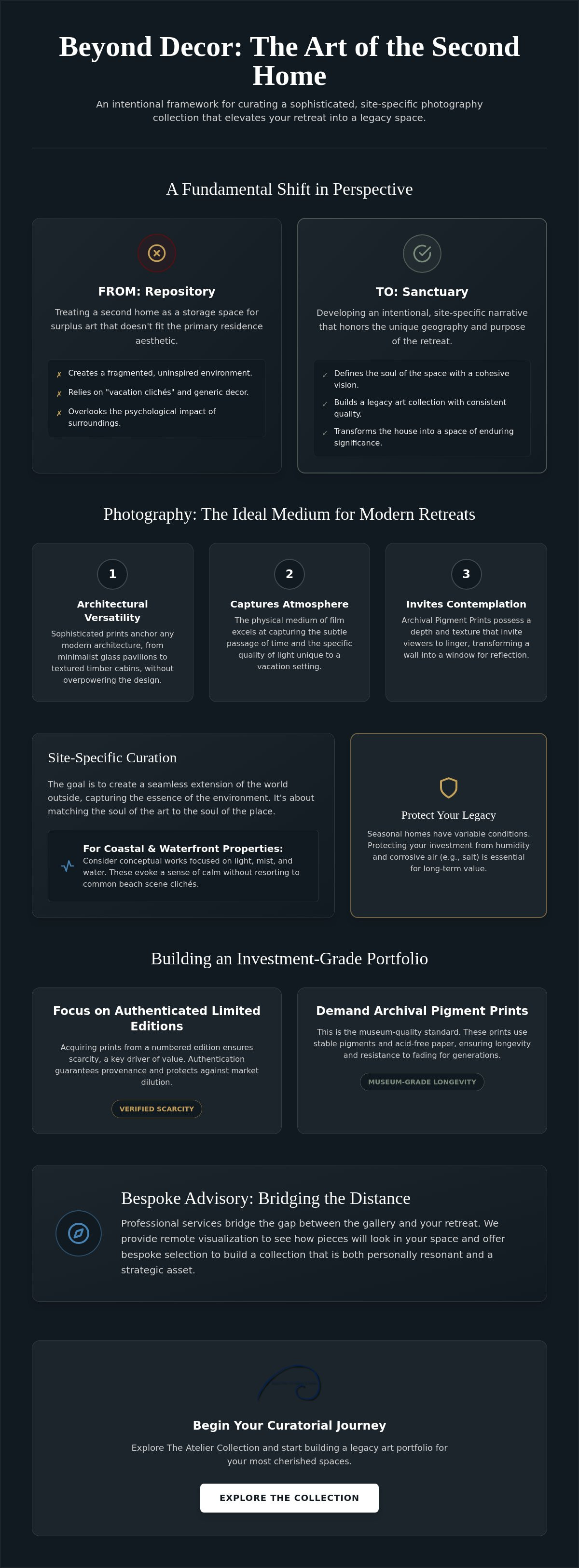
- Shift the perspective of your secondary residence from a repository for surplus works to a sanctuary defined by intentional curation.
- Discover the methodology for building a legacy art collection that harmonizes with the unique light and landscape of your specific geographic location.
- Identify the essential archival standards and environmental controls required to protect fine art photography in homes with variable occupancy.
- View art acquisition as a strategic asset play by focusing on authenticated Limited Edition and Archival Pigment Prints.
- Explore how professional advisory services bridge the distance between the gallery and your retreat through remote visualization and bespoke selection.
The Philosophy of the Second Home Art Collection
The acquisition of art for a secondary residence is frequently treated as an afterthought. Many collectors mistakenly use these retreats as storage for works that no longer align with the aesthetic of their primary home. This approach creates a fragmented environment that lacks the cohesion necessary for a truly distinguished private collection. A second home is a sanctuary. It's a space designed for reflection and restoration. The art within it must set a specific emotional tone that honors the landscape and the slower pace of life found there. Moving beyond "theme" decor, such as cliché nautical prints or rustic motifs, allows for the development of professional-grade photographic narratives. These stories don't just decorate a room; they define its soul.
Sanctuary vs. Storage: Avoiding the "Spare Room" Mentality
Collectors who relegate lesser works to their seasonal homes overlook the psychological impact of their surroundings. A space dedicated to relaxation requires art that is contemplative and intentional. Building a legacy art collection involves creating a dialogue between all your properties. This curatorial thread ensures that while the subject matter may shift to reflect the local geography, the quality and technical mastery remain consistent. A cohesive portfolio reflects a collector’s refined taste across every border. It transforms a vacation house into a legacy property that carries the same weight and significance as a primary residence.
Photography as the Ideal Medium for Modern Retreats
Fine art photography offers a unique versatility for the modern retreat. Whether the architecture is a minimalist glass pavilion or a textured timber cabin, Limited Edition Prints provide a sophisticated anchor. The physical medium of film is particularly effective here. It captures the subtle passage of time and the specific quality of light that defines a vacation setting. Archival Pigment Prints from The Atelier Collection offer an understated elegance that mass-market decor cannot replicate. These works possess a depth and texture that invite the viewer to linger. They transform a wall into a window, reflecting the heritage and craft of the photographic process. By focusing on high-register technical mastery, you ensure that your collection remains a valuable asset for generations to come.
Site-Specific Curation: Matching Photography to Your Environment
The geography of a second home dictates its visual language. Successful site-specific curation requires a deep understanding of how local light and landscape influence the interior experience. When building a legacy art collection, the objective is to create a seamless extension of the world outside the window. This isn't about matching upholstery to a print. It's about capturing the essence of the environment through a professional lens. Large-scale works from The Atelier Collection are particularly effective in vacation homes. Open-plan layouts and high-volume ceilings demand pieces with significant presence. A small frame on a vast wall disappears; a large-scale archival pigment print commands the room and establishes an intentional atmosphere.
Strategic collectors often balance these place-based narratives with broader, international works. This approach ensures the portfolio remains diverse while serving as a hedge against market fluctuations. Viewing your art collection as an investment allows you to justify the acquisition of museum-quality pieces that hold their value across multiple properties. It’s a way to merge personal heritage with financial foresight. To begin selecting works that resonate with your unique space, you might explore the curated options within The Atelier Collection.
Coastal and Waterfront Properties
Atmospheric photography is essential for homes overlooking the sea. Rather than literal beach scenes, consider conceptual works that focus on the interaction of light, mist, and water. These pieces evoke a sense of calm without falling into vacation clichés. It's also vital to consider the physical environment. Salt air is corrosive. Protecting your investment requires Archival Pigment Prints housed in professionally sealed frames. This prevents environmental degradation and ensures the longevity of the work. The goal is to select photography that feels as expansive as the ocean view it complements.
Mountain and Rural Retreats
Alpine and rural settings benefit from photography that emphasizes texture and organic forms. Large-scale landscapes can anchor a room with rustic or modern-mountain architecture. They provide a sense of scale that matches the peaks outside. Matte archival finishes are often preferred in these settings. They reduce glare from large windows while maintaining a soft, tactile quality. Curated lighting further enhances the depth of the print. It makes the artwork feel like an integral part of the home’s structure rather than a mere decoration. This thoughtful integration preserves the artistic integrity of the piece while celebrating the rugged beauty of the location.
Environmental Protection: Preserving Art in Seasonal Residences
A secondary residence often exists in a state of flux. Unlike primary homes, these spaces endure periods of vacancy where climate control systems may be adjusted or deactivated. When building a legacy art collection, one must account for these environmental variables from the outset. Museum-grade archival standards are essential for maintaining the integrity of the work over decades. Standard photographic prints often succumb to thermal expansion or humidity-induced silvering. In contrast, high-tier collections prioritize stability. For homes characterized by "walls of glass," managing light exposure is a priority. While natural light defines the beauty of a retreat, it remains the primary catalyst for artistic degradation.
Established conservation standards suggest maintaining a temperature range of 16 to 25 degrees Celsius (59 to 77 degrees Fahrenheit) and a relative humidity between 40% and 60%. Significant fluctuations beyond these parameters can lead to the physical warping of the substrate. Monitoring these levels remotely is now a standard practice for the discerning part-time resident. It ensures that the sanctuary remains a safe harbor for the medium, even when the owner is absent.
Archival Pigment Prints and Longevity
Museum-grade materials are non-negotiable for high-exposure environments. Archival Pigment Prints utilize mineral-based inks that offer superior light-fastness compared to traditional dye-based methods. This technical mastery ensures that the depth of the blacks and the nuance of the highlights remain unchanged over time. The science of longevity in limited edition photography relies on the synergy between the ink and the acid-free cotton rag paper. Archival mounting plays a critical role here. By securing the print to a rigid, pH-neutral substrate, collectors prevent the "cockling" or rippling that occurs when paper reacts to moisture. This level of technical rigor is what distinguishes a decorative object from a legacy asset.
Framing Strategies for the Second Home
Selecting the correct glazing is the most effective defense against UV-induced fading. Museum glass is the industry standard, offering over 99% UV protection while remaining virtually invisible to the eye. This allows the collector to enjoy the view without compromising the art. For coastal or high-humidity locations, sealed framing is a necessity. This process creates a micro-environment within the frame, protecting the print from salt air and airborne pollutants. Consulting with a professional advisor at Ilkaa's Fine Art Gallery & Atelier ensures these logistics are handled with precision. Whether you are in the mountains or by the sea, the right framing strategy acts as a guardian of your building a legacy art collection efforts, preserving the tactile beauty of the film medium for the next generation.
Building an Investment-Grade Portfolio Across Properties
Managing an art portfolio across multiple residences requires a shift from passive ownership to active asset management. While previous sections addressed the aesthetic and environmental considerations of the second home, the financial dimension of building a legacy art collection hinges on the meticulous documentation of provenance. In 2026, the art market is characterized by a more analytical, data-driven approach. Collectors now rely on price tracking and auction data to justify acquisitions that serve as a long-term wealth strategy. This is especially relevant as art is increasingly viewed as a core component of heritage planning. Maintaining a centralized archive of ownership history ensures that the value of the work is preserved, even as pieces are moved between diverse geographic locations.
The current market landscape emphasizes the importance of authenticity. Blockchain technology is increasingly used to secure ownership records and track the history of a piece from the atelier to the private residence. For the collector with properties in different states or countries, this digital trail is indispensable. It provides a layer of security and transparency that traditional paper records cannot match. By treating each acquisition as a strategic asset, you ensure that your collection remains a resilient part of your estate. This disciplined approach to documentation is what allows a private portfolio to transcend mere decoration and become a significant financial legacy.
The Value of Rarity: Limited Editions and Artist Proofs
Restricted quantities are the primary driver of value in the photographic secondary market. Limited Edition Prints ensure that a specific image remains exclusive, protecting your investment from the dilution of mass production. The role of the gallery is to act as the authoritative bridge in this process, verifying signatures and edition numbers with absolute precision. Artist Proofs represent an even higher tier of exclusivity, often carrying a premium due to their historical proximity to the creator's initial vision. A unique state print is a one-of-a-kind variation that increases rarity within a collection. These distinctions are what transform a visual experience into a significant heritage asset that holds its weight against inflation.
Photography as a Tangible Asset
Total sales in the global art market reached approximately $57.5 billion in 2024, demonstrating the resilience of tangible assets in fluctuating economies. Photography remains a particularly stable medium because it is rooted in both classical technique and historical documentation. Viewing an art collection as an investment requires an understanding of specific tax implications, such as the 28% maximum capital gains tax rate on collectibles. Working with a specialized advisory like Ilkaa's Fine Art Gallery & Atelier helps you navigate these complexities while sourcing works with high appreciation potential. To begin identifying the specific works that will anchor your multi-property portfolio, we invite you to explore our Limited Edition Prints.
Bespoke Advisory: Partnering with Ilkaa's Fine Art Gallery & Atelier
The distance between your primary residence and your seasonal retreat shouldn't create a gap in curatorial quality. While your second home may be located in a remote alpine valley or along a secluded coastline, the expertise required to anchor it remains accessible through a dedicated partnership. Ilkaa's Fine Art Gallery & Atelier acts as a sophisticated bridge for collectors, providing a specialized advisory service that translates the technical mastery of our Columbus atelier to your distant properties. Through remote curation services, we help you visualize how specific works interact with the unique architecture and shifting light of your retreat. This high-level intentionality is an essential step in building a legacy art collection that feels cohesive across every border.
Accessing The Atelier Collection offers an additional layer of exclusivity for the serious enthusiast. These rare works, often held back from the general public, represent the pinnacle of the photographic medium and the passage of time captured on film. Our historic home, the Joseph-Cherrington House, serves as the quiet center where these curatorial narratives are born. Here, the focus is on the tactile nature of the medium and the long-term preservation of artistic integrity. By partnering with an authoritative institution, you gain a guardian for your collection's heritage and a guide through the nuances of site-specific acquisition. We ensure that your second home becomes more than a residence; it becomes a curated sanctuary of enduring value.
Our Curatorial Process for Private Collectors
- Phase 1: Aesthetic Discovery and Site Analysis. We begin with a deep analysis of your property's architectural narrative. This phase focuses on how the local geography and interior volume dictate the emotional tone of the space.
- Phase 2: Sourcing and Authentication. We identify museum-grade works from our international roster and The Atelier Collection. Every piece is vetted for technical mastery, provenance, and its ability to complement your existing portfolio.
- Phase 3: Logistics and Secure Placement. Our team manages the complexities of secure transit and archival placement. We ensure that the final installation honors the work’s relationship with the surrounding environment while meeting the highest preservation standards.
Visit Our Columbus Gallery
There's no substitute for experiencing the depth and texture of fine art photography in person. We invite you to visit our historic gallery space to witness the tactile quality of our Archival Pigment Prints firsthand. A private consultation with curators Ilkaa Amalia and Millie Franz allows you to refine your vision and explore the possibilities for your multi-property portfolio. This personalized approach is vital for those committed to building a legacy art collection that transcends generations. We invite you to schedule a private curation session for your second home and begin defining your artistic heritage with clarity.
Defining Your Artistic Heritage
The journey toward building a legacy art collection for a second home is an exercise in deep intentionality. It requires a precise balance between the evocative nature of the medium and the technical rigor of archival preservation. By selecting site-specific works that resonate with the local geography and adhering to museum-grade standards, you transform a seasonal retreat into a permanent sanctuary of craft. This strategic approach ensures your portfolio remains a resilient asset, preserved for future generations despite the environmental variables of a secondary residence. A well-curated space reflects a life lived with purpose and an appreciation for the historical weight of the image.
At Ilkaa's Fine Art Gallery & Atelier, we guide collectors through this nuanced process from our studio in the historic Joseph-Cherrington House. Curators Ilkaa Amalia and Millie Franz bring an authoritative perspective to every acquisition, prioritizing the tactile beauty of film and the long-term integrity of the archive. We invite you to explore our curated collections for your second home to find pieces that honor your unique vision. Your retreat deserves a visual narrative as enduring and profound as the landscape itself. Start your curation journey today with confidence and clarity.
Frequently Asked Questions
Is it safe to hang expensive photography in a home that is vacant for half the year?
It's safe provided you maintain environmental stability through remote monitoring systems. These tools allow you to track temperature and humidity levels from any location. Museum-grade archival mounting prevents the print from reacting to subtle atmospheric shifts. These precautions ensure your investment remains protected during long periods of vacancy.
How do I choose a frame that protects art from coastal humidity?
Choose a professionally sealed frame constructed with pH-neutral materials. This micro-environment prevents salt air and moisture from reaching the print. Avoid mass-market frames that lack an airtight seal. High-quality glazing also acts as a barrier against coastal atmospheric pollutants and maintains the work's integrity.
Should the art in my second home match the art in my primary residence?
Aim for a consistent curatorial thread rather than a visual match. Your second home should honor its specific landscape while reflecting your broader aesthetic standards. Maintaining the same technical mastery and archival quality across all properties creates a unified portfolio. This approach ensures your collection feels intentional and cohesive regardless of geography.
What is the difference between a limited edition print and an open edition poster?
Limited edition prints are restricted runs of authenticated works; open edition posters are mass-produced without rarity. Scarcity and artist signatures make limited editions valuable assets. For those building a legacy art collection, the rarity of a numbered print is essential for long-term appreciation and secondary market interest.
How does Ilkaa’s Fine Art handle shipping and installation for out-of-state homes?
We coordinate the entire logistics process, including archival crating and climate-controlled transit. Our team works with specialized fine art handlers to ensure secure delivery to your retreat. We also oversee the installation process to guarantee museum-grade standards are met. This comprehensive service protects the work from our gallery to your wall.
Can photography increase in value over time?
Photography often appreciates in value when scarcity and provenance are strictly maintained. Limited edition runs ensure that as demand grows, the supply remains fixed. Technical excellence and historical relevance also contribute to a work's resilience in the secondary market. Partnering with an expert gallery helps you identify pieces with strong investment potential.
Do I need a professional art advisor for a single vacation property?
Professional advisory ensures your acquisitions are both site-specific and technically sound. An advisor helps you navigate environmental risks like UV exposure and humidity in a vacation setting. This partnership is vital when building a legacy art collection, as it bridges the gap between simple decor and an investment-grade portfolio.
What is the best way to clean and maintain archival prints in a seasonal home?
Maintain archival prints by using a soft, dry microfiber cloth on the glazing. Avoid liquid cleaners or solvents that could seep into the frame and damage the substrate. The most effective maintenance strategy for a seasonal home is consistent climate control. Ensuring the seals on your frames remain intact will prevent environmental damage during your absence.
Disclaimer
Information is provided for general editorial and educational purposes. Artwork availability, pricing, dimensions, framing, edition details, exhibition information, and event schedules are subject to change. Please contact Ilkaa’s Fine Art Gallery & Atelier for the most current information.
© 2026 Ilkaa’s Fine Art Gallery & Atelier. Article text, gallery photographs, graphics, and other original gallery content may not be copied, reproduced, republished, distributed, modified, or used for commercial purposes without prior written permission. Copyright in individual artworks, artist photographs, and other third-party materials remains with the respective artists, photographers, estates, or rights holders. Brief quotations and links may be used with appropriate attribution where permitted by law.