
Why does a digital image, flickering on a screen, feel so transient compared to the silent gravity of a physical print? If you've spent hours scrolling through online marketplaces, you likely know the fatigue of searching for something that possesses genuine weight and legacy. It's difficult to feel confident in a purchase when you can't inspect the grain or verify the archival integrity of the medium. For those seeking investment-worthy Ohio photographers, the transition from digital consumption to physical collection requires a more disciplined, intentional approach.
You deserve to know that the piece hanging in your home won't fade with the morning sun or lose its value because of an ambiguous edition count. This guide will show you how to evaluate the technical provenance of contemporary photography within the intimate setting of a Columbus fine art atelier. We'll examine the critical standards of archival pigment prints and the structural differences between limited and open editions. By the end, you'll have the clarity needed to acquire a work that honors the craft while securing a lasting place in your collection.
Key Takeaways
- Understand why physical proximity is essential for observing the subtle interplay of light and grain that digital screens fail to replicate.
- Learn the technical criteria for archival pigment prints to ensure your acquisitions maintain their visual integrity and market value for generations.
- Discover how to identify and support investment-worthy Ohio photographers by visiting the most respected fine art galleries in the Columbus region.
- Recognize the critical distinction between mass-market open editions and limited-run works to build a cohesive and valuable private art portfolio.
- Explore the philosophy behind the Atelier Collection, focusing on rare works that prioritize technical mastery and artistic legacy.
Beyond the Digital: Why Proximity Matters in Contemporary Photography
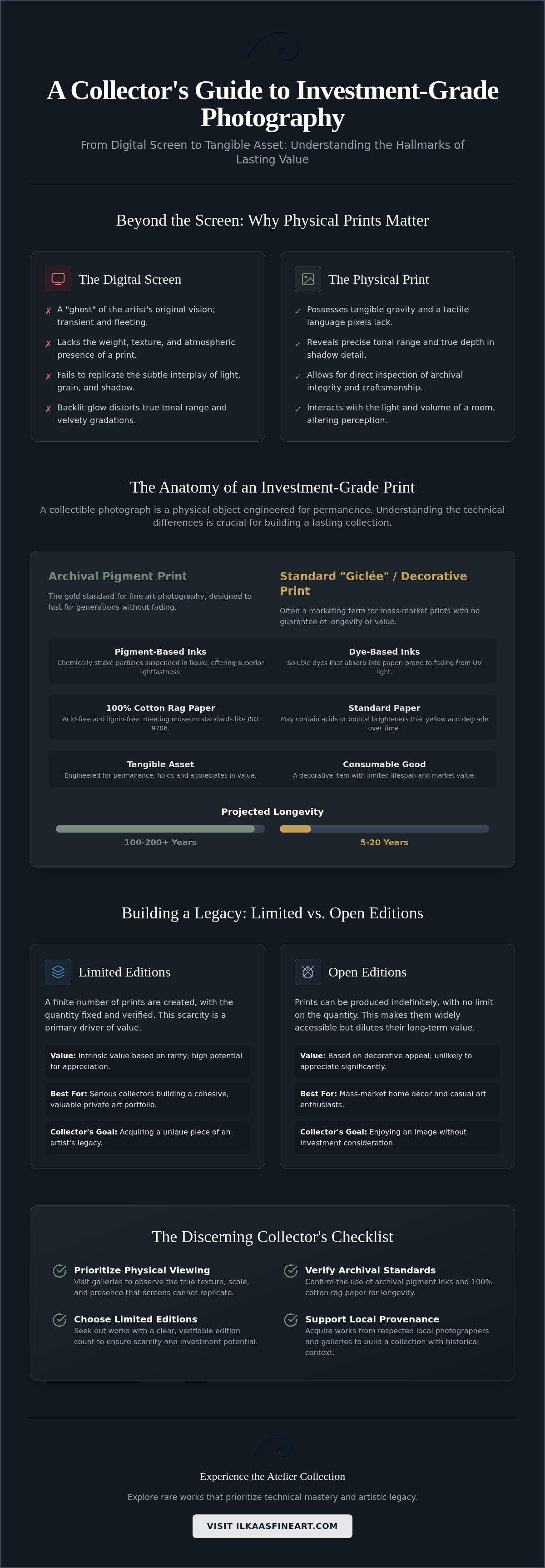
The digital screen is a poor translator of intent. While online marketplaces offer a convenient catalog of images, they lack the capacity to convey the weight, texture, and atmospheric presence of a physical print. A photograph viewed on a glowing display is a ghost of the artist's original vision. For collectors seeking investment-worthy Ohio photographers, the transition from a backlit monitor to the quietude of a physical gallery is not merely a preference; it's a technical necessity. True appreciation requires a direct encounter with the medium.
Local galleries in Columbus serve as a vital bridge in this process. They provide the controlled environment where the nuances of Fine-art photography become visible. In these spaces, the conversation shifts from the subject matter of the image to the craftsmanship of the object itself. Supporting the local ecosystem of curators and artists ensures that the Ohio art scene continues to mature, moving beyond temporary exhibitions toward a culture of permanent, high-value acquisition. The physical medium demands a witness.
The Sensory Experience of Fine Art
The physical medium of film and archival paper possesses a tactile language that pixels cannot replicate. When you stand before a large-format print, you observe the precise tonal range that defines its depth. Shadow detail that appears as a black void on a screen reveals subtle, velvety gradations in person. This is particularly true for Archival Pigment Prints, where the interaction between ink and 100% cotton rag paper creates a unique surface quality. Gallery lighting is purposefully designed to reveal these textures, allowing the viewer to judge the print's stability and technical mastery from a distance that feels intimate yet respectful. Scale also plays a silent role. A print that fills a wall interacts with the volume of a room, altering the viewer's perception of space in a way a digital thumbnail never could.
Columbus as a Growing Hub for Collectors
The Columbus art scene has evolved significantly. What once centered primarily on public street festivals and casual Gallery Hops has matured into a sophisticated network of private ateliers and specialized galleries. This shift reflects a growing community of discerning collectors who value technical provenance over mass-market appeal. When you acquire work from investment-worthy Ohio photographers through a local institution, you gain more than a print. You gain a narrative of origin. Local provenance adds a layer of historical context to a collection, connecting the work to the specific aesthetic and cultural heritage of the Midwest. Engaging with professional curators who understand this landscape allows for a more intentional building of a legacy, ensuring that each piece within a portfolio contributes to a cohesive, enduring story.
The Anatomy of Investment-Grade Photography: Archival Standards
A collectible photograph is more than a captured moment; it's a physical object engineered for permanence. While decorative images prioritize immediate visual impact, investment-grade works are defined by their technical rigor and long-term stability. For those curating a portfolio of investment-worthy Ohio photographers, the distinction between a mass-market poster and a numbered print is absolute. One is a consumable good, while the other is a tangible asset designed to endure for centuries. Understanding this difference requires an appreciation for the chemistry and scarcity that underpin the fine art market.
The Association of International Photography Art Dealers provides essential context in their guide On Collecting Photography, emphasizing that print quality and provenance are the pillars of value. Without a verifiable commitment to museum-grade production, a photograph cannot sustain its market position. Serious collectors look beyond the frame to the technical specifications of the print itself, ensuring that every acquisition meets international standards for archival preservation, such as ISO 9706 for paper permanence and ISO 18902 for photographic materials.
Archival Pigment Prints vs. Standard Giclee
The term "giclee" is often used as a broad marketing label, but it rarely guarantees archival quality. Standard giclee prints frequently utilize dye-based inks which, while vibrant, are chemically unstable and prone to fading when exposed to UV light or ozone. Investment-grade photography relies on pigment-based inks. These inks consist of microscopic mineral particles that sit on the surface of the substrate rather than soaking into it. When these pigments are applied to 100% cotton rag paper that is acid-free and lignin-free, the result is an image with exceptional tonal depth and resistance to environmental decay. Archival pigment prints represent the gold standard for museum-grade longevity in 2026. Collectors can explore these technical standards firsthand by examining the Archival Pigment Prints within the gallery’s current rotation.
Limited Editions and Numbered Prints
Scarcity is the primary driver of secondary market performance. Unlike open editions, which can be printed indefinitely, limited editions are restricted to a specific, predetermined quantity. A "1/10" designation indicates that only ten physical manifestations of that specific image will ever be produced in that size and format. This artificial scarcity protects the collector's investment. The Certificate of Authenticity (COA) serves as the legal backbone of the acquisition, documenting the print date, the artist's signature, and the atelier's embossed stamp. For anyone seeking investment-worthy Ohio photographers, these documents are non-negotiable. They establish the provenance necessary for future appraisal and resale, transforming a beautiful image into a documented historical record.
Navigating the Local Market: Fine Art for Sale in Columbus
The Columbus art landscape is a study in contrasts. While public festivals and outdoor markets offer a vibrant introduction to the city's creative energy, the serious collector must look toward more permanent, curated environments to find true value. Public exhibitions, such as the Columbus Arts Festival scheduled for June 12-14, 2026, serve as excellent scouting grounds. With over 1,100 applicants vying for roughly 230 spots, these events provide a concentrated look at emerging talent. However, the acquisition of an asset requires the quiet, disciplined atmosphere of a private gallery. Here, the focus shifts from the spectacle of the event to the technical provenance of the individual print.
Distinguishing between decorative retail spaces and galleries that specialize in investment-grade works is essential. A gallery dedicated to the long-term value of its roster will prioritize archival stability and limited edition structures over mass-market appeal. By engaging with these institutions, you gain access to investment-worthy Ohio photographers whose works are held to international museum standards. These spaces act as a filter, ensuring that every piece presented has undergone a rigorous curatorial review before it reaches the collector's eye. This professional vetting is what separates a casual purchase from a strategic addition to a private portfolio.
The Historic House Gallery Experience
The environment in which you view a photograph profoundly influences your perception of its depth. The Joseph-Cherrington House provides a unique, intimate context that the sterile "white cube" of a modern gallery cannot match. Within the walls of a historic residence, contemporary photography finds a temporal bridge, connecting modern perspectives with a sense of architectural heritage. This atelier environment encourages a slower pace of observation. It allows you to see how a large-format print interacts with the shadows and light of a living space, mirroring the eventual placement within your own home or office. It's a more human, evocative way to experience the physical medium of film.
Curating for the Columbus Home or Office
Building a collection within Ohio offers a rare opportunity to reflect local heritage through a sophisticated, global lens. Whether you are selecting investment-worthy Ohio photographers for a private residence or a corporate suite, professional placement is vital. A cohesive narrative within a workspace projects an image of permanence and cultural awareness. To maintain the integrity of these works, collaboration with local specialists is required. This includes working with framers who adhere strictly to archival museum standards, using UV-protective glazing and acid-free mounting. Such attention to detail ensures that the tonal range and paper grain remain preserved, securing the work's aesthetic and financial value for decades to come.
Building a Legacy: Why Curation Outperforms Open Editions
Acquiring art is an exercise in discernment. While many are drawn to the accessibility of open-edition prints, these items rarely transcend their status as temporary decor. Without the constraints of scarcity, an image cannot function as a financial or historical asset. For those focused on investment-worthy Ohio photographers, the objective is to build a portfolio that possesses internal logic and external value. Curation provides the necessary framework for this growth, transforming a disparate group of images into a cohesive narrative of artistic evolution.
The pitfalls of the mass market are often hidden behind the label of "affordability." However, an asset with zero resale value is an expense, not an investment. Professional curation mitigates this risk by evaluating a photographer’s career trajectory, examining their exhibition history, and noting presence in museum collections. This rigorous vetting process ensures that every piece added to a private collection carries the weight of established authority and technical mastery.
Open Edition vs. Limited Edition Comparison
Understanding the structural differences between these two formats is fundamental to legacy building. Rarity and provenance remain the primary drivers of secondary market performance. Owning a rare print offers a tangible connection to the artist's specific intent at a specific moment in time.
| Feature | Open Edition | Limited Edition |
|---|---|---|
| Production Quantity | Unlimited; printed on demand | Strictly restricted and numbered |
| Primary Purpose | Temporary home decoration | Investment-grade asset |
| Archival Integrity | Variable; often lower standards | Verified museum-grade standards |
| Secondary Market | Negligible or non-existent | Documented potential for appreciation |
The Role of Art Advisory
A curator acts as a guardian of standards, bridging the gap between the studio and the study. Art advisory services are essential for both new and seasoned collectors who wish to navigate the complexities of the fine art market with confidence. These professionals assist in sourcing rare photographic works that are often unavailable to the general public, focusing on pieces that balance technical brilliance with historical significance. They ensure that your collection is not merely a series of purchases, but a curated legacy that meets the highest archival requirements. Collectors seeking to refine their portfolio can explore the rare and unique works within The Atelier Collection to see how professional curation defines the acquisition experience. By prioritizing quality over volume, you secure a place for your collection in the future of the visual arts.
Experience the Atelier: Ilkaa’s Fine Art Gallery & Atelier in Columbus
Ilkaa’s Fine Art Gallery & Atelier represents the quiet culmination of the principles explored throughout this guide. Situated within the historic Joseph-Cherrington House, the gallery functions as a sanctuary for the physical medium of photography. Founders Ilkaa Amalia and Millie Franz have established a space where technical rigor and artistic legacy are the primary metrics of value. This is a collaborative environment. It's a place where the search for investment-worthy Ohio photographers meets a curated standard of excellence that rivals international institutions. The house itself provides a domestic, yet elevated, context for viewing works that are intended to live within a private collection. Its architecture offers a sense of permanence and history that mirrors the archival quality of the prints displayed within its rooms.
The Atelier Collection
The philosophy of the Atelier Collection is rooted in a deep reverence for the physical object. We focus on works that demonstrate a profound understanding of the medium, from the silver-rich depths of traditional film to the modern precision of Archival Pigment Prints. Every selection is intentional. We prioritize heritage and artistic integrity over fleeting trends. This collection serves as a vital bridge. It connects the raw, uncompromising vision of the creator with the sophisticated requirements of the collector. By focusing on rare and unique photographic works, the Atelier ensures that each acquisition possesses a clear technical provenance and a lasting emotional resonance. This is where the science of archival pigment mastery meets the soul of the artist's intent, resulting in a piece that holds its value over time.
Your Invitation to Collect
Beginning a journey into contemporary photography requires a shift in pace. We invite you to move beyond digital observation and experience the tactile depth of our prints firsthand. Private viewings are available to provide a quiet, focused environment for evaluating tonal range and paper grain. These sessions allow for a deeper understanding of the artist’s process and the work's historical context. You can explore our current selection of Limited Edition Prints to identify pieces that speak to your aesthetic goals. Whether you are a seasoned collector or a new enthusiast, the atelier provides the expert guidance necessary to secure investment-worthy Ohio photographers for your legacy. We look forward to hosting you for an upcoming exhibition or a private collection walkthrough where the nuances of the physical medium are given the space they deserve.
Securing Your Legacy in Light and Paper
Building a collection of contemporary photography is an act of preservation. By prioritizing museum-grade archival pigment prints over mass-market alternatives, you ensure that the tonal depth and texture of your acquisition remain unchanged by time. Identifying investment-worthy Ohio photographers requires a commitment to technical excellence and a discerning eye for rarity. A well-curated portfolio doesn't just decorate a space; it documents a specific artistic vision with verified provenance.
Whether you are curating for a private residence or a corporate environment, professional art advisory bridges the gap between initial interest and a lasting legacy. Within the quiet, historical rooms of the Joseph-Cherrington House, we provide the expertise needed to navigate the nuances of the fine art market. Our authenticated, limited edition prints offer the structural scarcity and technical stability that serious collectors demand.
Browse the Curated Atelier Collection to discover works that transcend the digital screen. We invite you to experience the tactile resonance of high-level craftsmanship and begin your journey as a guardian of the visual arts.
Frequently Asked Questions
Is photography a good investment compared to traditional paintings?
Market maturity has largely equalized the investment potential of both mediums. While paintings are unique by nature, limited edition works from investment-worthy Ohio photographers offer a similar trajectory for appreciation based on scarcity and institutional recognition. A well-vetted photograph doesn't just decorate a space; it functions as a tangible asset that can appreciate as the artist’s career matures.
How do I know if a photographic print is truly archival quality?
Archival quality is determined by the chemical stability of the ink and the substrate. A museum-grade print must utilize pigment-based inks and 100% cotton rag paper that is acid-free and lignin-free. These specific materials ensure the image remains resistant to environmental degradation and fading for generations, meeting international ISO standards for long-term photographic preservation.
What is the difference between an artist proof and a limited edition print?
An artist proof is a print produced outside the numbered edition for the artist's personal use or technical records. These are traditionally restricted to a very small percentage of the total run. While limited edition prints are the standard for collectors, artist proofs often carry a unique appeal due to their rarity and close association with the creator's original vision.
Can I visit Ilkaa’s Fine Art Gallery & Atelier without an appointment?
We recommend scheduling a private viewing to ensure an intimate experience within the Joseph-Cherrington House. This allows for a quiet, uninterrupted study of the works and the technical nuances of the physical medium. While we occasionally host public exhibitions, an appointment ensures that our curators are available to provide dedicated, one-on-one art advisory.
Do you offer art advisory services for corporate offices in Columbus?
We provide specialized advisory for corporate environments seeking to build a professional art legacy in Ohio. Our team assists in sourcing works from investment-worthy Ohio photographers that align with a firm's identity and architectural space. We focus on archival stability and narrative cohesion to ensure the collection remains a permanent and sophisticated institutional asset.
What should I look for in a certificate of authenticity for photography?
A robust certificate of authenticity must document the artist's signature, the edition number, and the exact technical specifications of the print. It should verify the date of production and the specific archival materials used. This document is the legal link between the collector and the work, ensuring the piece’s market value and provenance for future appraisals.
How do I maintain and care for a fine art photograph at home?
Preservation requires a stable environment away from direct sunlight and fluctuating moisture levels. We recommend museum-grade framing with UV-protective glazing and acid-free mounting to shield the print from environmental pollutants. Maintaining a consistent temperature within your home is the most effective way to protect the print's tonal range and the integrity of the paper grain.
Are the prints at Ilkaa’s Fine Art Gallery & Atelier signed by the artists?
Every work presented at Ilkaa’s Fine Art Gallery & Atelier is personally signed by the artist to verify its authenticity. This signature is often accompanied by the atelier’s embossed stamp, serving as a final seal of technical and artistic approval. It ensures that the physical object meets the highest standards of the studio before it enters your private collection.
Disclaimer
Information is provided for general editorial and educational purposes. Artwork availability, pricing, dimensions, framing, edition details, exhibition information, and event schedules are subject to change. Please contact Ilkaa’s Fine Art Gallery & Atelier for the most current information.
© 2026 Ilkaa’s Fine Art Gallery & Atelier. Article text, gallery photographs, graphics, and other original gallery content may not be copied, reproduced, republished, distributed, modified, or used for commercial purposes without prior written permission. Copyright in individual artworks, artist photographs, and other third-party materials remains with the respective artists, photographers, estates, or rights holders. Brief quotations and links may be used with appropriate attribution where permitted by law.