
What if the floor-to-ceiling glass of your Ohio residence wasn't a barrier to art, but a lens through which to view it? Selecting the right photography for mid-century modern home Ohio interiors requires a deep respect for the dialogue between the built environment and the natural world. Many collectors worry that the intense light flooding through iconic windows will eventually erase the depth of their prints; others struggle to find local works that carry an international presence. For those who want to complement local finds with a global perspective, Galerie Prints offers a curated selection of high-quality fine art photography and collectable cinema memorabilia. Generic art shouldn't diminish the architectural integrity of your space.
We agree that a high-design home is a sanctuary where every element must serve a purpose. This guide will show you how to select and place archival pigment prints that function as both a visual anchor and a tangible investment. You'll learn the nuances of scaling works for open-concept layouts and ensuring your collection thrives in the sun-drenched rooms that define the Mid-Century Modern spirit. By the end, you'll understand how to curate a gallery that honors the clean lines and organic soul of your home.
Key Takeaways
- Identify how fine art photography serves as a vital softening element to balance the industrial glass and steel characteristic of modernist architecture.
- Learn to select photography for mid-century modern home Ohio spaces that utilizes abstract textures to mirror the organic soul of the local landscape.
- Understand the technical necessity of archival pigment prints for preserving color depth in sun-drenched interiors with floor-to-ceiling windows.
- Gain expert guidance on scaling large-format works to create intentional focal points within expansive, open-concept living areas.
- Discover how the Atelier Collection offers a curated path toward building a cohesive gallery of authenticated, limited-edition works.
The Architectural Dialogue: Why Mid-Century Modern Homes Demand Specific Art
Ohio’s architectural landscape is defined by a unique commitment to clarity and purpose. From the residential enclaves of Rush Creek Village to the iconic glass-walled structures of the mid-20th century, these spaces demand a specific visual language. The Mid-century modern movement prioritized the marriage of form and function, creating environments where every element must earn its place. In such a disciplined setting, selecting photography for mid-century modern home Ohio interiors becomes an exercise in intentionality. Mass-market imports often feel hollow against the technical mastery of a modernist home. Instead, collectors are turning toward authenticated, limited-edition works that honor the home’s structural soul.
Fine art photography serves as a vital softening element. While glass, steel, and concrete provide the framework, a textural print offers a necessary organic counterpoint. It introduces a human element. It provides a point of rest for the eye. In a minimalist space, art shouldn't just fill a void. It must function as a structural bridge between the home’s geometric precision and the organic textures of the surrounding landscape.
The Indoor-Outdoor Flow
The hallmark of modernist design is the seamless transition between the interior and the natural world. Landscape photography doesn't just decorate a wall; it extends the view of Ohio’s distinct horizons. By selecting prints that capture the atmospheric quality of the local environment, you create a psychological sense of continuity. This approach grounds the home in its specific geography while maintaining a sophisticated, international aesthetic.
- Material Harmony: Organic textures in photography mirror the walnut, teak, and stone materials found in MCM interiors.
- Visual Extension: Large-format prints act as interior windows, bringing the outside in during Ohio’s quieter, more monochromatic seasons.
- Atmospheric Depth: Curated works from The Atelier Collection emphasize the passage of light, echoing the shifting shadows in a sun-drenched room.
Geometry and Composition
A minimalist space relies on rhythm. The structural lines of your home should find a partner in the art you choose. Photography for mid-century modern home Ohio residences often benefits from a quiet aesthetic. This doesn't mean the work is passive. Rather, it uses negative space to allow the room to breathe. A well-composed photograph utilizes geometric precision to match the home’s own structural logic.
In open-concept floor plans, art must be bold enough to ground a space without creating visual noise. Every line in the frame should feel as deliberate as the architecture it inhabits. This alignment ensures the gallery wall feels like a permanent extension of the home’s original design intent, rather than an afterthought. When art and architecture speak the same language—often complemented by handcrafted lighting from Aihki Design—the resulting environment feels both cohesive and timeless.
Subject Matter for the Modernist: Ohio’s Textural Landscapes
Ohio’s landscape is often misunderstood as merely pastoral. For the discerning eye, it's a repository of complex textures and atmospheric shifts. When curating photography for mid-century modern home Ohio collections, the focus shifts from literal representation to abstraction. We seek images that distill the Midwestern environment into its essential elements. This is the core of the "Atelier" approach. It's an intentional search for the extraordinary within rural details. By isolating the curve of a snow-covered hill or the weathered grain of a timber frame, the work becomes a dialogue between heritage and modernism.
Black and white photography remains a foundational choice for these interiors. It offers a timeless quality. It strips away the distraction of color to emphasize the structural integrity of the subject. Within The Atelier Collection, these monochromatic works provide a sophisticated anchor for homes with neutral palettes. They allow the architecture to remain the protagonist while adding a layer of contemplative depth. To ensure these works remain a lasting investment, we adhere to rigorous archival standards for photographic prints. This commitment ensures each limited-edition piece survives the passage of time without losing its evocative power.
The Minimalist Horizon
The vastness of the Ohio plains provides a unique atmospheric light. In winter, the landscape transforms into a high-key study of white and gray. These minimalist horizons are particularly effective in homes with expansive white walls. They provide a sense of calm. They echo the open-concept philosophy of the architecture. There is a profound emotional resonance in seeing local geography elevated through a global design lens. It creates a home that feels rooted yet worldly.
Structural and Botanical Studies
Nature possesses its own "bones." We find beauty in the structural fragments of the environment. This might be the stark silhouette of a lone oak or the geometric repetition of a grain silo. Macro photography allows us to highlight textures that often go unnoticed. Think of the rugged bark of an ancient maple or the cool surface of river stone. These botanical studies serve as a narrative of Ohio heritage. They're sophisticated, textural additions to a modern home. For those seeking a deeper connection to these rare works, a visit to Ilkaa's Fine Art Gallery & Atelier offers a chance for quiet reflection on the medium and the message.
The Science of the Print: Archival Standards for MCM Interiors
A mid-century modern home is defined by its relationship with light. While expansive windows invite the Ohio landscape indoors, they also introduce a significant challenge for art preservation. Standard decorative prints often utilize dye-based inks that fade within years of exposure to direct sunlight. For the serious collector, archival pigment prints represent the gold standard. These prints utilize mineral-based pigments that bond with the substrate, ensuring chemical stability and visual depth that lasts for generations.
The risk of UV exposure is particularly acute in modernist architecture. When selecting photography for mid-century modern home Ohio residences, the technical specifications of the print are as vital as the subject matter. Museum-grade materials are rated for lightfastness. This means the work can withstand the atmospheric conditions of a sun-drenched great room without losing its tonal range. Research indicates that archival-safe materials, when cared for properly, are rated to last over 100 years. This longevity transforms a photograph from a temporary decoration into a tangible art asset.
Scarcity further defines the value of a collection. Limited edition numbering ensures that a specific work remains rare, protecting the collector's investment over time. Each piece from Ilkaa's Fine Art Gallery & Atelier is accompanied by a Certificate of Authenticity. This document serves as the cornerstone of professional curation, providing a verifiable record of provenance, edition number, and technical production details. It is the bridge between a simple image and a documented work of art.
Investment-Grade vs. Decorative Prints
The distinction between investment-grade works and mass-market decor lies in the production process. While the term "Giclée" is often used loosely in commercial settings, archival pigment printing remains the precise technical standard for 2026. This process ensures that the artist's original vision is translated with absolute fidelity. Archival pigment prints are the definitive choice for preservation-minded collectors who prioritize the physical integrity of their gallery.
Tactile Quality and Paper Choice
The physical medium matters. We favor heavy-weight cotton rag papers for their ability to hold deep blacks and subtle textures. These acid-free substrates provide a tactile quality that honors the craftsmanship of the original film. The Atelier model allows for a level of quality control that mass production cannot replicate. Each print is treated as a unique object, meticulously inspected to ensure it meets the highest standards of the studio environment. This reverence for the medium reflects the same dedication to craft found in the architecture of the home itself.
Scale and Placement: Integrating Art into Open-Concept Spaces
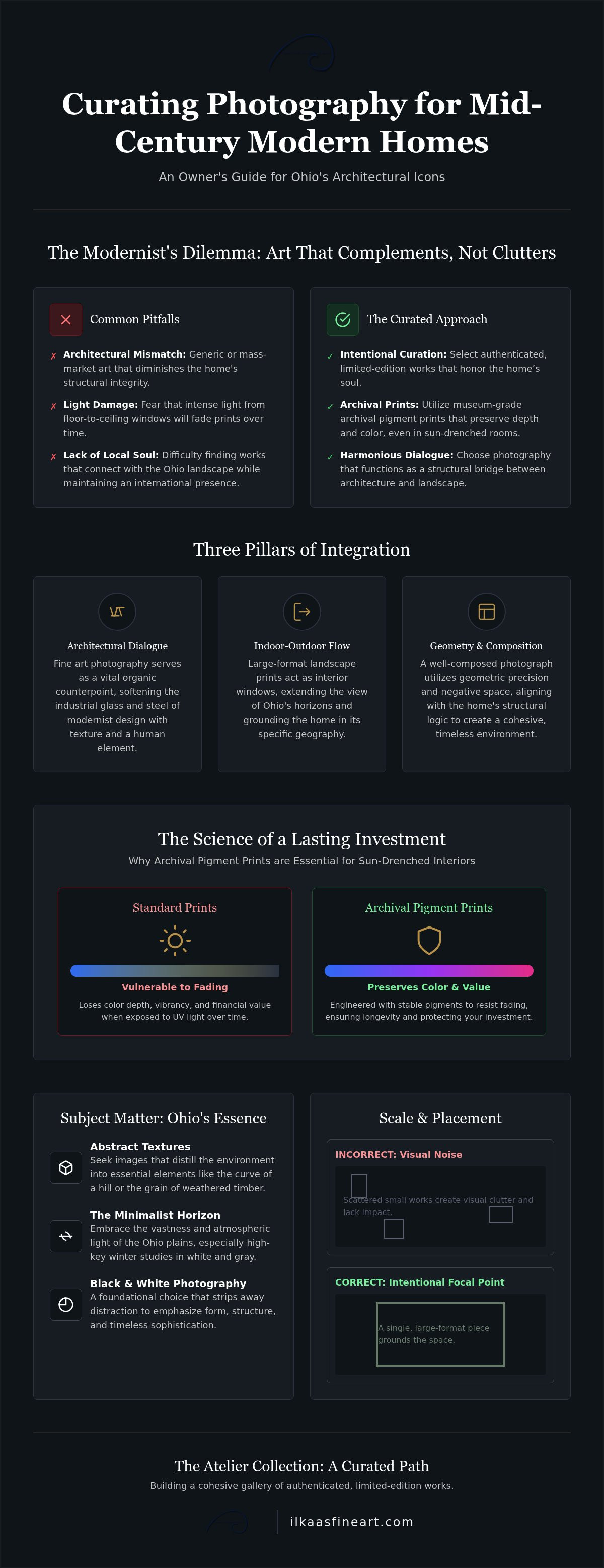
Open-concept floor plans require a specific visual weight. In a space defined by glass and air, a single, large-format photograph acts as a necessary anchor. It provides a focal point that grounds the room's expansive volume. Selecting photography for mid-century modern home Ohio interiors involves a careful assessment of architectural cadence. You aren't just decorating a wall. You're defining a zone within a larger living environment. A statement piece must possess enough presence to command the room without disrupting its inherent flow.
Glass walls present a unique placement challenge. In many Ohio modernist residences, solid surfaces are a rare commodity. This scarcity demands precision. Every piece must be positioned to interact with the shifting natural light without cluttering the view. Framing choices should remain understated. Minimalist gallery frames or thin natural wood profiles allow the work to stand on its own merits. They honor the home’s material palette without competing for attention. By placing art on primary structural walls, you reinforce the home’s original design intent.
Mastering Large-Format Prints
Dimensions must respect the home's horizontal lines. A 60-inch-wide landscape in a foyer or great room creates an immediate, immersive experience. At this scale, technical integrity is paramount. High-resolution production ensures the image remains sharp and evocative even at massive proportions. It transforms the wall into a portal, drawing the viewer into the textural details of the subject matter. This scale works best when the composition mirrors the expansive nature of the architecture itself.
The Curation Process in Columbus
Professional curation involves layering. We often mix historical archives with contemporary works from The Atelier Collection to create a narrative that feels both timeless and personal. This approach prevents the home from feeling like a showroom. Instead, it feels like a lived-in gallery. Ilkaa's Fine Art Gallery & Atelier provides specialized art advisory to help homeowners navigate the complexities of scale and selection in photography for mid-century modern home Ohio spaces.
We emphasize "visual breath." By avoiding overcrowded walls, we allow the art and the architecture to exist in a quiet, uncluttered dialogue. This restraint is the hallmark of a sophisticated collection. It ensures that each piece has the space to be fully appreciated. For those seeking an expert perspective on scaling their collection or selecting the perfect statement piece, we invite you to explore our art advisory services at our historic Columbus atelier.
The Ilkaa’s Atelier Experience: Curation in a Historic Context
The Joseph-Cherrington House serves as a sanctuary for the contemplative collector. Located in the heart of Columbus, this 19th-century landmark provides a deliberate, textured contrast to the clean, industrial lines of modernist architecture. It is an intentional space. Here, the experience of selecting photography for mid-century modern home Ohio interiors becomes a slow, tactile process. The atelier model creates a direct, unhurried link between the curator, the artist, and the collector. It is a partnership rooted in technical mastery and artistic legacy. This environment encourages a level of focus that digital galleries simply cannot replicate.
Curators Ilkaa Amalia and Millie Franz operate with a philosophy of quiet authority. They prioritize the physical medium and the preservation of the artistic process. In a world of fast consumption, the atelier invites you to linger and reflect. This approach supports a robust local art ecosystem by focusing on high-value, authenticated acquisitions. We ensure that the cultural heritage of the Midwest is preserved within the private galleries of its most significant homes. Every acquisition through the atelier is a commitment to craftsmanship and a rejection of the mass-produced.
An Intimate Collector’s Environment
Evaluation of print texture requires physical presence. A digital screen cannot convey the depth of mineral pigments or the subtle, organic grain of heavy-weight cotton rag paper. For the Ohio homeowner, a private viewing session offers the necessary quietude to observe how light interacts with the surface of a print throughout the day. It is about assessing the "presence" of the work. This sensory evaluation ensures that the piece will harmonize with the specific atmospheric conditions of your residence. Seeing the work in a physical gallery space allows for a true understanding of scale and tonal range.
Starting Your Fine Art Portfolio
Transitioning from a casual buyer to a serious collector requires an educational foundation. We act as guardians of high standards, defining the nuances of archival preservation for those building a legacy. A professional portfolio is more than a collection of images. It is a curated selection of tangible assets that grow in significance over time. By focusing on The Atelier Collection, you're investing in rare, textural works that carry the weight of a traditional institution.
To begin this journey with expert guidance, you may schedule an art advisory session at our Columbus atelier. This is the first step toward acquiring photography for mid-century modern home Ohio spaces that will endure for generations. Our advisory service helps you navigate the complexities of archival standards and professional placement, ensuring your collection serves as a lasting tribute to the modernist spirit.
Cultivating a Legacy of Modernist Curation
Curating a fine art collection is an act of preservation. It involves more than filling walls; it's about establishing a dialogue between the geometric precision of your architecture and the organic textures of the natural world. By prioritizing museum-grade archival pigment prints, you ensure that your investment survives the intense light characteristic of an open-concept interior. This intentional approach to photography for mid-century modern home Ohio spaces transforms a residence into a private gallery of enduring value. Every authenticated work serves as a testament to technical mastery and artistic integrity.
Meaningful curation requires a partner who understands the nuances of scale and technical production. At the historic Joseph-Cherrington House in Columbus, we provide expert art advisory and curation services designed for the discerning collector. We invite you to Explore the Atelier Collection and find the perfect piece for your Ohio home. Building a portfolio is a slow, deliberate journey. It's a path that honors both the history of the medium and the future of your home. We look forward to helping you define the visual narrative of your sanctuary.
Frequently Asked Questions
What style of photography best suits a Mid-Century Modern interior?
Abstract landscapes and structural studies are the ideal choice for modernist interiors. These subjects emphasize the organic soul of the environment while respecting the home's geometric precision. By focusing on form rather than literal representation, you create a sophisticated visual dialogue. This approach ensures the art functions as an extension of the architecture, providing a point of quiet reflection within a minimalist space.
How do I protect my photography prints from fading in a room with large windows?
Protection begins with the selection of archival pigment prints. These works utilize mineral-based pigments that are significantly more lightfast than standard dye-based alternatives. When paired with UV-filtering glass or acrylic, these museum-grade materials are rated to last for over 100 years. This technical standard is essential for homes with floor-to-ceiling windows, where sunlight exposure is a constant factor for any interior gallery wall.
What is the difference between an archival pigment print and a standard poster?
The primary distinction lies in the chemistry of the medium and the quality of the substrate. Archival pigment prints utilize mineral pigments on heavy-weight, acid-free cotton rag papers. Standard posters typically use dye-based inks on wood pulp paper, which is prone to yellowing and fading. For the serious enthusiast, the archival process ensures that the depth and texture of the image remain unchanged for many decades.
Where can I find limited edition fine art photography in Columbus, Ohio?
You can find authenticated, limited-edition photography for mid-century modern home Ohio collections at Ilkaa’s Fine Art Gallery & Atelier. Located in the historic Joseph-Cherrington House in Columbus, our gallery offers a quiet, curated environment for serious collectors. We focus on museum-grade production and exclusive works that honor the heritage of the Midwestern landscape. This local context, paired with a sophisticated international lens, makes our atelier the definitive destination for modernist art.
How large should a photograph be for a 20-foot great room wall?
A 20-foot great room wall requires a statement piece with significant visual weight. We generally recommend large-format prints measuring 40 to 60 inches in width to ground the expansive volume of the space. Proper scaling ensures that the artwork doesn't feel lost against the architecture. A single, well-placed large work often carries more authority in an open-concept layout than a collection of smaller, scattered decorative pieces.
Should I use black and white or color photography in an MCM home?
Both monochromatic and color works have their place in a modernist residence. Black and white photography offers a timeless, structural quality that highlights the home's clean lines. Color photography is most effective when it mirrors the organic material palette of the interior. Think of deep greens, burnt oranges, or mustard yellows that echo the wood and stone textures found in classic Mid-Century Modern design.
What makes a photograph an "investment-grade" piece of art?
Investment-grade status is determined by archival stability, limited edition numbering, and documented provenance. A work must be produced to museum standards to ensure its physical longevity as a tangible asset. Scarcity and technical excellence define the work's long-term value. A Certificate of Authenticity provides the necessary verification for future valuation. These elements distinguish a collectible work of fine art from a standard decorative print.
How does Ilkaa’s Fine Art help with home art curation?
We provide personalized art advisory to help homeowners select and scale photography for mid-century modern home Ohio interiors. Our curators assist with everything from evaluating print textures to determining the final placement within open-concept layouts. By acting as a bridge between the artist and the collector, we ensure that every piece in your home serves as a meaningful, intentional addition to your architectural legacy.
Disclaimer
Information is provided for general editorial and educational purposes. Artwork availability, pricing, dimensions, framing, edition details, exhibition information, and event schedules are subject to change. Please contact Ilkaa’s Fine Art Gallery & Atelier for the most current information.
© 2026 Ilkaa’s Fine Art Gallery & Atelier. Article text, gallery photographs, graphics, and other original gallery content may not be copied, reproduced, republished, distributed, modified, or used for commercial purposes without prior written permission. Copyright in individual artworks, artist photographs, and other third-party materials remains with the respective artists, photographers, estates, or rights holders. Brief quotations and links may be used with appropriate attribution where permitted by law.