
The difference between a decorative image and a legacy investment lies in the invisible chemistry of the medium. When searching for museum quality photography prints Columbus collectors often face a confusing landscape where technical mastery is frequently overshadowed by commercial marketing. It's a valid concern to worry that a significant acquisition might yellow or fade, losing the very soul that first captured your eye.
You recognize that true art requires a commitment to longevity. This guide clarifies the technical standards and archival requirements necessary to ensure your collection remains vibrant for generations. We'll explore the rigorous science behind archival pigment prints, the importance of ISO 9706 certified cotton rag papers, and the distinction between a standard print shop and a curated fine art atelier. Discover how to identify investment-grade photography that honors both the artist's vision and the collector's legacy through high-level craftsmanship and intentional curation.
Key Takeaways
- Technical requirements for archival pigment prints, focusing on the chemistry of pigment-based inks and acid-free substrates.
- The distinction between commercial print services and the curated excellence of museum quality photography prints Columbus collectors seek for long-term value.
- Scarcity models for Limited Edition Prints and how numbering dictates an artwork's future market trajectory.
- The tactile importance of scale and texture, best experienced through physical gallery engagement and bespoke art advisory.
What Defines a Museum Quality Photography Print?
The term "museum quality" is frequently used as a marketing flourish, yet it represents a rigorous technical baseline defined by chemical stability and material integrity. It isn't a subjective accolade. It's a measurable standard where archival science meets artistic intent. For those seeking museum quality photography prints Columbus offers, understanding these benchmarks is the first step toward building a lasting collection. A true archival work must adhere to strict archival preservation standards, ensuring the image remains unchanged for a century or more. This longevity isn't a guess; it's the result of combining acid-free substrates with stable pigment chemistry.
Technical perfection requires a collaborative effort between the artist and the master printer. Every variable, from the humidity in the atelier to the tension of the paper feed, influences the final result. This level of curation ensures that the work reflects the artist's vision with absolute fidelity while meeting the ISO 9706 requirements for permanence. When you acquire a museum-grade print, you're investing in a physical object designed to withstand the passage of time without yellowing, fading, or losing its structural stability.
Archival Pigment Prints vs. Standard Inkjet
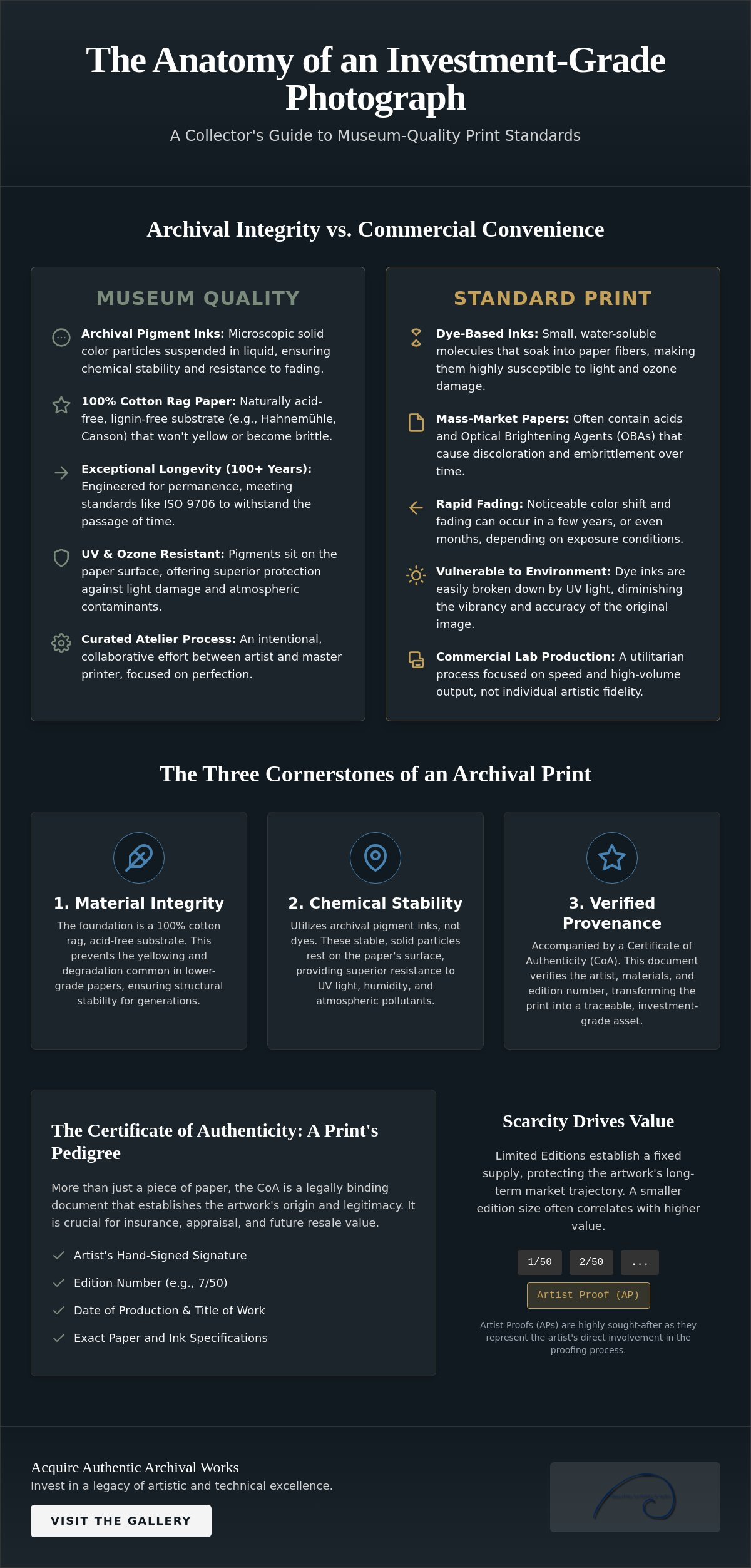
Standard commercial prints often rely on dye-based inks. These molecules are small and susceptible to rapid fading when exposed to light or ozone. In contrast, archival pigment prints utilize microscopic particles of solid color suspended in a liquid carrier. These pigments sit on the surface of the paper, resisting UV degradation and atmospheric contaminants. The substrate is equally critical. Museum-grade works utilize 100% cotton rag papers, such as those from Hahnemühle or Canson. These materials are naturally acid-free and avoid the optical brighteners that cause mass-market papers to become brittle and discolored over time.
The Role of the Certificate of Authenticity (CoA)
A fine art photograph is more than an image; it's a documented object with a specific history. A Certificate of Authenticity (CoA) serves as the print's pedigree. It verifies the production standards, the specific materials used, and the edition number. Essential elements include the artist’s hand-signed signature, the date of production, and the exact paper type. This document establishes provenance, which is vital for the long-term value of photographic art. It transforms a high-quality reproduction into an authenticated work of art, providing the collector with peace of mind regarding the piece's origin and future market trajectory.
Curated Fine Art vs. Commercial Photo Labs: A Collector’s Perspective
A commercial photo lab serves a utilitarian purpose: the efficient reproduction of digital files. While these facilities provide high-resolution output, they operate as service providers rather than artistic partners. The acquisition of museum quality photography prints Columbus collectors prioritize involves more than selecting a pleasing image. It requires a transition from a mere reproduction to an authenticated work of art. A gallery-grade print carries an intrinsic value rooted in its provenance and the rigorous standards of its creation, distinguishing it from mass-market products.
Professional curation provides a layer of investment security that a DIY printing service cannot replicate. When a work is acquired through a gallery, it's vetted for technical mastery and historical relevance. This oversight ensures that the materials used meet a museum-quality storage environment standard from the moment of inception. The result is an object that exists as part of a legacy, protected by the reputation of the institution that presents it. Collectors don't just buy a picture; they secure a piece of artistic history.
The Atelier Advantage: Crafting the Final Image
The atelier is a space of intentionality. It's where the raw vision of the photographer is translated into a physical medium through a collaborative dialogue between the artist and the curator. This environment differs from a commercial lab in its pace and precision. In a dedicated atelier, every print is treated as a singular event. The subtle textures of the paper and the depth of the shadows are scrutinized until they achieve a state of technical perfection. This process elevates the work, ensuring it possesses the tactile presence required for high-end collections.
Investment Grade Photography Prints
Scarcity is the primary driver of value in the secondary art market. Unlike open editions found in commercial shops, Limited Edition Prints establish a clear ceiling on supply. Collectors often seek out "Artist Proofs" or works in a "Unique State," as these pieces represent the artist's personal involvement in the proofing process. These designations signify rarity and demand, influencing the long-term market trajectory of the piece. Understanding why investment grade photography belongs in your portfolio requires looking beyond the frame to the scarcity model that supports its value.
For those seeking to elevate their surroundings with meaningful art, exploring a curated collection of archival works offers a path toward true connoisseurship.
Navigating the Columbus Fine Art Photography Scene
Columbus has evolved into a sophisticated destination for visual arts. This transformation is driven by a discerning community that values technical mastery over mass-market convenience. While digital portfolios offer a glimpse into an artist's vision, they cannot substitute for the physical presence of a print. To truly understand museum quality photography prints Columbus collectors must engage with the work in a gallery setting. It's here that the subtle textures of the substrate and the deep tonality of the pigments become visible. Scale and texture are tactile elements that require a physical proximity to be fully appreciated.
A curated gallery experience provides a necessary pause in a fast-paced metropolitan environment. It's a space designed for reflection rather than consumption. The local aesthetic often reflects this desire for quietude and depth, favoring works that demand a second look. By stepping into a physical space, the collector moves beyond the surface level to appreciate the craftsmanship inherent in the physical object. This deliberate engagement is the foundation of building a meaningful collection.
The Joseph-Cherrington House: A Historic Backdrop for Art
Architecture and art are inextricably linked. Viewing a contemporary photograph within the historic walls of the Joseph-Cherrington House creates a unique dialogue between eras. This setting, home to Ilkaa’s Fine Art Gallery & Atelier, elevates the viewing experience by providing a sense of permanence and heritage. The historic context reminds the collector that art is a legacy. It's an investment in beauty that transcends the current moment. This atmosphere encourages a slower, more reverent approach to acquisition, where the history of the space mirrors the technical heritage of the film medium.
Columbus Museum Standards for the Home
Integrating high-level art into a private residence requires a thoughtful approach to preservation. Translating museum standards to a home environment involves more than simple placement. It requires an understanding of how light and atmosphere affect archival materials over time. Many local enthusiasts utilize Professional Art Advisory and Curation in Columbus to navigate these complexities. When collecting fine art photography, the focus remains on the longevity of the medium. Proper curation ensures that the work remains a vibrant part of the home's narrative for decades. This commitment to quality defines the modern Columbus collector and protects the intrinsic value of the artwork.
The Role of Limited Editions in Archival Art Values
The valuation of photographic art rests on a delicate balance of technical perfection and controlled scarcity. For those acquiring museum quality photography prints Columbus offers, understanding the scarcity model is essential. Open editions serve a decorative purpose, produced in unlimited quantities. In contrast, Limited Edition Prints are restricted to a predetermined number, creating a finite supply that supports long-term market value. This distinction transforms a beautiful image into a collectible asset. It's a shift from consumption to connoisseurship.
The Atelier Collection represents the pinnacle of this model. These works aren't merely reproductions; they're the result of a precise production run where the artist and master printer have achieved a "Unique State" of the image. When a work is editioned, it carries a promise that no further prints will be made once the limit is reached. This transparency is vital for the secondary market, where provenance and rarity dictate the trajectory of an artist's career and the collector's portfolio.
Understanding Numbered Prints Value
The sequence of an edition carries significant weight in the art market. A designation like 1/10 indicates the first print in a small run, often commanding higher interest during initial acquisition. As an edition nears completion, the remaining works typically appreciate in value. This mathematical scarcity is a primary reason Numbered Prints Value: Why Rarity Matters for Collectors remains a central topic in art advisory. In the gallery environment, these numbers are more than labels. They're a record of the print's place in history.
The Science of Rarity: Archival Integrity
Rarity loses its meaning if the physical medium fails to survive. A limited edition print is only as valuable as its longevity. High-end collectors avoid works produced on non-archival materials because the risk of degradation undermines the investment. To maintain integrity, every work must meet the stringent museum standards discussed earlier. At Ilkaa’s Fine Art Gallery & Atelier, the commitment to archival pigment prints ensures that each numbered work remains a stable, vibrant piece of history. Every print is a testament to technical heritage and artistic intent.
Explore the exclusive selection of Limited Edition Prints available at our Columbus atelier and begin your journey into fine art acquisition.
Acquiring Archival Works at Ilkaa’s Fine Art Gallery & Atelier
The transition from appreciating fine art to acquiring it requires a partner who understands the weight of legacy. At Ilkaa’s Fine Art Gallery & Atelier, we provide a bridge between the artist’s technical mastery and the collector’s private sanctuary. Our space is dedicated to the museum quality photography prints Columbus enthusiasts seek, featuring a curated roster of internationally respected photographers. Each work in our collection is selected for its ability to transcend the current moment, offering a timeless aesthetic rooted in the physical heritage of the film medium. We view the acquisition process as a collaborative journey toward building a meaningful archive.
Acquiring from The Atelier Collection is an exercise in intentionality. These works aren't merely images; they're physical objects crafted with a reverence for the medium's history. Our commitment to museum-grade production ensures that every piece meets the archival standards discussed throughout this guide. By maintaining a focus on authentic provenance and rigorous material science, we protect the intrinsic value of your investment from the moment of purchase.
Consulting with the Curators
Building a cohesive photography portfolio is a deeply personal endeavor that benefits from expert guidance. Curators Ilkaa Amalia and Millie Franz offer personalized advisory sessions designed to assist collectors at every stage of their journey. These consultations take place within the quiet, contemplative environment of our gallery, allowing for a focused dialogue on theme, scale, and technique. Whether you're a seasoned connoisseur or a first-time buyer, our curators help you navigate the nuances of Archival Pigment Prints and Limited Edition Prints. This bespoke service ensures that every acquisition reflects your personal taste while adhering to the highest standards of the art market.
Your Next Steps as a Collector
The true depth of a photographic work is best realized through physical engagement. We invite you to experience the texture and tonality of our collections in person at the historic Joseph-Cherrington House. This setting provides a dignified backdrop for viewing art, allowing the work to breathe within a space of architectural significance. For those who prefer to begin their journey digitally, our online platform offers a refined interface for browsing our current holdings. Taking the next step in your collection is a matter of moving from observation to ownership, securing a piece of history for your own environment.
We invite you to explore our current exhibitions and limited edition prints to find the next cornerstone of your collection.
Elevating Your Private Collection
The journey toward building a meaningful archive is a commitment to both heritage and technical excellence. True connoisseurship begins with an understanding of the rigorous standards behind museum quality photography prints Columbus collectors prioritize. By focusing on archival pigment chemistry and verified provenance, you transform a visual experience into a lasting legacy. This intentionality ensures that every acquisition remains a stable and vibrant asset for future generations. It's a shift from temporary decoration to the stewardship of fine art.
Located in the historic Joseph-Cherrington House, Ilkaa’s Fine Art Gallery & Atelier offers a quiet sanctuary for this discovery. Our works are curated by internationally respected experts and include Certificates of Authenticity to safeguard their historical value. We invite you to move beyond the digital screen and experience the tactile depth of our physical archives. A sophisticated collection is a reflection of a discerning eye and a reverence for the medium's history. Your next acquisition awaits within a space dedicated to the highest standards of craftsmanship.
Browse The Atelier Collection of Limited Edition Prints and discover a work that resonates with your personal legacy.
Frequently Asked Questions
What exactly makes a print "museum quality"?
A museum quality print is defined by its adherence to rigorous archival standards, specifically the use of pigment-based inks on acid-free, 100% cotton rag paper. These materials ensure chemical stability and prevent the yellowing or brittleness common in standard papers. To meet this designation, the work must often comply with ISO 9706 requirements for permanence, ensuring the image remains unchanged by atmospheric contaminants or UV exposure over several generations.
How long do archival pigment prints last compared to standard photos?
Archival pigment prints are engineered for a lifespan exceeding 100 years when kept under proper environmental conditions. In contrast, standard dye-based photos often begin to show significant fading or color shifting within 10 to 20 years. The solid particles in pigment inks are far more resistant to light and environmental degradation than the small molecules found in traditional consumer dyes, making them the superior choice for legacy collections.
Where can I find signed photography prints in Columbus, Ohio?
You can find authenticated and signed museum quality photography prints Columbus collectors value at Ilkaa’s Fine Art Gallery & Atelier. Located in the historic Joseph-Cherrington House, the gallery features a curated selection of Limited Edition Prints from internationally respected photographers. Every numbered work includes the artist's signature, ensuring the piece's provenance and its status as a verified work of fine art rather than a mass-market reproduction.
Is photography a good investment for new art collectors?
Fine art photography represents a sophisticated entry point for new collectors, particularly when focusing on limited editions with documented provenance. Unlike open editions, limited runs create a finite supply that supports future market value. As an artist's career progresses and editions sell out, the secondary market demand for early or rare states often increases, making archival works a stable and culturally significant addition to a diverse art portfolio.
What is the difference between a Giclee print and a museum-grade pigment print?
"Giclee" is a broad marketing term for high-quality inkjet printing, but it doesn't inherently guarantee archival stability. A museum-grade pigment print represents a more stringent technical standard, specifically requiring the use of lightfast pigment inks and acid-free, OBA-free (Optical Brightening Agent) substrates. While many giclee prints use dyes that fade over time, a true museum-grade work is defined by its chemical longevity and resistance to environmental decay.
Why is the Joseph-Cherrington House important to the Columbus art scene?
The Joseph-Cherrington House serves as a vital cultural landmark by providing a historic architectural context for contemporary visual arts. As the home of Ilkaa’s Fine Art Gallery & Atelier, it bridges the gap between Columbus’s heritage and modern artistic expression. The building’s preserved elegance offers a quiet, intentional environment that encourages collectors to engage deeply with the tactile qualities of the medium, far removed from the pace of commercial galleries.
Do museum-quality prints require special framing?
Yes, preserving the integrity of a museum-grade work requires archival framing techniques, including the use of UV-protective glass and acid-free matting. Standard frames often contain wood pulps or adhesives that release harmful gases, leading to irreversible damage and discoloration. Professional conservation framing ensures that the environment inside the frame remains stable, protecting the print from moisture, light, and acidity for decades to come.
How do I verify the authenticity of a limited edition photograph?
Authenticity is verified through a formal Certificate of Authenticity (CoA) and the presence of edition numbering on the work itself. A valid CoA should include the artist's signature, the print date, and the specific materials used in production. These documents establish a clear chain of provenance, which is essential for verifying the work's origin and protecting its long-term value within the competitive fine art market.
Disclaimer
Information is provided for general editorial and educational purposes. Artwork availability, pricing, dimensions, framing, edition details, exhibition information, and event schedules are subject to change. Please contact Ilkaa’s Fine Art Gallery & Atelier for the most current information.
© 2026 Ilkaa’s Fine Art Gallery & Atelier. Article text, gallery photographs, graphics, and other original gallery content may not be copied, reproduced, republished, distributed, modified, or used for commercial purposes without prior written permission. Copyright in individual artworks, artist photographs, and other third-party materials remains with the respective artists, photographers, estates, or rights holders. Brief quotations and links may be used with appropriate attribution where permitted by law.