
To hold an Edward Weston print is to touch the very foundation of American modernism, where a simple bell pepper or a weathered shell transcends its form to become a study in pure light. You likely recognize that while his influence is undeniable, the landscape of Edward Weston prints for sale can feel dense with technical distinctions. It's common for even seasoned collectors to feel a sense of hesitation when navigating the nuances between a lifetime silver gelatin print and a posthumous estate edition printed by his son, Cole Weston.
This guide provides the essential framework you need to distinguish these works with confidence, ensuring you can appreciate the technical mastery and historical significance behind every frame. We'll explore the Weston family’s multi-generational legacy, the specific archival standards that define these works, and how to begin your collection through a curated environment. From the historic Joseph-Cherrington House at 785 East Broad Street, we offer a direct connection to the Weston archive, bridging the gap between historical mastery and the contemporary collector. By understanding the provenance and the physical medium, you can build a portfolio that honors one of photography's most enduring legacies.
Key Takeaways
- Navigate the market for Edward Weston prints for sale by distinguishing between lifetime vintage works and posthumous estate editions printed by his heirs.
- Understand the multi-generational legacy of the Weston family, including how Kim and Zach Weston maintain the historic Wildcat Hill atelier and traditional film practices.
- Identify key indicators of print quality and value, such as physical condition, provenance, and the necessity of a formal Certificate of Authenticity.
- Explore the transition from pictorialism to "straight photography" and why Weston’s focus on form and light remains a cornerstone of fine art photography.
- Learn how to approach collecting through an intentional viewing experience at Ilkaa’s Fine Art Gallery & Atelier, situated within the historic Joseph-Cherrington House.
The Enduring Significance of Edward Weston’s Vision
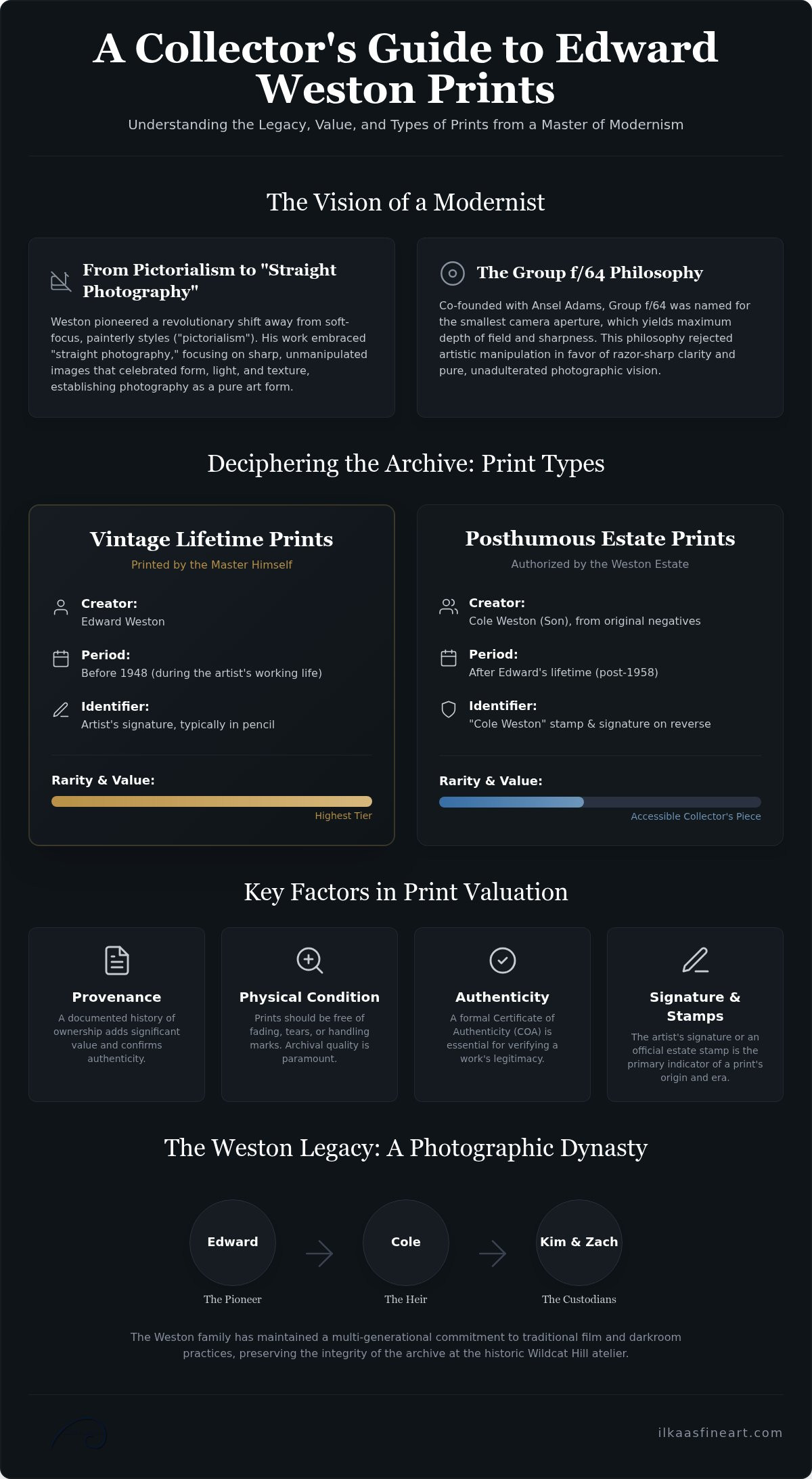
Edward Weston did not just take pictures; he sculpted light through a lens. In the early 20th century, photography was often trapped in "pictorialism," an aesthetic that mimicked painting through soft focus and heavy manipulation. Weston broke this mold. His 1922 journey to Middletown, Ohio, marked a pivotal transition. Photographing the towering stacks of the Armco Steel plant, he discovered a new language of industrial geometry. This shift from romanticism to "straight photography" is a primary reason why fine art photography changed forever. Understanding this evolution is vital for anyone exploring Edward Weston prints for sale, as these works represent the moment photography claimed its own unique identity.
The Group f/64 Philosophy
In 1932, Weston co-founded Group f/64 alongside Ansel Adams and Imogen Cunningham. The name refers to the smallest aperture on a large-format camera, which produces maximum depth of field and razor-sharp clarity. This philosophy rejected the "fuzzy" art of the past, favoring high contrast and unmanipulated prints. For the modern collector, a Weston print is a testament to this technical purity. It isn't just a record of a subject; it's a masterclass in the physical medium of silver gelatin. This commitment to "pure" photography transformed the American landscape into a series of profound, tactile textures that still resonate in contemporary spaces.
Iconic Motifs: From Peppers to Point Lobos
Weston’s ability to find the monumental in the mundane is perhaps his greatest legacy. Whether it's the famous "Pepper No. 30" or the undulating curves of a Nautilus shell, his work treats organic forms with the same reverence as a cathedral. Later in life, his focus shifted to the rugged coastline of Point Lobos, California. Here, the gnarled cypress trees and Pacific tide pools became abstract compositions of life and decay. According to Edward Weston's biography, his later years were spent refining these visions into the definitive statements of modernism we recognize today. These motifs are why his work remains a cornerstone of museum-grade collections. At Ilkaa’s Fine Art Gallery & Atelier, we recognize that acquiring such a piece is more than a purchase. It's the preservation of a revolutionary artistic sightline within your own private collection.
Deciphering the Archive: Types of Edward Weston Prints
Navigating the archive requires a discerning eye for the timeline of production. When seeking Edward Weston prints for sale, the distinction between eras is paramount. Vintage prints, those meticulously crafted and signed by Weston himself, are the rarest. Most were produced before 1948, the year he ceased darkroom work. These pieces are not merely images; they're physical records of the artist's personal touch on the silver gelatin medium. Because Weston was a perfectionist in the darkroom, these lifetime works carry an intimacy that defines the highest tier of photographic collecting.
Vintage vs. Posthumous Prints
The market separates lifetime works from posthumous editions with clear precision. Posthumous prints, or estate prints, were largely produced by his son, Cole Weston, from the original negatives. These are recognized by a characteristic "Cole Weston" stamp on the reverse. While they maintain the visual power seen in Edward Weston's 'Shell' at MoMA, their valuation reflects their status as estate-authorized works. A print's provenance and the presence of a signature remain the most vital metrics for those building a portfolio of tangible assets. Understanding these nuances ensures that your acquisition aligns with your long-term goals as a collector.
Museum Standards and Archival Integrity
True archival integrity is found in the material. Silver gelatin prints are the standard for historical collections, prized for their tonal depth and chemical stability. Yet, the Weston legacy hasn't remained static. Contemporary collections now embrace archival pigment prints, which provide a bridge to modern museum standards. These works offer a level of detail and longevity that complements the traditional darkroom processes. By adhering to museum-grade production standards, the archive continues to offer works that are as durable as they are visually arresting.
Supervised works, such as the Project Prints and the 50th Anniversary Portfolio, occupy a unique middle ground. Created in the 1950s under Edward’s direct oversight but printed by his sons, they carry an air of authenticity that later posthumous works cannot replicate. Understanding these tiers is essential for any serious collector. If you're ready to see these textures in person, consider a private gallery appointment to view works from the archive in an intentional, unhurried setting.
The Weston Legacy in the 21st Century: Kim and Zach Weston
The Weston name is synonymous with the evolution of the American lens. While many institutions, such as The Art Institute of Chicago's Edward Weston Collection, preserve the historical record, the family themselves ensure the medium’s vitality. Kim Weston, Edward’s grandson, maintains the historic Wildcat Hill atelier in Carmel, California. Here, the tradition of large and medium format film remains a tactile reality rather than a relic. Kim’s work, often found in the Kim Weston Photography Collection, expands on the family’s figurative roots while introducing expressive, hand-painted elements that push the boundaries of the traditional print.
The lineage extends further with Zach Weston, Edward’s great-grandson. Zach’s focus on landscape and abstract geometries mirrors the foundational principles of Group f/64 but carries a modern, contemplative energy. By working exclusively with black and white film, he honors the technical rigors established a century ago. This living connection is what makes current Edward Weston prints for sale particularly compelling. They aren't just artifacts of a bygone era but part of a continuous, breathing artistic dialogue that spans four generations of visionaries.
From the Archive: Rare Access in Columbus
Ilkaa’s Fine Art Gallery & Atelier serves as a unique bridge to this heritage within the Midwest. Located in the historic Joseph-Cherrington House at 785 East Broad Street, the gallery offers an intimate environment to view rare archival works. Sourcing prints from a gallery with direct family ties provides collectors with a layer of certainty and historical context that secondary market platforms often lack. The "From the Archive" collection allows visitors to experience the texture and light of these works in a setting that values the unhurried observation of fine art, far removed from the noise of the traditional auction house.
Continuing the Craft
Modern works produced by Kim and Zach Weston aren't mere imitations of the past. They represent a sophisticated intersection of historical legacy and contemporary expression. Every silver gelatin print or archival pigment work produced by the family today adheres to the museum-grade standards that have defined the Weston name for decades. If you're curious about how these curated selections are organized, exploring what is an Atelier Collection can provide deeper insight into our curatorial process. This commitment to the physical craft ensures that the Weston vision remains as relevant in a 21st-century home as it was in the studios of the 1930s.
Building a Collection: What to Seek in a Weston Print
Acquiring a print is a balance of technical scrutiny and emotional connection. When evaluating Edward Weston prints for sale, physical condition is the first point of order. Silver gelatin prints often exhibit "silvering," where metallic silver migrates to the surface, creating a mirror-like sheen in the shadows. While some collectors find this adds character, significant foxing, which appears as small brown spots, or physical abrasions can detract from the work's long-term preservation. A legitimate Certificate of Authenticity and a clear line of gallery provenance are non-negotiable. These documents serve as the pedigree of your investment, ensuring the work's place within the historical record.
Beyond technicalities, consider the dialogue between the work and your existing space. Is the piece being acquired for its historical weight or its personal resonance? Often, the most rewarding collections are those that successfully bridge both. For a deeper look at market trends and asset building, read our guide on Investing in Fine Art Photography.
Strategic Acquisitions for New Collectors
For those beginning their journey, limited edition prints from the family archive offer an accessible entry point into the Weston legacy. Building a cohesive portfolio doesn't require focusing solely on a single artist. Instead, look for thematic threads, such as form or light, that connect 20th-century masters with contemporary voices like Kim or Zach Weston. At our space at 785 East Broad Street, we recommend scheduling private gallery appointments to facilitate this process. These sessions allow for a quiet, intentional discovery of the work, away from the distractions of a public setting. It's in these moments that the nuances of a print truly reveal themselves.
Caring for Your Investment
Preservation is as important as acquisition. Museum-grade framing is essential, utilizing acid-free matting and UV-protective glazing to prevent fading and paper degradation. Environmental stability is equally vital; silver gelatin and pigment prints are sensitive to fluctuations in humidity and temperature. Ideally, art should be kept in a climate-controlled space with indirect lighting. We advocate for the practice of "slower looking." This is a method where the collector spends time observing the work in different lights over several days. This unhurried approach leads to a more profound understanding of the piece and ensures it remains a cherished part of your collection for decades.
Schedule a private viewing at our Columbus gallery
Experiencing the Weston Archive at Ilkaa’s Fine Art
The historic Joseph-Cherrington House, a refined landmark at 785 East Broad Street, provides a storied backdrop for the Weston archive. Within these walls, the architecture of the late 19th century mirrors the timelessness of the works on display. Unlike the impersonal nature of digital marketplaces, this space demands a slower pace. Visitors can expect an intentional encounter with history, where the light in the room is as considered as the light within the silver gelatin frames. It is an environment designed for the unhurried observation of fine art, allowing the textures of the physical medium to reveal themselves fully.
A Local Hub for International Photography
Ilkaa's Fine Art Gallery & Atelier functions as a vital conduit for museum-caliber works in Columbus, Ohio. Our "art-for-all" philosophy ensures that every visitor is met with the same level of professional guidance, regardless of their prior knowledge of the medium. Curators Ilkaa Amalia and Millie Franz offer personalized advisory, helping to demystify the technical nuances often associated with Edward Weston prints for sale. By focusing on material history and provenance, we ensure that the path to acquisition is transparent and rewarding. We invite you to Visit Ilkaa's Fine Art Gallery & Atelier to explore our current rotations from the "From the Archive" collection.
Private Viewings and Consultations
The gallery operates with a focus on intimacy and exclusivity. While you can browse our curated roster at ilkaasfineart.com for initial discovery, the physical presence of an archival print is best appreciated in person. Scheduling a private appointment allows for a dedicated consultation where we can discuss the specificities of editioning, condition reports, and museum-grade framing. This approach ensures that your collection is built on a foundation of trust and expert oversight. Our roster features internationally respected photographers, providing a context that elevates every acquisition within a broader artistic narrative.
Looking forward, the gallery is preparing for its public opening and anniversary celebration on May 16, 2026. This milestone will celebrate our first three years in the historic Joseph-Cherrington House and highlight the continued expansion of the Weston family legacy within our collection. Whether you are seeking a singular masterpiece or building a diverse portfolio of tangible assets, our atelier remains a dedicated guardian of artistic integrity in the heart of Columbus. We remain committed to acting as a bridge between the creator and the collector, ensuring that the spirit of modernism continues to thrive.
Preserving a Legacy of Light
Collecting fine art is a journey of discernment and technical appreciation. We have explored the foundational mastery of the Group f/64 philosophy and the multi-generational legacy that continues through the contemporary work of Kim and Zach Weston. Understanding these distinctions is essential for any collector evaluating Edward Weston prints for sale. By prioritizing provenance, physical condition, and museum-grade standards, you ensure that your acquisition remains a significant tangible asset. The transition from historical archive to personal collection is a path best walked with intentionality and expert guidance.
At Ilkaa’s Fine Art Gallery & Atelier, we offer direct access to rare works from the Weston family archive within the quiet elegance of the historic Joseph-Cherrington House. Curators Ilkaa Amalia and Millie Franz provide the personalized advisory necessary to navigate this sophisticated market with confidence. Whether you are drawn to the abstract geometries of nature or the profound textures of a silver gelatin print, our space serves as a bridge to photographic history.
Browse the Weston Family Archive and Limited Edition Prints at Ilkaa’s Fine Art
We look forward to assisting you in discovering a work that resonates with your personal vision. Every print is a masterclass in light, waiting to be part of your enduring legacy.
Frequently Asked Questions
What makes an Edward Weston print a good investment in 2026?
Edward Weston remains a pillar of modernist photography, ensuring his work maintains a high degree of market stability. His foundational role in the Group f/64 movement and the limited availability of lifetime works contribute to their status as tangible assets. In 2026, collectors prioritize these prints for their enduring aesthetic value and historical weight. As museum-grade works, they're a secure entry point for those building a portfolio of fine art photography.
How can I tell if an Edward Weston print is authentic?
Authenticity is verified through a combination of physical markers and documented history. Lifetime prints often bear Weston’s signature or initials, while posthumous works are typically identified by a "Cole Weston" stamp on the reverse. A formal Certificate of Authenticity and clear gallery provenance are essential for any Edward Weston prints for sale. Curators at Ilkaa’s Fine Art meticulously vet every piece to ensure it meets the rigorous standards of the Weston family archive.
What is the difference between a vintage print and a Cole Weston print?
A vintage print was created and signed by Edward Weston during his active years, typically before he ceased darkroom work in 1948. These are the rarest and most valuable works. In contrast, a Cole Weston print is a posthumous edition produced by Edward's son from the original negatives. While Cole’s prints are authorized and highly collectible, they occupy a different market tier than the lifetime works personally handled by the artist.
Where can I see Edward Weston prints for sale in Columbus, Ohio?
Rare works from the Weston archive are available for viewing at Ilkaa’s Fine Art Gallery & Atelier in Columbus. Located in the historic Joseph-Cherrington House at 785 East Broad Street, the gallery provides a curated environment for discovering these modernist masterpieces. Our selection includes rare archival pieces and limited edition prints. This local connection offers Ohio-based collectors a unique opportunity to engage with internationally respected photography without the need for travel to coastal markets.
Are Edward Weston prints available for private viewing at Ilkaa’s Fine Art?
Yes, we encourage private gallery appointments for an intentional and unhurried viewing experience. These sessions allow collectors to examine the tonal depth and physical condition of the prints in a quiet, professional setting. Our curators, Ilkaa Amalia and Millie Franz, are available to provide personalized advisory during these viewings. Scheduling a private session ensures you've got the space to reflect on the work's resonance before making a significant acquisition for your collection.
What should I look for in the condition of a silver gelatin print?
When evaluating a silver gelatin print, look for signs of chemical stability and physical integrity. It's important to inspect the work under raking light to identify common issues:
- Silvering: A metallic sheen in shadow areas.
- Foxing: Small brown spots from mold or impurities.
- Physical abrasions: Scratches or dents on the surface emulsion.
Yellowing of highlights also indicates improper fixing. Assessing these factors ensures the print remains a durable, long-term investment for your portfolio.
How does the Weston family continue Edward Weston’s photographic legacy today?
The legacy remains vibrant through the work of Kim Weston and Zach Weston. Kim maintains the family’s historic Wildcat Hill atelier, continuing the tradition of large-format film and figurative exploration. Zach, representing the fourth generation, focuses on landscape and abstract geometries that honor the Group f/64 philosophy. By adhering to traditional darkroom processes and museum-grade standards, the family ensures that the Weston vision continues to evolve while respecting its foundation.
Can I buy Edward Weston prints online through Ilkaa’s Fine Art?
You can browse a curated selection of Edward Weston prints for sale through our digital gallery at ilkaasfineart.com. While our online platform offers a convenient starting point for discovery, we'll recommend a follow-up consultation to discuss condition reports and provenance details. We provide secure, archival shipping for all acquisitions, ensuring your artwork arrives in museum-grade condition. It's a hybrid approach that combines the ease of modern discovery with the personalized service of a traditional fine art atelier.
Disclaimer
Information is provided for general editorial and educational purposes. Artwork availability, pricing, dimensions, framing, edition details, exhibition information, and event schedules are subject to change. Please contact Ilkaa’s Fine Art Gallery & Atelier for the most current information.
© 2026 Ilkaa’s Fine Art Gallery & Atelier. Article text, gallery photographs, graphics, and other original gallery content may not be copied, reproduced, republished, distributed, modified, or used for commercial purposes without prior written permission. Copyright in individual artworks, artist photographs, and other third-party materials remains with the respective artists, photographers, estates, or rights holders. Brief quotations and links may be used with appropriate attribution where permitted by law.