
In the architecture of a corporate identity, the walls speak louder than the mission statement itself. A workspace should serve as a silent testament to a firm's longevity and vision. You likely recognize that generic office decor often feels uninspired and fails to meet the sophisticated standards of your brand. Selecting the right fine art for corporate headquarters Columbus requires a deliberate shift from temporary decoration to the acquisition of lasting, museum-quality assets.
It's natural to feel uncertain about archival standards or the time required to manage a complex installation. You deserve a collection that reflects technical mastery and artistic legacy without the burden of self-guided sourcing. This guide will show you how museum-grade photography and professional art advisory can transform your Columbus headquarters into a reflection of institutional legacy. We'll explore the selection of authenticated, limited-edition works, including archival pigment prints from The Atelier Collection, and the precise placement strategies that turn a physical office into a curated gallery of professional excellence.
Key Takeaways
- Distinguish between temporary office decoration and institutional fine art to communicate brand stability and heritage.
- Discover the strategic value of sourcing museum-grade fine art for corporate headquarters Columbus through authenticated, limited-edition photography.
- Ensure the longevity of your corporate assets by prioritizing archival pigment prints that meet rigorous museum standards for lightfastness and detail.
- Navigate the complexities of selection and placement with a professional curatorial process tailored to your firm’s architectural vision.
- Leverage expert advisory to acquire rare works from The Atelier Collection, creating a cohesive environment that impresses stakeholders and clients.
The Strategic Role of Fine Art in Corporate Identity
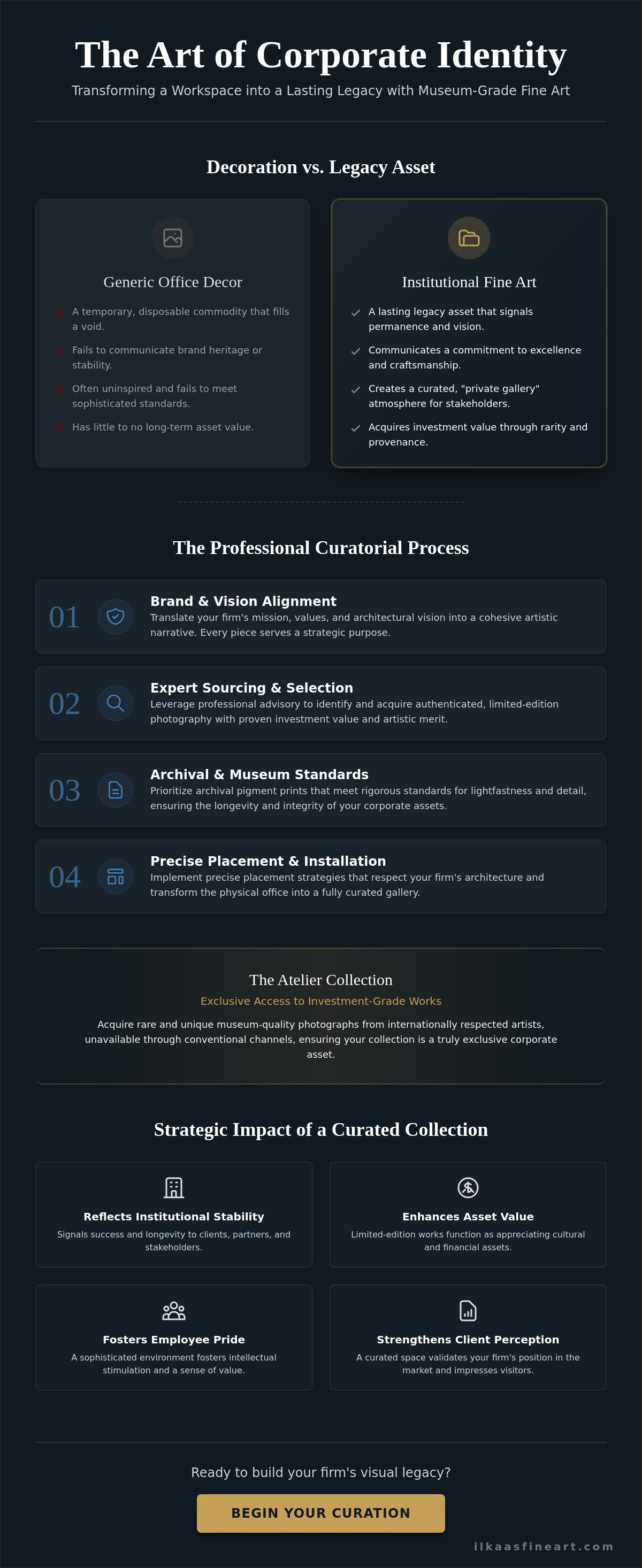
The architecture of a corporate headquarters serves as the first handshake between a firm and its stakeholders. Within these walls, the choice of visual elements acts as a silent but powerful communicator of values. Many organizations confuse decorative office art with institutional fine art. The former is a commodity; the latter is a legacy. While generic prints may fill a void, fine art for corporate headquarters Columbus establishes an atmosphere of permanence and intentionality. It's the difference between a temporary workspace and a lasting institution.
Visual environments profoundly influence client perception. A space adorned with museum-grade photography suggests a commitment to excellence that extends beyond the balance sheet. For employees, a curated environment fosters a sense of pride and intellectual stimulation. It signals that the institution values quality over convenience. This "Visual Legacy" aligns art selection with corporate values, transforming corridors into corridors of influence. High-quality art isn't just an ornament. It's a strategic asset that validates a firm's place in the market.
Photography is uniquely suited for the modern, sophisticated headquarters. Its clarity and technical depth mirror the precision of high-level industry. It offers a window into heritage or a vision of the future, all through a medium that feels both contemporary and timeless. Fine photography captures the textures of progress and the nuances of the human experience with a quiet, authoritative confidence.
Communicating Brand Values through Curation
Curation is the bridge between a company's mission and its physical presence. Selecting themes that resonate with a firm's industry creates a cohesive narrative. In a boardroom, the presence of large-scale, archival photography commands attention. These works don't merely decorate; they inspire contemplation. Moving beyond the generic requires a partnership with experts who understand how to translate institutional history into a visual language. Intentional collections reflect a brand's depth, ensuring that every piece serves a purpose.
Art as a Reflection of Institutional Stability
Acquiring authenticated, limited-edition works is a signal of success. It demonstrates to stakeholders that the firm is a guardian of culture and a patron of craftsmanship. This commitment to quality builds a "private gallery" atmosphere within public-facing spaces. By integrating works from international masters and local talent, a headquarters grounds itself in its community while maintaining a global perspective. Archival pigment prints ensure these assets retain their integrity for decades. They are tangible markers of a firm's journey, suggesting a future as enduring as the art on the walls.
Selecting Museum-Grade Photography for Columbus Headquarters
The acquisition of fine art for corporate headquarters Columbus isn't merely an aesthetic choice. It's a technical and financial decision. Unlike mass-produced imagery, museum-grade photography carries the weight of intentionality. It's a medium defined by its ability to capture light and texture with a precision that mirrors high-level corporate standards. For the institution seeking to build a meaningful collection, the focus must remain on works that offer both aesthetic depth and long-term asset value. This transition from decoration to collection requires a commitment to technical mastery and provenance.
A curator serves as the vital link between the artist's studio and the boardroom. Identifying investment-grade opportunities involves evaluating a photographer's technical mastery and their historical standing within the broader art market. This process goes beyond visual appeal. It includes an analysis of the artist’s exhibition history and the archival integrity of their prints. Whether sourcing works from internationally respected names like Kim Weston or Roman Loranc, the objective remains the same: the acquisition of pieces that possess a lasting narrative. The Atelier Collection provides a unique avenue for this, offering access to rare and unique works that aren't available through conventional commercial channels. By focusing on these high-register acquisitions, a firm ensures its collection is viewed as a serious cultural contribution rather than mere office furnishing.
The Value of Limited Edition and Numbered Prints
Scarcity is the primary driver of value in the photographic medium. When a print is part of a restricted run, its rarity is protected, ensuring the work remains an exclusive asset for the firm. Each piece should be accompanied by a certificate of authenticity, detailing the edition number and the artist's signature. A Limited Edition is a strictly controlled production of a specific work, where the total number of prints is predetermined and never exceeded to preserve its market value and exclusivity. For those beginning their journey, exploring authenticated limited edition prints is the foundational step in professional curation.
Photography Styles for High-End Commercial Spaces
The style of photography selected should complement the architectural language of the headquarters. Atmospheric landscapes offer a sense of expansive vision, while architectural studies emphasize structure and detail. Black and white photography remains a staple of corporate elegance, providing a timeless quality that doesn't compete with interior color palettes. These works invite quiet contemplation, allowing clients and stakeholders to linger on the tonal range and composition without being distracted from the business at hand. The goal is a visual environment that feels curated, balanced, and profoundly professional.
The Curatorial Process: Professional Art Advisory in Columbus
Professional art advisory transforms the acquisition of fine art for corporate headquarters Columbus from a series of disjointed purchases into a cohesive institutional asset. This methodology ensures that every piece serves the broader narrative of the firm while meeting rigorous archival standards. A successful collection requires a bridge between the artist’s vision and the architectural reality of the corporate environment. This process is methodical, beginning with the physical space and ending with a transformed atmosphere.
A curator acts as a guardian of quality and a navigator of the fine art market. Beyond simple selection, the advisory process includes the management of custom framing and archival mounting. These technical details are essential for protecting the integrity of Archival Pigment Prints over decades. Professional installation ensures that each work is positioned with mathematical precision, considering sightlines and the interplay of light. This level of intentionality elevates a headquarters from a functional office to a curated gallery space.
Step 1: Space Analysis and Portfolio Strategy
The process begins with a comprehensive assessment of the headquarters. We evaluate the nuances of natural lighting, the flow of daily traffic, and the specific dimensions of key focal walls. This analysis informs a portfolio strategy that balances aesthetic impact with the firm's investment goals. By developing a cohesive narrative, the collection feels integrated rather than added. This stage is where we define the visual language of the institution, ensuring the art mirrors the precision and stability of the business itself.
Step 2: Sourcing and Authenticated Acquisition
Leveraging an established gallery and atelier provides access to exclusive collections not found in the open market. We focus on sourcing Limited Edition Prints that possess clear provenance and museum-grade production standards. Managing the logistics of acquisition includes the meticulous handling of archival documentation and certificates of authenticity. This ensures that every addition to the corporate collection is a verified asset. Our permanent location at 785 East Broad Street serves as a dedicated environment for reviewing these rare works from The Atelier Collection before they transition to your space.
Step 3: Installation and Lighting Design
The final stage is the technical execution of the vision. Hanging large-scale pigment prints requires specialized knowledge of weight distribution and archival mounting hardware. We optimize gallery-style lighting to enhance the depth and tonal range of the photography, revealing textures that might otherwise remain hidden. A final walkthrough ensures the collection achieves the desired mood of quiet confidence. The result is a refined environment where the art and architecture exist in perfect, silent dialogue.
Archival Standards and Investment Value for Corporate Assets
Acquiring fine art for corporate headquarters Columbus is a decision that moves beyond the marketing budget and into the realm of asset management. For an institution, the primary objection to art acquisition often centers on the perceived fragility of the medium. However, archival quality isn't a luxury; it's a non-negotiable standard for any firm viewing its collection as a long-term investment. While mass-market reproductions rely on fugitive dyes that shift and fade within years, institutional fine art utilizes stable, lightfast pigments. This technical distinction ensures that the visual legacy of the firm remains as vibrant in fifty years as it is on the day of installation.
Protecting the financial value of these assets requires a commitment to conservation-grade materials. This includes the use of UV-filtering glass and archival mounting techniques that prevent environmental degradation. Every component, from the mounting substrate to the adhesive, must be chemically inert to ensure the work's longevity. By adhering to these museum standards, a firm protects the physical integrity of its collection, ensuring that each piece remains a pristine representation of the brand’s commitment to excellence.
Understanding Archival Pigment Prints
The science of the medium is found in the interplay between pigment and paper. Unlike dye-based prints that soak into the fibers, pigment particles sit on the surface of the substrate, creating a depth of color and texture that is tactile and enduring. The choice of pH-neutral, acid-free papers made from 100% cotton rag is essential for preventing the yellowing or brittleness associated with commercial photo papers. Museum-grade archival pigment prints on acid-free cotton rag substrates are engineered to maintain their chromatic integrity for over 100 years when preserved behind UV-filtering glass. This technical mastery is what defines the works within The Atelier Collection, offering a level of permanence that standard office decor cannot match.
Art as a Financial Asset for the Firm
Fine art photography has seen a significant shift in market perception, increasingly viewed as a fluid asset class. According to the Art Basel and UBS Survey of Global Collecting, 51% of high-net-worth collectors purchased digital or fine art works in 2024 and 2025, signaling a robust secondary market for authenticated pieces. Capital is increasingly shifting toward established artists with museum validation, providing a layer of security for corporate buyers. Beyond potential appreciation, a curated collection offers tax and branding benefits, positioning the firm as a sophisticated patron of the arts. As market trends favor mid-career artists with proven records, the acquisition of limited-edition photography remains a prudent strategy for firms looking to diversify their institutional holdings.
Ilkaa's Fine Art Gallery & Atelier: Bespoke Curation for Columbus Institutions
The Joseph-Cherrington House at 785 East Broad Street stands as a testament to architectural preservation and artistic integrity. Since its permanent grand opening on May 16, 2026, this historic space has served as the heart of Ilkaa's Fine Art Gallery & Atelier. It's here that the selection of fine art for corporate headquarters Columbus moves from a simple transaction to an immersive experience. The building’s storied walls, located just east of the Columbus Museum of Art, provide a dignified backdrop for reviewing the textures and tonal ranges of museum-grade photography. This environment allows collectors to step away from the digital world and appreciate the physical presence of the printed image.
At the core of this institution is the partnership between Ilkaa Amalia and Millie Franz. Their collaboration represents a fusion of curatorial expertise and creative vision. While Millie Franz brings a deep understanding of the physical medium and the artistic process, Ilkaa Amalia provides the strategic oversight necessary for institutional acquisition. Together, they act as guardians of high standards, ensuring that every piece added to a corporate collection carries the weight of technical mastery. This partnership has successfully elevated hospitality and corporate environments across Ohio, transforming sterile offices into spaces of quiet reflection and prestige. By focusing on the relative safety of established, mid-career artists with museum validation, we help firms avoid the volatility of speculative markets.
A Personalized Approach to Corporate Curation
The atelier model differs fundamentally from a traditional retail gallery. It's an intimate, research-driven approach to collection building. Rather than offering a rotating stock of decorative pieces, we tailor each portfolio to the specific architectural language of your headquarters. We consider the interplay of shadow and light within your halls, selecting works that harmonize with the building's materials. Our commitment remains rooted in archival integrity. Every acquisition from The Atelier Collection is a verified, limited-edition work, accompanied by full provenance and certificates of authenticity. This process ensures that your investment is protected by the highest standards of the medium.
Your Next Steps: Building a Visual Legacy
Initiating a corporate art collection is an investment in the firm’s future identity. It's a declaration of stability and a commitment to cultural heritage. Starting a photography portfolio today ensures that your visual legacy grows alongside your institutional success. We invite you to experience the depth of our archives firsthand through a private gallery visit or an onsite consultation at your facility. This is an opportunity to define the atmosphere of your workspace for decades to come.
Contact Ilkaa's Fine Art Gallery & Atelier for a corporate art consultation to begin the process of curating a space that reflects your brand's enduring values.
Cultivating an Institutional Legacy
Building a collection of fine art for corporate headquarters Columbus is an investment in institutional permanence. It moves beyond the ephemeral nature of standard decor, establishing a space that reflects a firm's long-term vision and technical standards. By prioritizing museum-grade archival pigment prints and limited-edition works, your headquarters becomes a visual testament to your organization's stability and commitment to craftsmanship. These assets don't just decorate; they communicate a narrative of success and meticulous attention to detail.
The curatorial process, managed by experts at Ilkaa's Fine Art Gallery & Atelier, ensures that every acquisition aligns with the architectural nuances of your workspace. This level of intentionality transforms corridors and boardrooms into curated reflections of professional excellence. Your space deserves a collection that resonates with stakeholders while serving as a lasting cultural asset. The final result is an environment where art and architecture exist in a silent, powerful dialogue.
Schedule a Curatorial Consultation for Your Columbus Headquarters to begin shaping a visual legacy that honors your firm's journey. We invite you to explore the depth of our archives and discover how fine art can redefine your corporate environment. End your search for uninspired decor and begin the process of building a collection with enduring significance.
Frequently Asked Questions
What is the role of an art consultant for a corporate office in Columbus?
An art consultant at Ilkaa's Fine Art Gallery & Atelier provides technical due diligence and narrative development for fine art for corporate headquarters Columbus. They manage the transition from architectural blueprints to a fully realized visual environment, ensuring every acquisition meets a high register of craftsmanship. This role involves navigating the fine art market to secure pieces that align with a firm's institutional stability and long-term vision.
How do I choose art that fits my company's brand identity?
Choosing the right works involves identifying visual themes that mirror your industry's precision and heritage. Rather than following trend-driven demands, focus on timeless compositions that evoke a sense of quiet confidence and technical mastery. The selection should feel like a natural extension of the building's architectural language, creating a space that invites contemplation and reflects the firm's internal culture and professional standards.
Why is limited edition photography better for a headquarters than mass-market prints?
Limited edition works possess a scarcity that mass-market reproductions cannot offer, providing a secure asset class for corporate investors. In an economy characterized by a K-shaped recovery, owning authenticated, numbered prints ensures that your collection retains its exclusivity and prestige. These works carry the weight of a traditional institution, signaling to stakeholders that the firm values high-level craftsmanship and artistic integrity over temporary decoration.
What are archival pigment prints and why do they matter for offices?
Archival pigment prints utilize mineral-based pigments that sit on the surface of acid-free cotton rag substrates, creating a depth and texture that dye-based prints lack. These materials are essential for corporate environments because they resist environmental stressors and maintain their clarity over decades. This technical mastery ensures that the collection remains a pristine representation of the firm's values, serving as a guardian of high standards within the physical workspace.
Can you help with framing and installation for large corporate spaces?
Yes, Ilkaa's Fine Art Gallery & Atelier oversees the entire logistical process, from custom archival framing to strategic placement and installation. Large-scale works require specialized mounting techniques and gallery-style lighting to reveal their full tonal range and depth. Our methodical approach ensures that every piece is positioned with structural clarity, allowing the artwork to breathe and interact effectively with the office's traffic flow and natural light.
How does fine art photography retain its value over time?
Fine art photography retains value through museum validation and the relative safety of established, mid-career artists. By focusing on works with clear provenance and technical depth, a firm builds a portfolio that is less susceptible to market volatility. As the distinctions between luxury collectibles and digital assets continue to shift, authenticated physical prints remain a stable anchor for institutional collections, appreciating as the artist's legacy grows.
Is it possible to commission specific works for our hospitality project?
Our atelier model allows for a personalized approach to curation, where we can develop site-specific narratives for regional hospitality and corporate developments. This involves sourcing rare works from The Atelier Collection that harmonize with a project's unique architectural language. We act as a bridge between the creator and the collector, ensuring that the final collection feels intentional, ordered, and deeply rooted in a world of high-level craftsmanship.
Why is the Joseph-Cherrington House significant for art collectors?
The Joseph-Cherrington House provides a contemplative environment that mirrors the experience of walking through a quiet exhibition. As the permanent home of Ilkaa's Fine Art Gallery & Atelier, this historic location allows for a slow and deliberate review of museum-grade photography. It serves as a sanctuary for technical mastery, offering a dignified space where collectors can connect with the tactile and historical aspects of the medium away from a traditional retail setting.
Disclaimer
Information is provided for general editorial and educational purposes. Artwork availability, pricing, dimensions, framing, edition details, exhibition information, and event schedules are subject to change. Please contact Ilkaa’s Fine Art Gallery & Atelier for the most current information.
© 2026 Ilkaa’s Fine Art Gallery & Atelier. Article text, gallery photographs, graphics, and other original gallery content may not be copied, reproduced, republished, distributed, modified, or used for commercial purposes without prior written permission. Copyright in individual artworks, artist photographs, and other third-party materials remains with the respective artists, photographers, estates, or rights holders. Brief quotations and links may be used with appropriate attribution where permitted by law.