
The physical soul of a photograph exists far beyond the surface of the image. In a market where digital replication is effortless, the distinction between a masterpiece and a mere reproduction lies in the tangible markers of the artist's intent. You recognize that building a collection is an act of preservation. However, the complexity of technical terminology and the rise of sophisticated forgeries can create a sense of unease. Mastering how to authenticate fine art photography is the only way to transform that uncertainty into the quiet confidence of a seasoned curator.
This guide provides a structured approach to verifying your acquisitions, from the meticulous trail of provenance to the specific physical traits of archival pigment prints. You'll gain the clarity needed to discuss archival standards with any gallery owner. We explore the essential role of the Certificate of Authenticity and the impact of the 2025 Art Market Integrity Act on modern transactions. This framework ensures your investment in limited edition prints and the Atelier Collection remains secure for generations.
Key Takeaways
- Identify the essential data points required for a valid Certificate of Authenticity to ensure the work's historical and investment value.
- Learn how to authenticate fine art photography by identifying physical markers such as wet signatures and embossed atelier blind stamps.
- Establish a rigorous pre-purchase verification process that evaluates gallery reputation alongside the documented history of the piece.
- Understand the technical requirements for museum-grade archival pigment prints to protect the long-term integrity of your collection.
- Gain the technical vocabulary and confidence needed to engage in meaningful dialogues with gallery curators regarding the provenance of any acquisition.
The Imperative of Authentication in Fine Art Photography
Authentication serves as the definitive boundary between a curated collection and a mere gathering of images. In the context of visual arts, it represents the formal verification of originality and the explicit authorization of the artist. Understanding how to authenticate fine art photography requires an appreciation for the medium's unique vulnerabilities. Unlike a sculpture or a painting, where the artist's hand is physically embedded in the substrate, a photograph often begins as a digital file. This file, theoretically infinite in its reproductive capacity, must be intentionally tethered to a physical object through rigorous standards and documented intent.
The gallery stands as the silent guardian of this process. It provides the necessary friction against the ease of mass production, ensuring that every piece remains a true reflection of the creator's standards. For the serious collector, the emotional weight of a work is inseparable from its legitimacy. Owning a piece that lacks a clear lineage creates a persistent shadow of doubt. It affects not only the soul of the collection but also its long-term financial viability. Without verification, a photograph is simply paper and ink; with it, it becomes a protected asset of cultural heritage.
Why Digital Reproductions Require Physical Proof
The challenge of the digital age lies in the tension between the infinite digital file and the restricted physical print. A mass-market poster is a product of convenience. Conversely, a museum-grade archival pigment print is a product of deliberate artistic intent. The artist's vision is realized only when the digital data meets a specific archival medium under controlled conditions. This transformation is what creates value. A Certificate of Authenticity (COA) serves as the primary document that links the physical work to this moment of creation. It's the proof that the work is a deliberate extension of the artist's hand rather than a byproduct of a commercial printer.
The Risks of the Unverified Market
An unverified market is a landscape of dilution. Unauthorized open editions can quietly erode the exclusivity of a collector's portfolio, turning a unique investment into something commonplace. Without a transparent paper trail, establishing secondary market value becomes nearly impossible. Collectors often find that the absence of verification leads to an anxious relationship with their own walls. Authentication is the bridge between the creator's vision and the collector's legacy. It ensures that Limited Edition Prints remain rare and that the Atelier Collection maintains its prestige. Knowing how to authenticate fine art photography is the collector's first line of defense against the anonymity of the mass market.
The Anatomy of a Valid Certificate of Authenticity (COA)
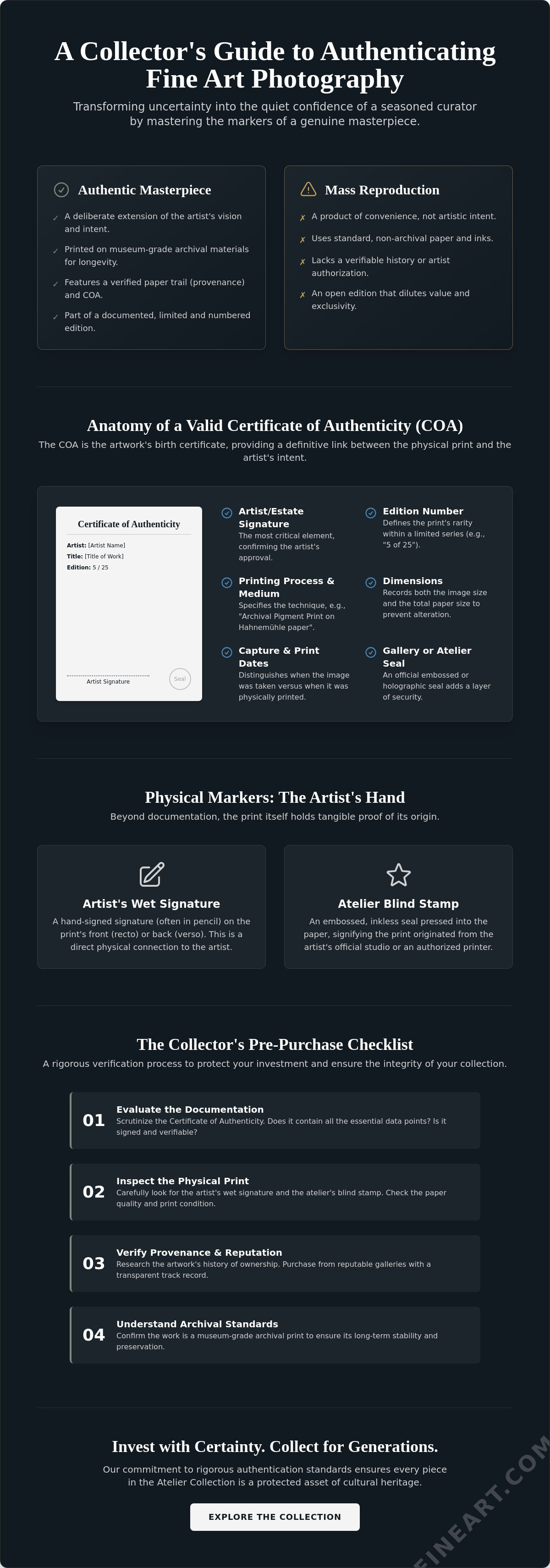
The Certificate of Authenticity (COA) functions as the essential birth certificate of a photographic work. It provides a definitive link between the physical object and the artist's original intent. Understanding how to authenticate fine art photography begins with a rigorous examination of this document. It isn't merely a receipt; it is a formal testament to the work's legitimacy. A valid COA must contain specific, non-negotiable data points that define the print's identity within the artist's broader body of work. Without these details, the document fails to provide the necessary security for a high-value acquisition.
The presence of the artist's or an authorized estate's signature is the document's most critical element. This signature represents a final seal of approval, confirming that the print meets the creator's exacting standards. For many collectors, the COA is as valuable as the work itself. It ensures that the piece can be identified and valued decades after the initial purchase. When evaluating a new acquisition, following established guidelines for collectors helps ensure that every piece of documentation aligns with international gallery standards.
Essential Information Every COA Must Include
A professional certificate must explicitly state the printing process used. Whether it's a traditional silver gelatin print or a modern museum-grade Archival Pigment Print, the medium dictates the work's longevity and texture. The document should also record the image dimensions and the total paper size. These measurements prevent unauthorized trimming or resizing, which can drastically alter the artist's composition. It's also vital to distinguish between the capture date and the print date. A print created years after the original exposure may carry different market implications than a vintage print made closer to the moment of capture.
Security Features and Registry Systems
Modern authentication has moved beyond simple signatures. Sophisticated galleries now utilize matching security holograms or unique serial numbers on both the print and the certificate. Some institutions have even begun adopting DNA tagging, which can cost approximately $150 per work, to create an unforgeable physical link. As of early 2026, roughly 9% of online art platforms have integrated blockchain technology for digital registry. These systems allow for third-party verification that is independent of the physical document. A COA printed on standard, lightweight printer paper is a significant red flag. Professional certificates are typically produced on heavy, acid-free stock to mirror the archival quality of the artwork itself. You can find these high standards reflected in the documentation provided with every piece in our Atelier Collection.
Physical Markers and the Artist’s Hand
The authenticity of a photographic work is etched into its physical fibers. While digital certificates provide a necessary paper trail, the tactile evidence on the print itself offers the most intimate proof of its origin. Learning how to authenticate fine art photography requires a keen eye for the subtle traces left by the artist and the printmaker. These markers aren't merely decorative. They're intentional signatures of quality that distinguish a museum-grade acquisition from a commercial reproduction. For the discerning collector, the weight of the paper and the depth of the ink are the first indicators of a work's true pedigree.
The presence of edition numbers, typically rendered as a fraction such as 2/25, serves as a transparent declaration of rarity. This numbering isn't just a record; it's a commitment to the collector that the artist's vision remains exclusive. Beyond the numbers, the physical edges of the work tell a story of production. A deckled edge, often found on heavy cotton rag papers, suggests a hand-torn process that respects the paper's grain. Conversely, a clean, straight edge indicates a precise, modern finish. These details, combined with the specific texture of Archival Pigment Prints, create a sensory profile that is nearly impossible for unauthorized parties to replicate with accuracy.
The Nuance of the Signature
A signature's placement carries significant weight in the world of curation. Modern curators often prefer a signature on the verso, or back, of the print. This allows the image to breathe without visual interruption. Traditionalists, however, may still favor a recto signature on the front, typically located in the lower margin. The medium used for the signature is equally vital. Artists use archival pencils or specific pigment-based pens to ensure the markings don't bleed or damage the paper fibers over time. The signature acts as the final seal of the artist's approval, transforming a physical object into a verified work of art.
Atelier Marks and Blind Stamps
The blind stamp is a quiet, embossed seal that carries immense prestige. It identifies the specific atelier or gallery where the work was curated and produced. These marks are often found in the corner of the paper, visible only when caught by a raking light. A blind stamp tells you that the print has passed through the hands of master technicians who adhere to the highest standards of the craft. In The Atelier Collection, these stamps serve as a guarantee of technical mastery. Verifying the limited nature of Limited Edition Prints through these physical numbering conventions and atelier marks ensures that the collection's integrity remains unassailable. These tactile layers of security provide the peace of mind that a digital file alone can never offer.
The Collector’s Checklist: Pre-Purchase Verification
A structured approach is the collector's greatest asset. When the moment of acquisition arrives, technical knowledge must translate into a methodical sequence of checks. Knowing how to authenticate fine art photography is a matter of discipline rather than intuition. This checklist ensures that every acquisition meets the standards of a museum-grade collection. It serves as a filter, removing the risk of unauthorized reprints or overlooked forgeries before the transaction is finalized.
- Step 1: Verify the Gallery’s standing. Research their history and direct relationship with the artist or estate. An authorized representative will have deep knowledge of the artist's printing history and editioning habits.
- Step 2: Inspect the print in person. Catch the light to reveal the atelier's blind stamp. Confirm the texture of the paper fibers and the precision of the ink application.
- Step 3: Audit the documentation. Ensure the COA contains the security features, holographic seals, and serial numbers that link it directly to the physical print.
- Step 4: Demand the provenance. A clear ownership history is essential for establishing the work's legitimacy and long-term resale value.
- Step 5: Confirm the substrate. Ask for the specific manufacturer of the acid-free paper and the lightfastness rating of the pigments used in the production.
Auditing the Provenance and Pedigree
A robust provenance report traces a work back to its original gallery debut or exhibition. This lineage is the backbone of an artwork's market value. Collectors should look for a chain of custody supported by original invoices, exhibition catalogs, and gallery labels. While minor gaps in older works are common, contemporary Limited Edition Prints should have a seamless record. For works valued at over $5,000, the IRS requires a qualified appraisal for charitable purposes, highlighting the importance of a verified paper trail. The proposed Art Market Integrity Act of 2025 further underscores the need for transparency in transactions exceeding $10,000, making rigorous documentation a legal necessity as much as an artistic one.
Verifying Archival Integrity
Authenticity also concerns the physical endurance of the work. You should ask specific questions about the longevity of the pigments and the PH-neutrality of the paper. Museum-grade handling requires that the print has never been touched by bare hands or exposed to non-archival adhesives during the framing process. Professional galleries will confirm that their works meet rigorous standards for permanence. Establishing a personal archive for your Archival Pigment Prints is the final step in responsible stewardship. For those seeking works with verified pedigree and technical perfection, you can explore our curated collections at Ilkaa’s Fine Art Gallery.
Elevating Standards at Ilkaa’s Fine Art Gallery & Atelier
The physical experience of art begins with trust. At Ilkaa’s Fine Art Gallery & Atelier, we translate the complex requirements of how to authenticate fine art photography into a seamless, transparent journey for the collector. Located within the quiet elegance of the historic Joseph-Cherrington House in Columbus, our gallery serves as a sanctuary for those who value technical mastery and artistic legacy. We believe that the acquisition of a photograph should be as intentional as its creation. Every piece in our care undergoes a rigorous verification process, ensuring that the bridge between the artist’s vision and your collection remains unassailable.
Our commitment to excellence is reflected in our exclusive focus on museum-grade Archival Pigment Prints. These works are not mere reproductions; they are carefully curated extensions of the artist’s hand, produced under the watchful eye of technicians who respect the medium’s heritage. We invite local Columbus collectors to experience these works firsthand through a private viewing. In the intimate setting of our atelier, the texture of the paper and the depth of the pigments can be fully appreciated. This personal connection to the work provides a level of certainty that digital browsing simply cannot replicate.
The Ilkaa’s Fine Art Guarantee
Peace of mind is the ultimate luxury for a collector. Every work we place is accompanied by a comprehensive, signed COA that serves as its permanent record. We act as guardians of the photographers we represent, ensuring that every Limited Edition Print is accounted for and every provenance trail is unbroken. This commitment to transparency protects the long-term value of your acquisition. Acquiring work from a dedicated fine art atelier means you are participating in a tradition of high-level craftsmanship and artistic integrity.
Advisory Services for the Discerning Collector
Building a collection is a slow, deliberate evolution. Our advisory services are designed to help you shape this path, focusing on the creation of investment-grade portfolios that stand the test of time. We provide expert consulting on the precise placement and long-term preservation of high-value photographic works, ensuring your collection retains its vibrancy for generations. Understanding how to authenticate fine art photography is only the first step. Proper stewardship is what defines a true collector. To begin your journey with confidence, explore our curated Atelier Collection of authenticated works.
Preserving the Integrity of Your Collection
A collection is more than a display; it's a curated legacy of artistic intent. By mastering how to authenticate fine art photography, you ensure that every acquisition reflects the true standards of the artist's hand. You now understand that a valid Certificate of Authenticity and the presence of tactile markers, such as atelier blind stamps, are non-negotiable requirements for any serious investment. These layers of verification protect the archival life and the future resale value of your works. They transform a simple purchase into the stewardship of a cultural asset.
At Ilkaa’s Fine Art Gallery & Atelier, we uphold these rigorous standards within the quiet walls of the historic Joseph-Cherrington House. Curated by Ilkaa Amalia and Millie Franz, our gallery specializes in museum-grade, authenticated limited editions that honor the physical medium of film. We invite you to Discover Investment-Grade Photography at Our Columbus Gallery. Here, you'll find the peace of mind that comes with a transparent, expertly managed acquisition. Build your portfolio with the quiet confidence that every piece is a verified masterpiece.
Frequently Asked Questions
What is the difference between a signature on the front and on the back?
A signature on the front, or recto, follows a traditional aesthetic that makes the artist's mark visible within the frame. Modern curators often prefer a signature on the back, or verso, to allow the image's composition to exist without visual interruption. Verso signatures frequently include additional technical data such as the specific paper type or the date the print was made.
Can a Certificate of Authenticity be issued for a digital-only photograph?
A Certificate of Authenticity can be issued for digital assets to define ownership and usage rights. In the sphere of fine art, however, the certificate is almost always tethered to a physical object like an archival pigment print. This ensures that the digital file is transformed into a restricted, tangible work of art with a documented edition size.
What should I do if my artwork’s COA is lost or damaged?
Contact the gallery where the work was purchased or the artist’s foundation immediately. Many institutions maintain meticulous archives and can issue a replacement document if you provide proof of purchase and the print's edition number. Maintaining a clear paper trail of your transaction is essential for this recovery process.
How do I know if a photographer’s signature is genuine?
Examine the signature under magnification to look for the fluid pressure and rhythmic variations of a hand-applied mark. A genuine signature will show slight indentations in the paper fibers that a printed facsimile lacks. Comparing the mark against verified examples in a catalogue raisonné or gallery archive provides the most reliable verification.
Is a receipt from a gallery considered a valid form of authentication?
A gallery receipt is a vital piece of provenance but it isn't a substitute for a formal COA. The receipt proves the financial transaction took place at a specific time and location. The COA serves a different purpose; it is the artist's personal guarantee that the work is an authorized part of their creative output.
Why is the edition number so important for the value of a print?
The edition number establishes the scarcity of the work by confirming exactly how many prints of that image exist. Scarcity is a primary driver of market value in the visual arts. A lower total edition size ensures that your piece remains part of an exclusive group, protecting its status as a limited edition print.
What is an Artist’s Proof (AP) and does it need a different COA?
Artist’s Proofs are prints created outside the regular numbered edition, traditionally reserved for the artist's personal use or archive. They often carry a higher level of prestige among collectors due to their proximity to the creator. They require a specific COA that clearly identifies the work as an AP to distinguish it from the standard series.
Can I authenticate a photograph myself if I bought it at an estate sale?
You can perform a preliminary audit by checking for blind stamps, paper watermarks, and signature styles. However, a definitive ruling on how to authenticate fine art photography found at an estate sale requires a professional appraisal or estate review. Formal authentication is necessary to establish the work's legitimacy for future resale or insurance purposes.
Disclaimer
Information is provided for general editorial and educational purposes. Artwork availability, pricing, dimensions, framing, edition details, exhibition information, and event schedules are subject to change. Please contact Ilkaa’s Fine Art Gallery & Atelier for the most current information.
© 2026 Ilkaa’s Fine Art Gallery & Atelier. Article text, gallery photographs, graphics, and other original gallery content may not be copied, reproduced, republished, distributed, modified, or used for commercial purposes without prior written permission. Copyright in individual artworks, artist photographs, and other third-party materials remains with the respective artists, photographers, estates, or rights holders. Brief quotations and links may be used with appropriate attribution where permitted by law.