
The true value of a photograph resides not in its price, but in the silence it commands within a room. You likely feel the pull of a specific image, yet hesitate at the threshold of a gallery, wary of fleeting trends or the complex language of editioning. It's common to seek a connection that is both deeply personal and technically sound. Learning how to buy your first piece of art is a journey from initial aesthetic attraction toward a disciplined understanding of craft and heritage.
This guide offers a path to approaching the art market with quiet confidence, ensuring your acquisition is both an emotional anchor and a sound, archival-grade asset. You'll discover how to move beyond the intimidation of formal spaces to find work that resonates with your personal narrative. We will define the essential criteria for selecting museum-quality pieces, from the nuances of the Atelier Collection to the technical standards of archival pigment prints, transforming a simple purchase into a lasting legacy.
Key Takeaways
- Transition from filling wall space to curating a personal narrative by selecting works that offer a meaningful, long-term dialogue.
- Understand the technical mastery of photography as a sophisticated entry point, favoring the precision of Archival Pigment Prints.
- Identify the role of museum-grade materials and limited editioning in ensuring your acquisition remains a sound, tangible asset.
- Learn how to buy your first piece of art with poise by navigating intimate gallery environments and the local art scene.
- Discover the value of curated guidance and exclusive selections, such as The Atelier Collection, to bridge the gap between artist and collector.
The First Acquisition: Shifting from Decorator to Collector
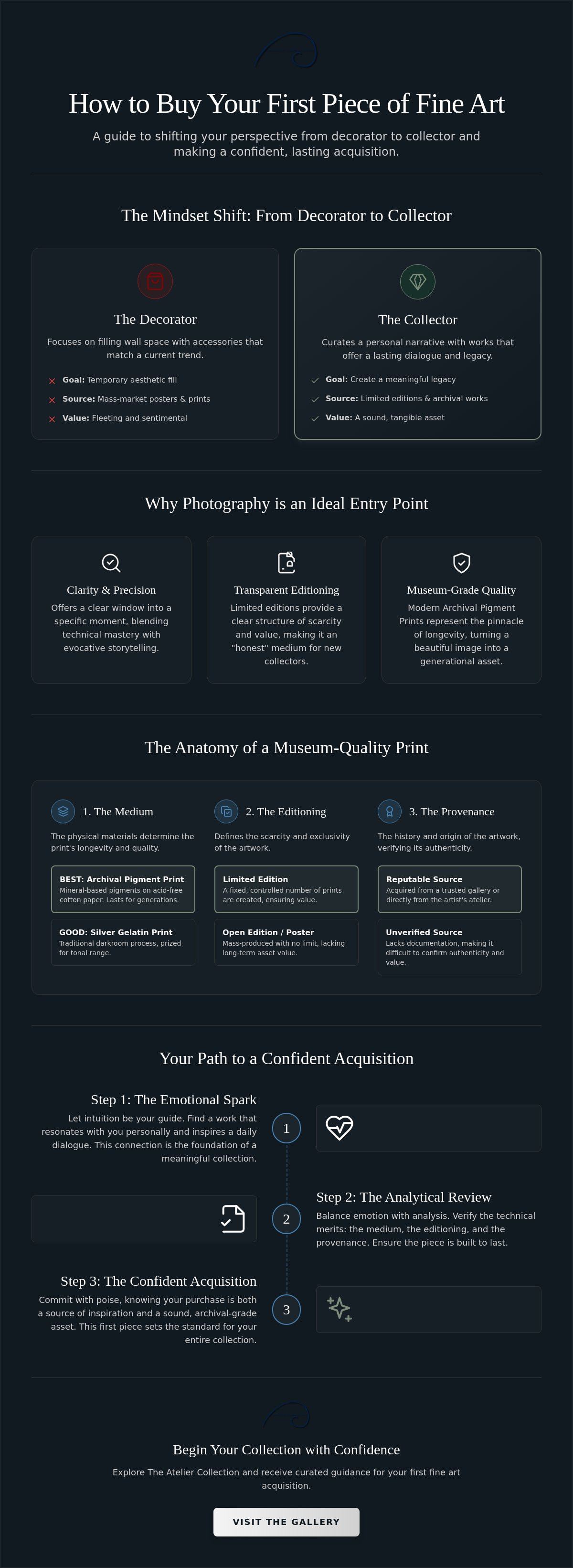
Decorating a room is often an exercise in filling space. Collecting, by contrast, is an act of curation. When you begin to explore how to buy your first piece of art, the focus shifts from the temporary to the permanent. You're no longer seeking a mere accessory; you're looking for a narrative that resonates. A mass-market print is a flat reproduction, often lacking the depth and longevity of a true fine art acquisition. Curated works, particularly Limited Edition Prints, offer a direct connection to the artist's hand and a commitment to archival standards that posters cannot replicate. This is the start of a lifelong dialogue between the viewer and the work.
Defining the "Collector Mindset"
Adopting a collector mindset means viewing art as a tangible asset. It's an investment in heritage. Throughout the history of art collecting, the most significant private holdings began with a single, intentional purchase. This process demands patience. It's about moving away from the disposable and toward the archival. Confidence in your taste isn't found in textbooks; it's built through the steady observation of light, shadow, and form in a gallery setting. You're not just a consumer; you're a steward of a creative legacy.
The Emotional vs. Analytical Purchase
The most enduring acquisitions sit at the intersection of intuition and technical merit. That first aesthetic spark is your guide. It ensures the work remains a source of daily inspiration. However, a collector must also be an analyst. You should weigh the emotional pull against the physical quality of the work. Consider these factors before committing:
- The Medium: Is the piece an Archival Pigment Print designed for longevity?
- The Editioning: Is the work part of a controlled limited edition, or a mass-produced open run?
- The Provenance: Does the work come from a reputable source like The Atelier Collection?
Balancing these factors prevents the acquisition of "trendy" art that loses its luster as fashions change. Real value is found in technical mastery and emotional truth.
Identifying recurring themes in the work you admire is the first step toward a cohesive collection. You might notice a preference for specific textures, historical subjects, or quiet, contemplative landscapes. Once your aesthetic is defined, establish a budget that respects the craft. While you're learning how to buy your first piece of art, remember that an investment-grade acquisition reflects the labor of the artist and the integrity of the materials. This first piece is a foundation. It sets the standard for every acquisition that follows.
Deciphering the Medium: Why Photography is the Ideal Entry Point
While the tradition of fine art often prioritizes oil on canvas, photography has ascended to a position of profound significance in the contemporary market. It offers a unique clarity for those discovering how to buy your first piece of art, bridging the gap between technical precision and evocative storytelling. Unlike more abstract media, a photographic print provides an atmospheric window into a specific moment, making it an ideal anchor for a residential setting where intimacy is paramount. The medium allows for a deep appreciation of light and texture, inviting a "slower looking" experience that is central to building a meaningful collection.
Understanding the physical medium is the first step toward informed acquisition. Collectors typically choose between two primary paths: traditional silver gelatin and modern pigment processes. Silver gelatin prints are rooted in the history of the darkroom, prized for their rich tonal range and the physical presence of silver in the paper. Archival Pigment Prints, however, represent the pinnacle of modern archival standards. These prints use mineral-based pigments on heavy, acid-free cotton rag papers, ensuring that the work retains its integrity for generations. This technical mastery is what transforms a simple image into a museum-grade asset.
The Appeal of Limited Edition Photography
Limited Edition Prints provide a structured balance between exclusivity and accessibility. For the emerging collector, photography is often the most "honest" medium; the editioning process is transparent, and the scarcity is clearly defined. This structure allows you to own a piece of significant artistic value without the prohibitive costs of unique paintings. The role of the atelier is vital here, as it serves as the guardian of these standards, ensuring that each print in the series meets the artist's original vision with absolute fidelity.
Evaluating Photographic Craft
To evaluate a piece properly, one must look beyond the subject matter to the artist's hand in the composition and lighting. The way light falls across a landscape or the deliberate choice of a paper's texture can define the entire mood of a room. A curated roster of photographers ensures a consistent level of quality, where every piece reflects a commitment to heritage and craft. If you are seeking a starting point, exploring a curated selection like The Atelier Collection can provide the necessary guidance to identify works of lasting merit.
Ultimately, photography allows the collector to participate in a historical narrative. Whether it is a large-format landscape or a quiet architectural study, the medium captures the passage of time with a poise that other forms rarely match. As you refine your search, focus on the tactile qualities of the print. The depth of the blacks, the crispness of the highlights, and the weight of the paper all contribute to the piece's enduring value as a tangible asset.
The Anatomy of Value: Archival Standards and Limited Editions
The distinction between a casual purchase and a true acquisition lies in the physical and economic structure of the work. Value is not merely a reflection of an artist's reputation; it is anchored in the tangible integrity of the object itself. Understanding the technical composition of a work is fundamental when learning how to buy your first piece of art. A collector must look past the image to verify the standards of production and the scarcity of the release, as these factors dictate whether a piece will endure as a lasting asset or fade as a temporary decoration.
Central to this evaluation is the concept of provenance. This is the documented history of the work, tracing its origin from the artist's studio to the gallery. For a new collector, the Certificate of Authenticity (COA) serves as the essential deed of ownership. This document should detail the medium, the edition number, and the artist's signature, providing a verifiable link to the work's heritage. Without this paperwork, the long term value of even the most striking image remains unanchored.
The Significance of Numbered Prints
Limited Edition Prints derive their value from controlled scarcity. When a work is numbered, such as 2/10, the artist has made a legal and professional commitment to never produce more than that specific quantity. This restriction protects your investment. You may also encounter "Artist Proofs," traditionally marked as AP. These are a small number of prints set aside for the artist's personal use, often carrying a premium due to their closer proximity to the creative process. Unlike open editions, which can be printed indefinitely, limited runs ensure that your acquisition remains rare and desirable within the market.
Museum-Grade Production Standards
The longevity of a collection depends entirely on the science of its materials. Archival Pigment Prints represent the gold standard of modern preservation. These works utilize mineral-based pigments that resist the ultraviolet degradation common in lesser inks. When paired with heavy, acid-free cotton rag papers, the result is a piece designed to last for a century or more without yellowing or loss of detail. The preservation process continues with archival framing. Using acid-free matting and UV-protective glass ensures that the environment surrounding the art is as stable as the pigments themselves. High standards in production are what transform a photograph into a museum-grade legacy.
As you refine your search, prioritize these technical merits. A piece that resonates emotionally while meeting rigorous archival standards offers the highest level of security for a new collector. By focusing on the intersection of scarcity and craft, you ensure that your first acquisition is a sound foundation for the future.
Navigating the Columbus Art Scene: Where to Begin Your Search
Columbus presents a diverse landscape for those discovering how to buy your first piece of art. While the Short North remains a primary destination, a more contemplative experience is found in the city's historic neighborhoods. Districts like Olde Towne East have seen a shift toward intimate, atelier-style spaces. These environments, often housed in historic residences, strip away the intimidation of the "white cube" gallery. They offer a quiet, domestic context that helps a new collector visualize how a piece will inhabit their own home.
The "Historic House" model encourages a slower pace. It fosters a dialogue between the viewer, the architecture, and the art itself. This is particularly relevant for photography, where the physical presence of the print demands a specific type of attention. By moving away from the crowded festival circuits, collectors can engage in the deliberate process of selection. This intentionality is central to learning how to buy your first piece of art with poise and confidence.
The Gallery vs. The Online Marketplace
Digital marketplaces provide breadth, but they sacrifice the essential tactile experience. The nuance of an Archival Pigment Print is lost on a backlit screen. Seeing the work in person allows you to appreciate the weight of the paper and the depth of the pigments. Physical galleries also provide a critical layer of authentication. A local gallerist offers professional insight into framing and archival preservation that a digital algorithm cannot provide. This relationship ensures your acquisition is protected from the moment of purchase.
Engaging with Columbus Curators
Curators in Columbus are becoming vital advisors for emerging collectors. Their role is to bridge the gap between the creator's intent and the collector's vision. When visiting a space, ask about the editioning process or the historical context of the work. This engagement transforms a simple transaction into a partnership. A knowledgeable curator helps you identify investment-grade works, ensuring your collection has a cohesive narrative. They can guide you through the technical merits of a piece, from the paper stock to the specific pigment used.
Approaching a gallery visit should be an exercise in observation. There is no requirement to purchase on your first visit. Instead, use the time to identify recurring themes in what you admire. When you're ready to take the next step in your journey, book a private appointment to experience a curated environment designed for quiet reflection and intentional collecting.
The Ilkaa’s Experience: Curated Guidance for the Emerging Collector
The transition from observer to collector requires more than just interest; it demands an environment that respects the gravity of the acquisition. At Ilkaa’s Fine Art, the philosophy is rooted in intentionality. We provide a space where the noise of the traditional market fades, replaced by a quiet, contemplative focus on the work itself. This curated environment is designed specifically for those discovering how to buy your first piece of art with a focus on longevity and artistic integrity. By acting as a bridge between internationally respected photographers and the local community, the gallery ensures that every piece serves as a meaningful addition to your personal narrative.
Our commitment to museum-grade production is absolute. Every work, from our standard Limited Edition Prints to the rare selections within The Atelier Collection, undergoes a rigorous authentication process. We prioritize the physical medium, ensuring that Archival Pigment Prints meet the highest standards of stability and tonal depth. This dedication to craft protects the collector’s investment, transforming a solitary purchase into a tangible asset that carries the weight of a traditional institution.
A Tailored Approach to First-Time Buying
Navigating the nuances of fine art photography can be complex. The gallery offers personalized art advisory services to simplify this journey for both private and corporate collectors. We provide guided tours of our space within the historic Joseph-Cherrington House in Columbus, allowing you to experience the work in a domestic, architectural context. This intimate setting is vital for understanding how to buy your first piece of art that harmonizes with your living environment. We help you decipher technical specifications, from paper weight to pigment stability, ensuring your choice is informed by both emotion and science.
The Legacy of the Atelier
The Atelier represents a sanctuary for high-level craftsmanship. By supporting a curated roster of established talent, the gallery maintains a standard of excellence that benefits the artist and the collector alike. Each piece is a testament to the enduring power of the photographic medium. We believe that the relationship between a collector and a gallery should be one of stewardship and shared appreciation for the artistic process. This partnership ensures that your collection is built on a foundation of quality, heritage, and technical mastery.
When you are ready to move beyond the digital screen and engage with the tactile reality of fine art, we invite you to experience our collection in person. Begin your collection with a private viewing at Ilkaa’s and discover the difference that intentional curation makes in the life of a collector.
Cultivating Your Legacy through Intentional Acquisition
The journey of a collector begins with a single, deliberate choice. You now understand that the difference between decoration and a true collection lies in the integrity of the medium and the scarcity of the edition. By prioritizing museum-grade materials and verified provenance, you ensure that your first acquisition remains a source of inspiration for decades. Knowing how to buy your first piece of art with poise allows you to navigate the market not as a casual consumer, but as a steward of artistic heritage.
Building a portfolio of meaningful work is a process of refinement and observation. At Ilkaa’s Fine Art, we specialize in museum-grade archival photography and offer professional art advisory to guide you through these early, critical decisions. Located in the historic Joseph-Cherrington House, our gallery provides an intimate environment for reflection and discovery. This setting allows you to experience the tactile depth of a print before it enters your private space.
Explore The Atelier Collection at Ilkaa’s Fine Art and find the piece that speaks to your personal narrative. Your collection is a living history; let its first chapter be one of timeless quality and technical mastery.
Frequently Asked Questions
Is photography a good investment for a first-time art buyer?
Photography is an excellent choice for those learning how to buy your first piece of art because it provides a clear framework for value. The medium's presence in the fine art market is supported by rigorous editioning and technical standards. Unlike unique paintings, Limited Edition Prints allow you to acquire works by established artists at a more accessible entry point while maintaining the exclusivity that drives long term asset growth.
What is the difference between a limited edition and an open edition print?
A limited edition print is part of a strictly controlled run where the artist commits to producing only a specific number of copies. This scarcity is a primary driver of value. In contrast, an open edition print can be reproduced indefinitely, often as a mass-market poster. For the serious collector, limited runs ensure that the work remains rare and its market value is protected over time.
How much should I expect to spend on my first piece of fine art?
The cost of an investment-grade piece depends on the artist's reputation, the rarity of the edition, and the complexity of the production process. While prices vary, a first-time collector should focus on the quality of the materials rather than seeking the lowest price. Investing in museum-grade works like those in The Atelier Collection ensures that the piece retains its physical and aesthetic value as the artist's career progresses.
How do I know if an art print is archival quality?
Archival quality is defined by the use of stable, mineral-based pigments and acid-free cotton rag papers. These materials are designed to resist fading and yellowing for a century or more. When you are researching how to buy your first piece of art, always verify that the work is an Archival Pigment Print. This technical standard is what distinguishes a fine art acquisition from a temporary, disposable reproduction.
What questions should I ask a gallery curator before buying?
You should ask about the specific printing process, the paper's archival rating, and the history of the artist's work. Inquire about the total edition size and whether any artist proofs exist outside the numbered series. Understanding the provenance and the technical merits of the work helps you make a confident decision. A transparent gallery will provide detailed information on the craft and the heritage of each piece.
Do I need an art advisor to buy my first piece of art?
While you don't strictly need an advisor, professional guidance can be invaluable for a first-time collector. An advisor or curator acts as a knowledgeable bridge, helping you navigate technical terms and identify works with lasting resonance. This relationship provides a level of security, ensuring that your first acquisition aligns with your long-term goals for both aesthetic enjoyment and asset preservation.
What is a Certificate of Authenticity and why is it important?
A Certificate of Authenticity is the essential document that verifies the work's origin and technical specifications. It acts as a deed of ownership, detailing the artist's signature, the edition number, and the medium used. This document is vital for the work's future valuation and provenance. Without this paperwork, the long-term marketability of a fine art print is significantly compromised.
How should I care for and display my first fine art photograph?
Proper care involves mounting the work with acid-free materials and using UV-protective glass to prevent light damage. You should display your photograph away from direct sunlight and areas with high humidity. Archival framing is a critical step in preserving the physical integrity of the print. By maintaining a stable environment, you don't just protect your purchase; you ensure that the work's texture and tonal depth remain unchanged for generations.
Disclaimer
Information is provided for general editorial and educational purposes. Artwork availability, pricing, dimensions, framing, edition details, exhibition information, and event schedules are subject to change. Please contact Ilkaa’s Fine Art Gallery & Atelier for the most current information.
© 2026 Ilkaa’s Fine Art Gallery & Atelier. Article text, gallery photographs, graphics, and other original gallery content may not be copied, reproduced, republished, distributed, modified, or used for commercial purposes without prior written permission. Copyright in individual artworks, artist photographs, and other third-party materials remains with the respective artists, photographers, estates, or rights holders. Brief quotations and links may be used with appropriate attribution where permitted by law.