
A photograph on a wall is often just a decorative window. A numbered, archival print held within a private collection is something else entirely; it's a legacy. Since the public opening of Ilkaa's Fine Art Gallery & Atelier in May 2026, the local conversation has shifted toward the permanence of the medium. Many collectors find themselves at a crossroads, unable to distinguish between the ephemeral nature of mass-market imagery and the enduring substance of investment grade photography in Columbus. It's a common concern to see a piece lose its physical luster or its market relevance because the technical markers of archival quality were overlooked.
You likely recognize the quiet power of a masterfully captured frame, yet you may feel the weight of uncertainty regarding provenance or the technical complexities of pigment prints. This guide provides the clarity needed to transition from casual buying to intentional curation. You'll learn to identify the markers of value that ensure every acquisition preserves its artistic integrity and financial potential. We will explore the necessity of limited editions, the importance of authentication, and the specific standards of The Atelier Collection that define museum-quality acquisitions.
Key Insights
- Distinguish between decorative imagery and tangible assets through the lens of restricted supply and archival integrity.
- Evaluate technical markers of permanence, specifically the necessity of archival pigment prints and acid-free, 100% cotton rag substrates.
- Learn the specific criteria for investment grade photography Columbus collectors prioritize, including limited edition numbering and archival provenance.
- Secure the future of your collection with a Certificate of Authenticity, the essential title deed for every archival acquisition.
- Align your portfolio with professional curation standards to ensure each work from The Atelier Collection reflects a cohesive legacy.
Defining Investment Grade Photography in the Columbus Market
The Columbus art scene is maturing. While traditional painting once dominated local collections, there's a visible shift toward photography as a serious alternative. Collectors now seek works that offer the same depth and permanence as a canvas. This evolution requires a precise understanding of investment grade photography in Columbus. It isn't merely about the image on the paper. It's about the substrate, the pigment, the edition number, and the hand of the artist. In this context, the term "investment" moves away from service fees and toward the acquisition of a tangible, appreciating asset.
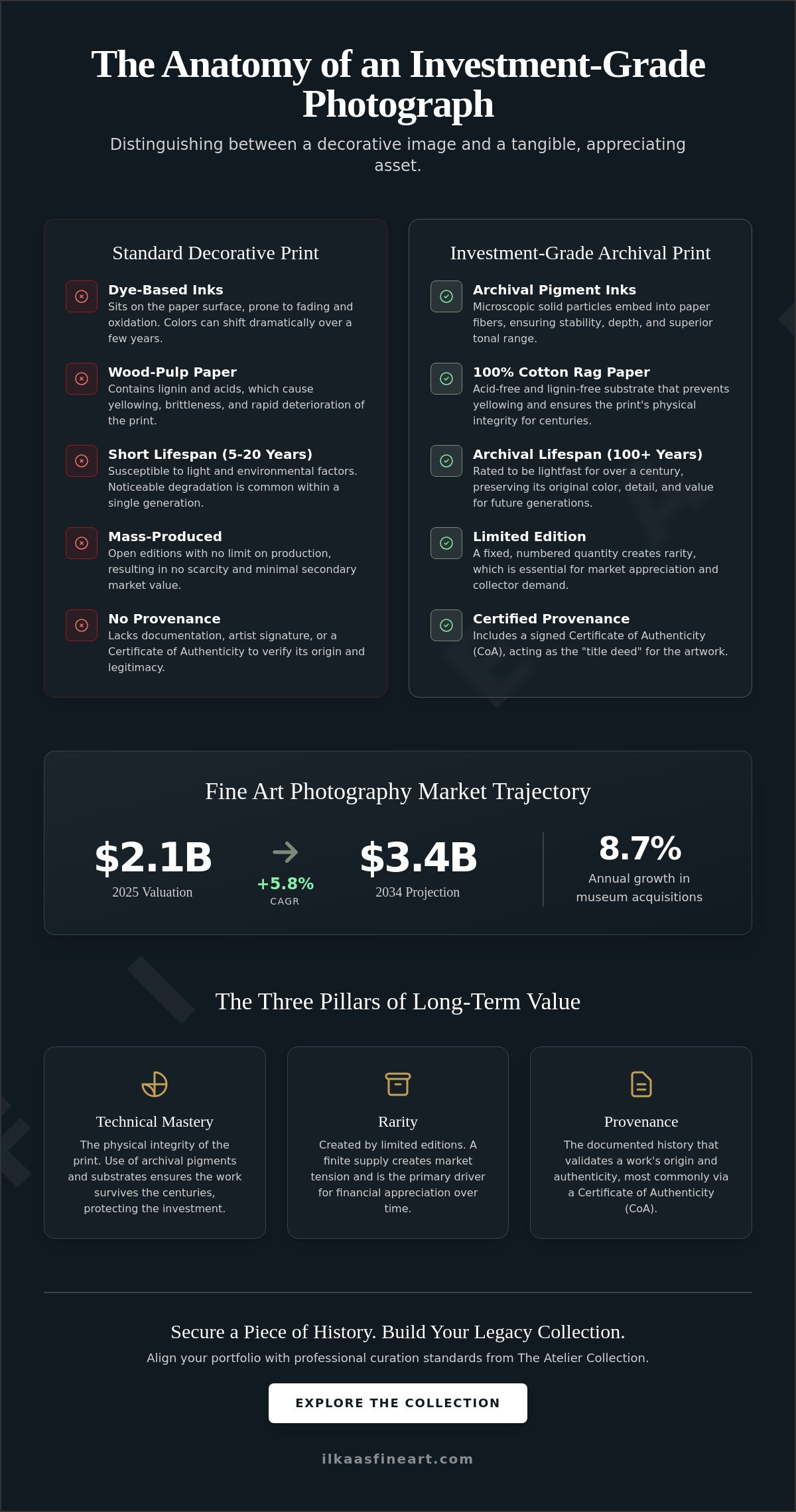
Value in this space rests on three pillars. Technical mastery ensures the work survives the centuries. Rarity creates the market tension necessary for appreciation. Provenance provides the documented history that validates the work's origin. Together, these elements elevate a print from a decorative object to a serious financial and artistic holding. One is a transaction for a photographer's time; the other is the purchase of a legacy.
The Asset Class: Why Photography Appreciates
The global photography art market reached a valuation of $2.1 billion in 2025. Projections suggest a rise to $3.4 billion by 2034, representing a compound annual growth rate of 5.8%. This growth reflects a broader institutional acceptance of the medium. As museum acquisitions of fine art photography grow at a rate of 8.7% annually, private collectors are following suit. Defining Fine Art Photography involves looking past the subject to the intent and the physical execution. Investment-grade photography is a limited-edition work backed by a certificate of authenticity and museum-grade production.
Beyond the Portrait: Art vs. Service
Local search results often conflate "investment" with package pricing for commercial services. A wedding gallery is a beautiful record, but it's rarely an asset designed for secondary market resale. True investment-grade work is vetted by a curator who understands the artist's trajectory and the print's historical context. These works, such as those found in The Atelier Collection, are produced as Archival Pigment Prints. They're intended to withstand the passage of time without fading or degradation.
In the Columbus market, from the historic brick of German Village to the light-filled lofts of the Short North, these pieces serve as anchors. They provide both aesthetic beauty and financial stability. Recognition of works with resale potential requires professional guidance. It's the difference between buying a trend and securing a piece of history. These aren't just photos. They're heritage held in light and shadow.
The Technical Markers of Value: Archival Standards and Longevity
Value is often invisible at first glance. It resides in the chemical bond between pigment and fiber. When acquiring investment grade photography in Columbus, the collector must look beyond the composition to the construction. The physical integrity of a print determines its ability to survive the centuries. Without a commitment to archival standards, a photograph is merely a temporary image; with them, it becomes a permanent asset. These technical markers aren't optional additions. They're the foundation of the medium's financial and historical worth.
Archival pigment prints, or Giclée, represent the pinnacle of photographic reproduction. Unlike standard dye-based inks that sit on the surface and remain susceptible to oxidation, pigment-based inks consist of microscopic solid particles. These particles embed within the paper's fibers, creating a work that's rated to remain light-fast for over 100 years. The substrate is equally critical. Museum-grade works utilize acid-free, 100% cotton rag papers. Standard wood-pulp papers contain lignin, a natural substance that causes yellowing and brittleness over time. According to the Archival Standards for Photographs, the total absence of these acids is non-negotiable for long-term survival.
Archival Pigment Prints vs. Standard Inkjets
Visual depth is the hallmark of a museum-grade process. Standard large-format prints often appear flat, lacking the tonal range and D-max-or maximum black density-found in professional output. A true pigment print offers a tactile quality, where shadows hold detail and highlights retain texture. This precision is essential for statement pieces that demand high-resolution clarity at significant scales. Discerning collectors often begin their journey by examining the tactile quality of Archival Pigment Prints in person to see these differences.
Protecting the Asset: Framing and Environment
The environment is a silent participant in an artwork's life. Columbus experiences significant seasonal shifts; dry winters and humid summers can stress the fibers of an improperly mounted print. Protecting the asset requires UV-protective glass to block harmful rays and acid-free matting to prevent chemical transfer. Archival integrity is the baseline requirement for any work intended to serve as a legacy asset. Without these protections, even the most masterful composition risks losing its luster. Proper stewardship ensures that the technical mastery of the artist remains visible for generations.
Rarity and Provenance: The Mechanics of the Limited Edition
Scarcity defines the transition from image to asset. In the context of investment grade photography Columbus, a limited edition is a deliberate constraint. It's an agreement that the artist will never produce more than the specified number of prints at a given size. This restriction transforms a beautiful photograph into a finite resource. It's the difference between a mass-market commodity and a curated asset. Without scarcity, value cannot be sustained.
Provenance is the lifeblood of art collecting. It's the documented lineage of a work's ownership. A clear history of possession solidifies value and ensures the piece's legitimacy in the secondary market. For the serious collector, this documentation is as vital as the print itself. It's the story of the work's journey from the artist's atelier to your collection. This record protects you from the risk of buying prints that lose value due to a lack of verifiable history.
The Certificate of Authenticity (COA) acts as the title deed to the artwork. This document serves as the physical link between the artist's intention and the collector's acquisition. A standard COA typically includes:
- The edition number and total print run.
- The artist’s signature and the date of production.
- Technical specifications of the archival pigment print.
- A unique identifier or holographic seal for verification.
Artist Proofs, or APs, occupy an even more rarefied space. These are prints produced outside the main edition, often kept for the artist’s personal archive. They carry a unique status and often a premium value due to their closer proximity to the creator's hand.
Limited Edition vs. Open Edition: A Value Comparison
Open editions are intended for mass consumption. They're "decor." Limited editions are "fine art." Owning one of only 10 or 25 prints in existence creates a specific psychological and financial position. This rarity influences the initial acquisition price and provides the necessary tension for future appreciation. In a market where digital images are infinitely reproducible, the physical, numbered print remains the only version with tangible value.
The Signature and the Number: Verifying Authenticity
Traditional numbering, such as 1/25, remains the gold standard. The signature acts as the artist's final seal of approval. Collectors of investment grade photography Columbus understand that a signature is more than a name; it's a guarantee of rarity. While physical signatures are classic, digital verification is becoming standard for authenticated prints. At Ilkaa’s Fine Art Gallery & Atelier, the verification process is rigorous. Every piece in the Atelier Collection is vetted to ensure its place within the global art market. This commitment protects the collector and the integrity of the work.
Building a Collection in Columbus: Curation and Placement
Curation is an act of translation. It requires an understanding of how light, space, and subject matter interact within a specific environment. For those acquiring investment grade photography in Columbus, the city's architectural diversity offers both a challenge and an opportunity. A collection isn't merely a series of individual purchases; it's a dialogue between the art and the walls it inhabits. Whether grounding a modern loft or honoring a historic estate, the placement of a work is as intentional as the shutter's release.
From the weathered textures of German Village brick to the expansive, industrial volumes of Short North lofts, the architectural context of Columbus informs every decision. The Joseph-Cherrington House, home to Ilkaa’s Fine Art Gallery & Atelier, serves as a masterclass in this integration. It demonstrates how contemporary, archival works can resonate within a historic framework without compromising the integrity of either. Collectors seeking to build a cohesive portfolio often utilize expert curation services to navigate these aesthetic complexities.
Placement Strategies for Statement Art
Scale is the primary consideration in open floor plans. A statement piece must possess enough visual weight to anchor a room. In contrast, the intimate rooms of a historic home allow for a closer, more contemplative engagement with texture and detail. Juxtaposition is a powerful tool; placing a sharp, contemporary pigment print within a traditional interior creates a compelling tension. Lighting serves as the final, essential element. Proper illumination reveals the atmospheric depth inherent in archival pigment prints, ensuring the work's nuances aren't lost to shadow.
The Role of the Art Advisor
The path from enthusiast to collector is rarely traveled alone. Ilkaa Amalia and Millie Franz bridge the gap between the creator's vision and the collector's goals. An art advisor helps define a thematic focus-whether it be architectural, abstract, or purely archival-ensuring the collection remains cohesive over time. This professional guidance is vital for selecting works from The Atelier Collection that align with long-term portfolio growth. A private gallery viewing remains the most effective way to assess the scale and tactile quality of a work before it enters your private space.
To begin defining your own aesthetic legacy, consider a private consultation at the Atelier to explore works that resonate with your environment.
The Atelier Experience at Ilkaa’s Fine Art Gallery
The journey of a collector often begins with a single, resonant encounter. At Ilkaa’s Fine Art Gallery & Atelier, located within the historic walls of the Joseph-Cherrington House, that encounter is designed to be intentional and immersive. This isn't a traditional retail space; it's an intimate environment where the physical medium of film and the precision of the archival print are given room to breathe. For those seeking investment grade photography in Columbus, the gallery serves as a bridge between the technical rigors of the darkroom and the refined aesthetic of the private collection.
Stepping into the atelier allows for a tactile engagement with the work that digital screens cannot replicate. Here, the nuances of shadow, the texture of the cotton rag paper, and the depth of the pigment are revealed under curated lighting. This physical presence is essential for understanding the value of an asset meant to endure. The transition from simply buying a print to starting a legacy begins with this shift in perspective, moving toward works that carry the weight of both artistic integrity and museum-grade production standards.
A Curated Roster of International Talent
Exclusivity is the hallmark of a serious collection. The gallery represents a meticulously vetted roster of internationally respected photographers, each chosen for their technical mastery and unique visual voice. These artists prioritize the physical craft of the medium, ensuring that each work in The Atelier Collection meets the highest standards of the global art market. Finding rare photography prints for sale in Columbus often requires looking beyond the mass-market options found in commercial districts. The historic house setting provides a contemplative backdrop for these works, allowing collectors to envision how a piece might transform their own private environment. It's a space where the history of the architecture meets the future of your collection.
Starting Your Investment Journey
Building a portfolio is a methodical process that benefits from professional stewardship. Whether you're a seasoned collector or just beginning to explore the medium, the gallery provides ongoing support regarding the care, placement, and maintenance of your acquisitions. Discerning individuals can Explore our authenticated Limited Edition prints through our online platform or schedule a private consultation for a more personal experience. This private viewing allows for a detailed discussion on provenance, rarity, and the specific archival markers that define your investment. By focusing on quality over volume, you ensure that every acquisition preserves its financial value and its place within your personal legacy. The atelier remains committed to guarding these high standards, acting as a sanctuary for those who value the enduring power of the photographic image.
Cultivating an Aesthetic Legacy
The transition from observer to collector requires a discerning eye for technical permanence and documented rarity. True value resides in the intersection of museum-grade archival pigment standards and the strict mechanics of the limited edition. By prioritizing works with verifiable provenance, you ensure that your acquisitions remain enduring assets. Building a portfolio of investment grade photography in Columbus is a deliberate act of preservation. It's a commitment to the artistic process and the physical medium itself. These choices define the difference between a temporary decoration and a lasting heritage.
Located within the historic Joseph-Cherrington House, our atelier provides a quiet space for this intentional curation. Every authenticated limited edition work we represent is vetted for its long-term integrity and its place within the global art market. We invite you to Request a Private Curation Consultation to explore how these atmospheric works can anchor your private or professional environment. Your journey toward a meaningful collection starts with a single, curated frame. It's time to secure a piece of history that resonates with your own.
Frequently Asked Questions
What makes a photograph 'investment grade' versus just a nice print?
Investment-grade photography is defined by archival permanence, limited rarity, and documented provenance. It's a tangible asset produced to museum standards. A standard decorative print is often a mass-produced object without a restricted supply or technical longevity. While a decorative piece might suit a room's palette, an investment-grade work preserves its artistic legacy and financial value through scarcity and technical excellence.
How do I know if a photographer's work will appreciate in value?
Appreciation is driven by institutional recognition and market scarcity. Focus on photographers represented in museum collections or those with a consistent history of gallery exhibitions. When acquiring investment grade photography in Columbus, prioritize artists whose limited edition runs are strictly managed. Technical mastery and a clear artistic trajectory are the most reliable indicators of a work's potential for future value growth.
What is the difference between a Giclee print and a standard inkjet print?
The distinction lies in the chemistry of the inks and the substrate's purity. Giclee, or archival pigment prints, utilize solid pigment particles that embed within 100% cotton rag paper. Standard inkjet prints often use dye-based inks on wood-pulp paper. These materials are susceptible to oxidation and yellowing. Archival pigments are rated to remain light-fast for over a century, ensuring the work's longevity.
Does Ilkaa’s Fine Art Gallery offer certificates of authenticity with every purchase?
Every acquisition from our gallery is accompanied by a formal Certificate of Authenticity. This document acts as the title deed for your artwork. It provides essential verification of the edition number, the artist's signature, and the specific production standards used. Holding a COA is vital for establishing a clear line of provenance, which is necessary for any future secondary market valuation or insurance purposes.
How should I display investment photography to prevent fading?
Preservation requires UV-protective glass and a stable environment. Never hang archival works in direct sunlight or areas with high humidity. Using acid-free matting and museum-grade framing materials protects the print from chemical degradation. These steps are essential for maintaining the atmospheric depth of the pigment. Proper stewardship ensures that the work's visual integrity remains unchanged for generations of collectors.
Why are limited editions so much more expensive than open editions?
Value is a function of scarcity. A limited edition represents a finite number of prints, creating the market tension required for appreciation. Open editions are produced without limit, which classifies them as decorative commodities rather than fine art assets. The investment in a limited work secures a piece of an artist's restricted output, backed by museum-grade production and a verified provenance.
Can I get help choosing a statement piece for my specific Columbus home architecture?
Professional curation services are available to help you navigate the relationship between art and architecture. Whether grounding a historic brick estate or an expansive modern loft, we help select works that resonate with your specific space. This advisory process ensures your investment grade photography in Columbus complements the architectural heritage of your home while fulfilling your goals as a serious collector.
What is the 'Atelier Collection' and how is it curated?
The Atelier Collection is a curated selection of works from internationally recognized photographers. Each piece is chosen for its technical mastery and unique artistic voice. Curation focuses on works that meet museum-grade archival standards and offer significant rarity. This collection provides an intimate gateway for collectors to acquire authenticated, limited-edition prints that represent the highest level of craftsmanship in the photographic medium.
Disclaimer
Information is provided for general editorial and educational purposes. Artwork availability, pricing, dimensions, framing, edition details, exhibition information, and event schedules are subject to change. Please contact Ilkaa’s Fine Art Gallery & Atelier for the most current information.
© 2026 Ilkaa’s Fine Art Gallery & Atelier. Article text, gallery photographs, graphics, and other original gallery content may not be copied, reproduced, republished, distributed, modified, or used for commercial purposes without prior written permission. Copyright in individual artworks, artist photographs, and other third-party materials remains with the respective artists, photographers, estates, or rights holders. Brief quotations and links may be used with appropriate attribution where permitted by law.