
Can a single image command the silence of an entire room? For the discerning collector, the allure of large format film photography lies in its ability to transcend simple documentation, offering a level of tonal depth and physical presence that digital alternatives rarely achieve. When searching for large format photography prints for sale, it's natural to feel a sense of hesitation. You may worry about archival longevity or struggle to translate technical film dimensions into a meaningful scale for your private collection.
We believe that acquiring art should be an intentional, unhurried process rooted in an appreciation for craft and heritage. This guide provides the clarity needed to evaluate museum-grade acquisitions, ensuring your chosen piece brings both aesthetic elevation and long-term value to your home. We'll explore the technical mastery behind the physical print, the importance of ISO standards for paper permanence, and practical strategies for visualizing these expansive works within a sophisticated residential environment. By understanding the intersection of historical technique and modern archival standards, you can build a collection that resonates with timeless elegance.
Key Takeaways
- Learn why large format photography, captured on 4x5 or 8x10 film, offers an unparalleled level of detail and a commanding physical presence that transforms a residential space.
- Understand the visual distinctions between medium and large format film to determine which level of clarity and depth best aligns with your personal aesthetic.
- Evaluate museum-grade production standards, such as Silver Gelatin and Archival Pigment Prints, to ensure the longevity and investment potential of your collection.
- Discover a curated selection of large format photography prints for sale featuring the technical mastery of artists like Mark Arbeit and rare works from historical archives.
- Experience the benefits of slow looking by visiting a Columbus art gallery, where the scale and texture of film photography can be appreciated in an intentional setting.
Defining the Authority of Large Format Photography Prints
To understand the gravitas of a truly expansive work, one must first define the medium at its source. Large Format Photography refers specifically to images captured on sheet film measuring 4x5 inches or larger. While modern digital sensors are remarkably capable, they often struggle to replicate the smooth tonal transitions and micro-contrast inherent in these massive negatives. A native large-format print possesses a physical authority that commands a room. It isn't just about size; it's about the density of information and the lack of digital artifacts.
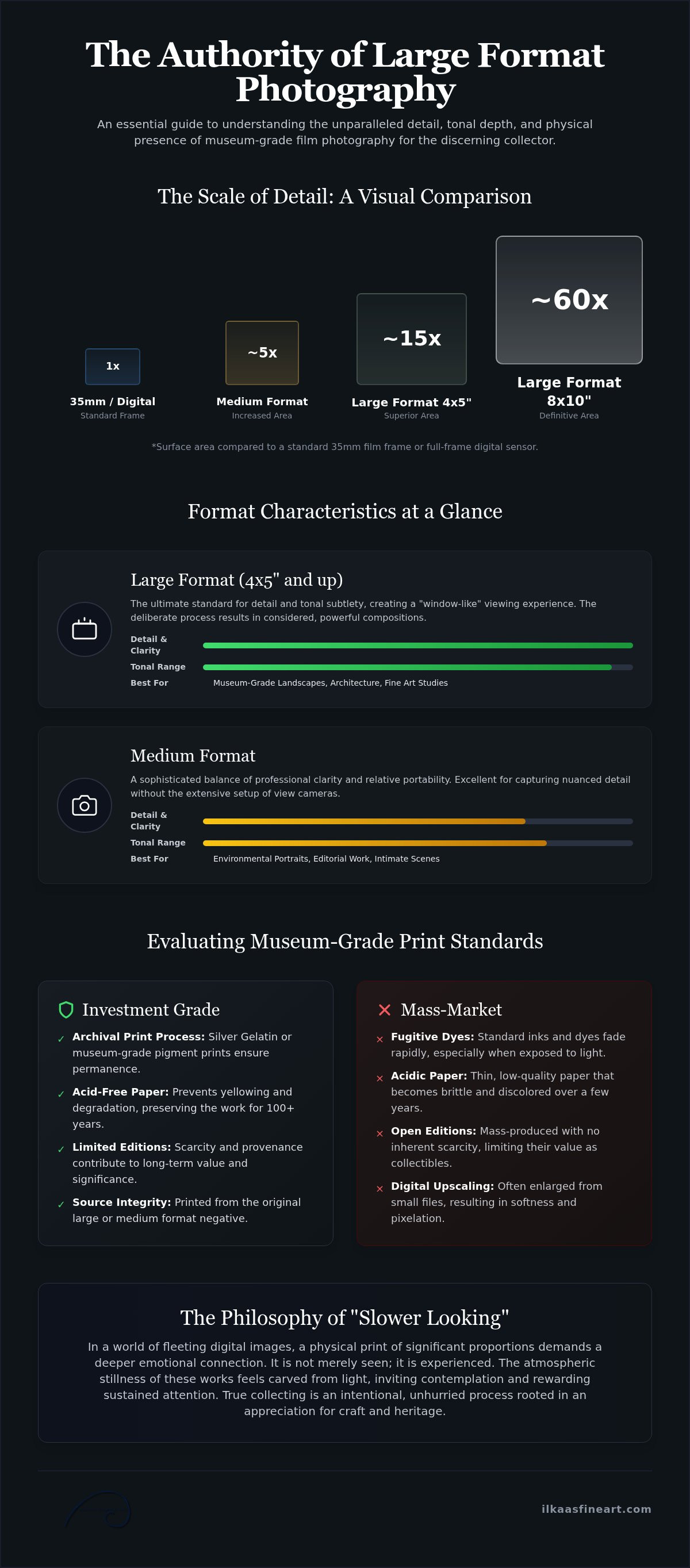
When viewing large format photography prints for sale, collectors often notice a "window-like" quality. This clarity stems from the fact that a 4x5 negative has roughly fifteen times the surface area of a standard 35mm frame. This allows for massive enlargements that retain sharpness and textural nuance, avoiding the pixelation or artificial smoothing found in digital upscaling. Serious collectors prioritize these works for their archival depth, often rendered through traditional silver gelatin or museum-grade archival pigment processes.
The Emotional Impact of Scale
Large-scale works naturally invite a philosophy of "slower looking." In a world of fleeting digital images, a physical print of significant proportions demands a deeper emotional connection. You don't just glance at these works; you inhabit them. The texture of the paper and the way light interacts with the physical silver or pigment create a tactile experience. For those interested in how different organic surfaces can influence this presentation, you can learn more about WoodSnap and their specialized printing on birch wood. These film-based works possess an atmospheric stillness that feels carved from light rather than constructed from data.
Investment Grade vs. Mass Market
True museum-caliber photography begins with the integrity of the source material. There is a profound distinction between mass-market open-edition posters and limited-edition fine art. The former often uses thin, acidic paper and fugitive dyes that fade within years. In contrast, investment-grade prints are built on a foundation of material craftsmanship and historical significance. At Ilkaa’s Fine Art Gallery & Atelier, we focus on the bridge between the creator and collector, ensuring every piece reflects a commitment to technical mastery and long-term archival stability.
Comparing Large and Medium Format Film: A Visual Distinction
Collectors often encounter a point of confusion between "large format" and "large scale." While any digital file can be printed at a significant size, the term large format refers specifically to the dimensions of the original film negative. Medium format photography typically utilizes 120 film, offering a sophisticated balance of portability and professional clarity. It's an excellent choice for environmental portraits where a sense of intimacy is required. However, large format film, particularly in 4x5 and 8x10 inch sheets, remains the definitive standard for museum-grade landscapes and architectural studies.
The source format essentially dictates the quality ceiling of the final work. Finding museum-grade large format photography prints for sale involves recognizing that the larger the negative, the less it must be enlarged to reach its final dimensions. This preserves micro-contrast and edge sharpness that smaller formats simply can't replicate. Beyond the technical output, the physical ritual of using a view camera forces a slower, more intentional composition. This deliberate pace often results in a final image that feels more considered and structurally sound.
The Technical Mastery of the Large Format Camera
The authority of a large format print is partially due to the specialized equipment used to capture it. Unlike standard cameras, large format view cameras utilize a flexible bellows system. This allows the photographer to employ tilt and shift movements to correct perspective or precisely control the plane of focus. An 8x10 inch film sheet holds nearly 60 times the information found on a standard full-frame digital sensor. This density ensures that a large format print remains breathtakingly clear even when viewed from just inches away, revealing textures in stone, foliage, or skin that digital sensors often smooth over.
Choosing the Right Format for Your Space
Selecting between formats depends on the intended atmosphere of your collection. Medium format works are often ideal for more intimate settings, such as a study or a private hallway, where detailed portraits or candid street scenes can be appreciated up close. For expansive living areas or entryways, large format prints provide the necessary presence to anchor the room. When Acquiring Large Format Art, consider how the scale of the subject matter interacts with the physical dimensions of the piece. You can explore more about these considerations in our guide on Investing in Fine Art Photography: A 2026 Collector’s Strategy. For those seeking a personal connection with the work, viewing these formats in person provides the best perspective on how they might inhabit your own environment.
Evaluating Museum-Grade Standards in Film Photography
The transition from a film negative to a physical print is where technical mastery becomes a tangible legacy. When vetting large format photography prints for sale, a collector must look beyond the image to the chemistry and substrate. Museum-grade standards are defined by two primary processes: the traditional Silver Gelatin print and the modern Archival Pigment print. Silver Gelatin remains the gold standard for black and white works, utilizing light-sensitive silver salts suspended in a gelatin layer on fiber-based paper. Archival Pigment prints, when executed with precision, offer a color gamut and stability that meet the most rigorous institutional requirements.
Provenance plays a critical role in the authority of a collection. Our "From the Archive" collection provides rare access to works with deep historical roots, including those linked to the Weston family legacy. Such pieces aren't merely decorations; they are artifacts of photographic history. Every acquisition must be accompanied by a Certificate of Authenticity (COA). This document is essential. It verifies the artist’s hand, the edition number, and the specific materials used. Without this, a print lacks the institutional validation required for serious investment.
Archival Quality and Longevity
Preserving the integrity of a large format work requires materials that resist the passage of time. True archival prints utilize 100% cotton rag or alpha-cellulose papers that meet ISO 9706 standards for permanence. These materials are naturally acid-free and lignin-free, preventing the yellowing and brittleness common in mass-produced alternatives. Modern benchmarks, such as ISO 18937-3:2026, ensure that pigments remain stable even under contemporary LED lighting systems. For a deeper analysis of these technical standards, consult our guide on Archival Pigment Prints for Sale: The Collector’s Guide.
The Value of the Limited Edition
Exclusivity is the cornerstone of art as an investment. A limited edition print ensures that only a specific number of copies, often as few as 10 or 25, will ever exist. This scarcity protects the market value over time. Within these editions, you may encounter "Artist Proofs" (AP). These are typically the first prints used to finalize the artist's vision and often hold a higher tier of desirability for collectors. Ilkaa’s Fine Art Gallery & Atelier intentionally restricts edition sizes to maintain the distinction of the work and the integrity of your collection.
Highlights from the Film Photography Collection
The current 9-piece Film Photography collection represents a meticulous distillation of the medium's potential. Each work has been selected for its ability to anchor a space through technical precision and emotional resonance. When browsing large format photography prints for sale, the distinction lies in the artist’s relationship with the physical film. Mark Arbeit, for instance, demonstrates a technical mastery that transforms the photographic surface into something nearly sculptural. His works don't merely show a subject; they reveal the intricate interplay of light and form that only large-format negatives can resolve.
The legacy of the medium is further anchored by Kim Weston. As a steward of the Weston family archive, his contributions carry the weight of photographic history, bridging the gap between classical traditions and contemporary expression. You can explore these rare works within our Kim Weston photography collection, where the archival depth ensures every piece serves as a significant addition to a private collection.
Standout Works and Artists
Our roster includes photographers whose works have graced the pages of National Geographic, Vogue, and Vanity Fair. Artists like Roman Loranc and Cristina Mittermeier utilize the expansive canvas of large format to capture the extraordinary nuances of the natural world. Loranc’s landscapes, often characterized by a haunting atmospheric quality, benefit from the tonal range inherent in traditional silver processes. Mittermeier’s work brings a profound sense of presence and purpose, inviting the viewer to linger on details that would be lost in smaller, faster formats. These aren't just images; they're invitations to a more observant way of seeing.
Browsing the Atelier Online
Navigating our curated selection is designed to be an intentional experience, mirroring the atmosphere of our physical space. Millie Franz, our resident photographer, brings an expert perspective to the collection, focusing on the quiet, intentional moments that film capture rewards. Whether you're a seasoned collector or acquiring your first museum-grade work, our online atelier allows for a measured exploration of these rare pieces. Selected works are available for secure delivery or can be arranged for local pickup at our Columbus location. This flexibility ensures that the transition from our archive to your collection is as seamless as the art itself.
Browse the Film Photography Collection
Acquiring Large Format Art in Columbus: The Gallery Experience
Viewing large format photography prints for sale online is a necessary starting point, but the true authority of these works is best understood through physical presence. In Columbus, the historic Joseph-Cherrington House at 785 East Broad Street serves as a dedicated environment for intentional, unhurried observation. Private gallery appointments allow collectors to experience the physical scale and tonal depth of film without the distractions of a traditional commercial space. This setting is particularly valuable when evaluating how a piece might anchor a room or command a specific architectural focal point.
Integrating large format prints into modern office or residential interiors requires a nuanced understanding of light and volume. For collectors in Bexley, Upper Arlington, or New Albany, seeing the work in a space that mirrors the proportions of a home provides essential context. The gallery’s architecture, renovated specifically for optimal art viewing, helps visitors visualize how a museum-grade piece will inhabit their own private sphere. Our advisory services focus on this relationship between the work and its environment, ensuring that the final placement honors both the artist’s vision and the collector’s aesthetic.
Personalized Curation and Advisory
Curator Ilkaa Amalia provides personalized advisory services to assist collectors in building cohesive portfolios that reflect a deep appreciation for craft. This process often includes selecting the appropriate frame and determining the ideal placement to protect the work's archival integrity. Our "art-for-all" philosophy ensures that every visitor feels welcome to explore fine art photography, regardless of their prior knowledge or the size of their existing collection. We act as a bridge between the creator and the collector, making the acquisition process personal, approachable, and deeply informed.
Visit the Atelier in Olde Towne East
We invite the community to join us for our public opening and anniversary celebration on May 16, 2026. Located in the heart of Olde Towne East, the gallery offers an intimate environment that encourages reflection rather than fast-paced consumption. For those visiting, convenient parking is available, making the transition from the city’s pace to our quiet exhibition space seamless. To ensure a focused experience, we recommend scheduling a time to Visit Ilkaa’s Fine Art Gallery & Atelier. This intentional approach allows the technical mastery of the medium to speak for itself, fostering a lasting connection with the art of film.
Cultivating a Legacy of Light and Form
Large format photography represents a commitment to the slower, more intentional aspects of the artistic process. By choosing works captured on expansive film sheets, you're acquiring a level of detail and presence that digital enlargements cannot match. Understanding museum-grade archival standards ensures that your investment remains stable for decades. Whether you're focused on the historical weight of the Weston family archive or the contemporary mastery of Mark Arbeit, each piece serves as a timeless anchor for your collection.
When evaluating large format photography prints for sale, remember that the physical medium is as vital as the image itself. Our historic Columbus gallery location provides the ideal setting to experience these works with the quiet focus they deserve. Each piece in our collection is curated by internationally respected experts to meet the highest standards of craftsmanship and heritage.
We invite you to visit our atelier to see how these works might inhabit your own space and inspire a deeper appreciation for the physical photograph. Building a meaningful collection is a personal journey, and we're here to guide you through every intentional step.
Frequently Asked Questions
What is the difference between large format film and large scale prints?
Large format film refers to the source medium, specifically 4x5 or 8x10 negatives, while large scale prints refers to the physical size of the final object. A large scale print can be made from any digital file, but a native large format film source provides superior detail and tonal depth. This distinction is crucial for collectors seeking high-fidelity large format photography prints for sale that maintain clarity even at expansive dimensions.
Are the large format prints at Ilkaa’s Fine Art limited edition?
Yes, our photography collection consists exclusively of limited edition works. We intentionally restrict quantities to maintain the market value and exclusivity of each piece. Edition sizes are typically small, ensuring that your acquisition remains a rare and significant addition to your collection. Every print is numbered and signed by the artist, reflecting our commitment to the integrity of the medium and the collector's long-term investment.
How do I know if a photography print is archival quality?
Archival quality is determined by the combination of acid-free, 100% cotton rag paper and stable, pigment-based inks or traditional silver gelatin chemistry. These materials must meet international standards such as ISO 9706 for paper permanence. Truly archival works resist yellowing and fading for 100 years or more under typical indoor conditions. We provide detailed specifications for every piece to ensure it meets museum-grade standards for longevity and preservation.
Can I view these large format prints in person in Columbus, Ohio?
We welcome visitors to view our collection at the historic Joseph-Cherrington House, located at 785 East Broad Street in Columbus. Experiencing the scale and texture of these works in person is the most effective way to appreciate their physical authority. While we officially open to the public on May 16, 2026, we encourage private appointments. This ensures an intimate and unhurried viewing environment tailored to your specific interests and aesthetic requirements.
What is included with a limited edition print purchase?
Every purchase includes a museum-grade print produced to archival standards and a formal Certificate of Authenticity. This document verifies the work's provenance, the edition number, and the specific technical processes used by the artist. Our certificates are essential for the long-term valuation and authentication of the piece. We also offer guidance on selecting appropriate framing materials to ensure the work is both protected and elegantly presented within your private collection.
Do you offer art advisory services for selecting large format pieces?
Ilkaa Amalia and our resident experts provide personalized art advisory services to help you build a cohesive and meaningful collection. We assist in evaluating the technical mastery of specific works and their suitability for your residential or office environment. Whether you're a seasoned enthusiast or a new collector, our goal is to make the acquisition of large format photography prints for sale a personal, approachable, and deeply informed experience.
How are large format photography prints shipped to ensure safety?
We utilize specialized, high-impact packaging and climate-controlled shipping methods to protect the delicate surface and archival integrity of each print. Large works are often shipped flat in reinforced crates or carefully rolled in wide-diameter tubes to prevent creasing or surface damage. Every shipment is fully insured and tracked from our Columbus atelier to your door. For local collectors, we offer secure pickup and professional installation recommendations to ensure the work is handled properly.
What is an Atelier collection in fine art photography?
An Atelier collection refers to a curated body of work produced or housed within a professional artist's studio or gallery workshop. At Ilkaa’s Fine Art Gallery & Atelier, this signifies a focus on the tactile, handcrafted aspects of the medium, encompassing photography, paintings, and works on paper. It represents a bridge between the creator's technical process and the final museum-grade object. Our collections emphasize material craftsmanship, historical significance, and the intentional environment where these works are preserved.
Disclaimer
Information is provided for general editorial and educational purposes. Artwork availability, pricing, dimensions, framing, edition details, exhibition information, and event schedules are subject to change. Please contact Ilkaa’s Fine Art Gallery & Atelier for the most current information.
© 2026 Ilkaa’s Fine Art Gallery & Atelier. Article text, gallery photographs, graphics, and other original gallery content may not be copied, reproduced, republished, distributed, modified, or used for commercial purposes without prior written permission. Copyright in individual artworks, artist photographs, and other third-party materials remains with the respective artists, photographers, estates, or rights holders. Brief quotations and links may be used with appropriate attribution where permitted by law.