
A corporate environment shouldn't feel like a temporary arrangement. It should serve as a physical manifestation of a firm's legacy and technical mastery. Many professionals find that generic decor eventually feels dated or lacks the gravitas required for a high-stakes setting. If you've noticed the gap between commercial printing and true fine art, you're ready for a more intentional approach. Selecting large scale photography for Columbus office spaces involves more than filling a void; it's about establishing an atmosphere of quiet confidence and artistic integrity.
You'll learn how to navigate the transition from mass-market imagery to museum-grade, investment-grade art. We understand the worry that comes with image pixelation at scale and the confusion between standard commercial prints and archival pigment prints. This guide provides a clear path toward a prestigious environment that reflects the sophisticated growth of the Central Ohio business community. We'll explore the technical standards of The Atelier Collection and the seamless process of local curation. By the end, you'll understand how to secure pieces that honor the tactile heritage of photography while meeting the demands of modern architecture.
Key Takeaways
- Identify the specific technical requirements for large scale photography for Columbus office environments to ensure visual clarity in expansive professional spaces.
- Distinguish between mass-market reproductions and Limited Edition Prints to build a collection with enduring investment value and artistic prestige.
- Apply the 60/40 rule for wall-to-art ratios to harmonize museum-grade photography with your existing office architecture and furniture.
- Understand the significance of Archival Pigment Prints in preserving the technical mastery and longevity of your corporate art assets.
- Discover the benefits of professional art advisory in bridging the gap between artistic legacy and your firm's unique cultural identity.
The Impact of Large Scale Photography in Columbus Corporate Spaces
Large scale photography for Columbus office environments is defined by more than physical dimensions. When a piece exceeds 40x60 inches, it enters a space where technical precision becomes the primary concern. Achieving clarity at this scale requires a foundation in understanding large format photography, where detail and tonal range are preserved during magnification. These aren't merely decorations. They are structural anchors for a professional room. A piece of this magnitude demands a high level of technical mastery to ensure that the image remains crisp and evocative even when viewed from a distance of just a few feet.
Generic office decor often fails because it lacks a cohesive narrative. It feels "cheap" or "dated" when it's chosen without intention. Shifting toward narrative-driven photographic works allows a firm to communicate its values silently. A single, museum-grade image suggests a commitment to excellence. It shows a respect for the artistic process that mass-produced posters simply can't replicate. This intentionality transforms a workspace into a curated environment where every visual element serves a purpose. It moves the conversation away from simple decoration and toward the establishment of a firm's cultural legacy.
Visual Authority and First Impressions
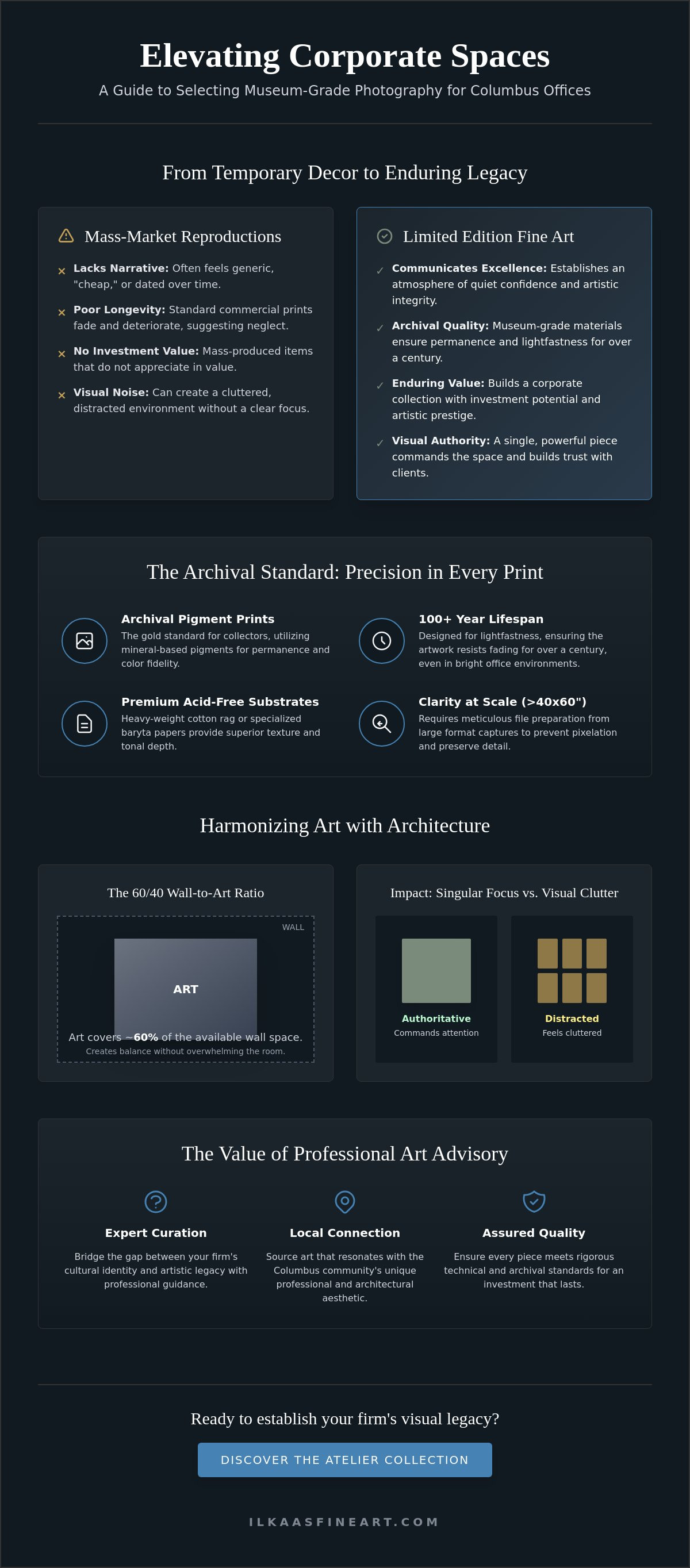
First impressions in a boardroom or reception area are vital. A singular, large-format statement piece communicates stability and a sophisticated vision. While a gallery wall of smaller prints can feel cluttered or distracted, a solitary large work commands the space. It invites quiet contemplation. This visual authority builds trust with clients. It signals that the firm values quality and possesses the confidence to make bold, singular choices. The scale of the work mirrors the scale of the firm's ambitions, creating a psychological environment of prestige and professional integrity.
Columbus Business Aesthetics: From Downtown to the Short North
Columbus has a distinct architectural landscape. It ranges from the historic brick of the Short North to the glass facades of Downtown. Selecting large scale photography for Columbus office interiors requires an eye for these local nuances. Modern spaces often benefit from the clean lines of minimalist compositions. Traditional offices might favor works that evoke texture, light, and heritage. Sourcing from a local Columbus fine art gallery ensures the imagery resonates with the community's professional aesthetic. It creates a bridge between the workspace and the city's cultural identity, fostering an environment where employees feel inspired by their surroundings.
Technical Standards for Large-Format Archival Prints
Precision is the quiet foundation of any significant art collection. For large scale photography for Columbus office spaces, the technical requirements shift from simple aesthetics to rigorous archival standards. When an image is expanded to sixty inches or more, every nuance of the original capture is exposed. This scale demands a level of file preparation that prevents pixelation and preserves the atmospheric depth of the work. It's not enough for a piece to be large; it must maintain its integrity under close inspection.
Archival Pigment Prints represent the gold standard for collectors, utilizing mineral-based pigments and acid-free substrates to ensure a lifespan exceeding a century. Unlike standard commercial prints, these works are designed for permanence and lightfastness. This technical excellence directly supports research on art boosting productivity, as a pristine and high-fidelity environment fosters a sense of professional pride and well-being. A fading or deteriorating image suggests neglect, while an archival print reflects a commitment to quality.
Museum-Grade Materials and Longevity
True archival quality is defined by the 100-year standard for pigment-based inks. This longevity is achieved through the use of premium substrates, such as heavy-weight cotton rag or specialized baryta papers. Cotton rag offers a soft, matte texture ideal for natural landscapes. Baryta, with its subtle sheen, provides the deep blacks and high contrast necessary for architectural studies. In high-light office environments, UV-protective glazing is essential. It guards against fading while maintaining the clarity of the image. Archival pigment prints are the definitive choice for those seeking a permanent legacy within their corporate walls.
The Atelier Process: From Negative to Grand Scale
The transition from a negative or digital capture to a grand scale work requires the steady hand of a master printer. Within the atelier, the focus remains on edge-to-edge sharpness. This process involves careful interpolation and tonal adjustments to ensure the work retains its integrity at scale. The Atelier process ensures that large scale photography for Columbus office interiors meets the highest possible standards of clarity and depth. In black and white photography, the printer manages the delicate balance of silver tones. In color, the focus is on the accuracy of the palette and the texture of the light.
The result is a piece that feels both massive and intimate. Each work in The Atelier Collection reflects this commitment to technical perfection, acting as a bridge between historical craftsmanship and modern office design. Selecting the right substrate and scale ensures that your investment remains a centerpiece for decades.
Commercial Reproductions vs. Limited Edition Photography
Choosing art for a firm is a matter of fiscal and cultural responsibility. Many businesses settle for "Open Edition" posters, which are mass-produced reproductions lacking any inherent rarity. These pieces function as temporary decor rather than permanent assets. In contrast, Limited Edition Prints represent a finite collection of works, each numbered and authenticated by the artist. This distinction is critical when selecting large scale photography for Columbus office environments, as the choice reflects either a transient fix or a long-term investment in the company's prestige.
The psychological value of a restricted collection shouldn't be underestimated. Research from the Harvard Graduate School of Education on the impact of art in the workplace suggests that original works foster deeper emotional responses and social interaction among employees. Owning a piece that few others possess creates an atmosphere of exclusivity. It signals to clients that your firm values technical mastery and artistic legacy. Authenticated prints serve as tangible assets on a balance sheet, carrying a value that mass-market posters simply can't hold.
Understanding Limited Edition Tiers
Exclusivity is driven by the size of the edition. A print numbered 1/10 carries significantly more market weight than one from a run of 500. Lower edition numbers often command higher prestige among serious collectors and legacy firms. Every piece in a restricted run should be accompanied by a Certificate of Authenticity (COA). This document is vital for business insurance and future appraisals. It provides the necessary provenance to prove the work's origin and its place within the artist’s archive.
Comparing Value Over Time
Commercial prints are a depreciating expense. They lose their physical and financial value as soon as they're hung. Fine art photography, however, functions as an asset. Investment-grade prints from The Atelier Collection are the preferred choice for firms that view their office as a reflection of their enduring success. Sourcing through a local Columbus gallery adds a layer of regional provenance, connecting the firm to the local creative economy. This approach ensures that the art on your walls grows in cultural significance alongside your business.
Selecting and Placing Large Art in Your Office Layout
Placement is a spatial dialogue between architecture and art. When integrating large scale photography for Columbus office interiors, the relationship between the work and the surrounding wall is paramount. A common guiding principle for curated spaces is the 60/40 rule. This suggests that the artwork should occupy approximately 60 percent of the available wall width, leaving enough negative space to allow the piece to breathe. Overwhelming a wall creates visual clutter. Conversely, a piece that is too small feels incidental. The goal is a sense of intentionality and structural balance.
Harmonizing the work with existing furniture requires a focus on chromatic harmony. A monochromatic landscape might anchor a room with dark walnut desks, while vibrant architectural studies can energize a minimalist, glass-heavy floor plan. Lighting must be handled with extreme care. Large-scale glazing is prone to glare, which can obscure the technical depth of the print. Utilizing anti-reflective museum glass or specialized acrylic ensures the image remains the focus, regardless of the angle of the sun or overhead fixtures. These technical choices preserve the integrity of the work throughout the day.
Logistics present a unique challenge for oversized works, particularly in the high-rise buildings of Downtown Columbus. Freight elevator dimensions and hallway clearances must be verified before the printing process begins. Professional installation teams ensure that these pieces are secured with specialized hardware, maintaining safety and precision in a busy corporate environment. This level of preparation ensures that the final installation feels as permanent and stable as the building itself.
Curating for Specific Office Zones
Boardrooms benefit from singular "power pieces" that command attention and foster a sense of authority. In common areas, large-scale landscapes help reduce stress, drawing on the principles of biophilic design to create a more restorative atmosphere. For the executive suite, pieces from The Atelier Collection offer a more personal reflection of taste and artistic appreciation. Each zone requires a different narrative weight to achieve the desired psychological impact on both clients and employees.
Framing and Presentation for the Modern Office
The choice of framing defines the final presentation. A shadowbox frame adds a sense of three-dimensional depth, while a floating mount provides a clean, minimalist edge for contemporary spaces. These choices should align with the building's architectural style, whether it's a historic renovation or a modern glass tower. Local Columbus installation standards often require security hardware to ensure the work remains level and safe. You can consult with our curators on custom framing to ensure your large scale photography for Columbus office environments is presented with the prestige it deserves.
Art Advisory: Partnering with a Columbus Fine Art Gallery
Building a corporate collection requires a partner who understands the distinction between simple wall coverage and true curation. While many local businesses offer basic printing services, they often lack the art-historical perspective necessary to build a legacy. Professional art advisory serves as a bridge between the creator’s technical mastery and the collector’s professional environment. For those seeking large scale photography for Columbus office spaces, this partnership ensures that every piece aligns with the firm's prestige and long-term investment goals. A curator doesn't just fill a space; they define it.
Ilkaa's Fine Art Gallery & Atelier operates as a private atelier, providing a level of intimacy that commercial agencies cannot replicate. The process often begins at the historic Joseph-Cherrington House, where the quiet, scholarly atmosphere allows the work to be viewed with the reverence it deserves. This setting provides the necessary context to appreciate the subtle textures and tonal ranges of Archival Pigment Prints. Custom curation allows for the development of a cohesive portfolio that spans multiple floors, ensuring a consistent narrative from the reception area to the executive boardrooms.
The Ilkaa's Fine Art Experience
Clients gain exclusive access to rare archival collections and works by respected photographers who prioritize the physical medium of film. These personalized advisory sessions focus on your firm’s specific cultural goals rather than fleeting design trends. Within the intimacy of the Atelier, you can witness the craft behind the print, observing how light and chemistry translate into grand-scale art. This transparency is vital for a discerning audience that values technical integrity and artistic heritage. It's an invitation to participate in a tradition of excellence.
Next Steps for Your Columbus Office
The journey toward a prestigious office environment involves more than digital browsing. While our online archive serves as a useful introduction, the depth of a large-scale work must be experienced physically to be fully understood. Evaluating your space through an on-site consultation allows us to consider the specific lighting and architectural nuances of your building. This methodical approach ensures that the final selection of large scale photography for Columbus office interiors feels intentional and permanent. We invite you to move beyond generic decor and begin the process of intentional curation.
Cultivating a Lasting Professional Legacy
Transforming a corporate environment requires a shift from decorative filler to intentional curation. We've explored how technical mastery and museum-grade materials define the longevity of an archival print. By prioritizing authenticated works over mass-market reproductions, your firm secures a tangible asset that reflects its commitment to excellence. Investing in large scale photography for Columbus office environments is more than a design choice; it's a statement of stability and vision. The proper placement of these works ensures a spatial harmony that inspires both employees and clients.
Located in the historic Joseph-Cherrington House, our gallery provides the quiet atmosphere necessary for discerning these qualities. Curated by Ilkaa Amalia and photographer Millie Franz, Ilkaa's Fine Art Gallery & Atelier specializes in museum-grade, authenticated limited editions that honor the physical medium of film. We invite you to experience the tactile depth and atmospheric light of our works in person. Selecting art is a deliberate act of building a cultural heritage within your workspace. We're ready to help you define that legacy.
Frequently Asked Questions
What is considered "large scale" in fine art photography?
Fine art photography is generally defined as large scale when the dimensions exceed 40x60 inches. At this size, the work functions as a structural anchor within a room rather than a mere accent. These dimensions require specific technical mastery in both capture and printing to ensure the image maintains its presence without losing detail.
How do I know if a photograph will remain sharp when printed at 60 inches?
Sharpness is guaranteed through the use of high-resolution captures and the meticulous scaling process within the atelier. We utilize large format film or high-density digital files prepared specifically for grand dimensions. This technical foundation ensures that edge-to-edge clarity remains intact, even when viewed from a close distance in a professional setting.
What is the difference between a Giclee print and an Archival Pigment Print?
While the terms are often used interchangeably, Archival Pigment Prints utilize mineral-based pigments on acid-free, museum-grade substrates. This distinction is critical for long-term collections. Standard giclee prints may not always meet the 100-year archival standard required for investment-grade corporate art, whereas pigment prints are designed for permanent legacy.
How do I protect large-scale photography from fading in a bright office?
UV-protective museum glass or specialized acrylic glazing serves as the primary defense against fading. In sun-drenched environments, these materials filter out harmful light while significantly reducing glare. This preservation allows the work to maintain its original tonal depth and contrast for decades without any visible deterioration.
Does the gallery provide professional installation for large works in Columbus?
We coordinate with specialized local installers who understand the unique requirements for mounting oversized works. This ensures that large scale photography for Columbus office spaces is installed with security hardware and exact precision. Proper mounting is essential for safety and visual balance in high-traffic corporate corridors and boardrooms.
Why should a business invest in limited edition prints rather than open editions?
Limited edition prints offer market rarity and authenticated value that mass-produced open editions cannot provide. A restricted run ensures that your corporate art remains an exclusive asset rather than a common commodity. These numbered and signed works carry a provenance that supports the firm’s prestige and long-term financial interest.
Can I see the Atelier Collection in person before purchasing for my office?
Private viewings of the Atelier Collection are hosted at the historic Joseph-Cherrington House by appointment. Experiencing the physical prints allows you to appreciate the subtle textures and light that digital screens fail to replicate. This intimacy is a vital step in selecting the right large scale photography for Columbus office environments.
How does art advisory help my business save money in the long term?
Art advisory prevents costly mistakes by ensuring pieces are correctly scaled, framed, and archival from the beginning. By selecting investment-grade photography rather than depreciating decor, a business builds a collection with enduring market value. Professional guidance ensures the work integrates seamlessly with your architecture, eliminating the need for future replacements.
Disclaimer
Information is provided for general editorial and educational purposes. Artwork availability, pricing, dimensions, framing, edition details, exhibition information, and event schedules are subject to change. Please contact Ilkaa’s Fine Art Gallery & Atelier for the most current information.
© 2026 Ilkaa’s Fine Art Gallery & Atelier. Article text, gallery photographs, graphics, and other original gallery content may not be copied, reproduced, republished, distributed, modified, or used for commercial purposes without prior written permission. Copyright in individual artworks, artist photographs, and other third-party materials remains with the respective artists, photographers, estates, or rights holders. Brief quotations and links may be used with appropriate attribution where permitted by law.