
A photograph that fades is merely a ghost of an intended moment. For the discerning collector, the distinction between a fleeting image and a lasting legacy rests entirely upon the technical integrity of the medium. You likely understand the quiet anxiety of seeing a valued acquisition lose its depth or yellow at the edges. This often occurs when the label "professional" is treated as a marketing veneer rather than a commitment to archival excellence. Distinguishing true museum grade photography prints from standard commercial offerings requires an eye for detail and an understanding of the chemistry behind the craft.
This guide serves as a technical and curatorial roadmap for those who value permanence. You'll gain a clear perspective on the rigorous standards that define investment-grade art, from the composition of archival pigment prints to the structural purity of acid-free substrates. We'll explore the nuances of limited editions, the necessity of verifiable provenance, and the precise methods required to preserve the visual impact of your collection for a century or more. This exploration provides the knowledge necessary to build a collection with confidence, ensuring each piece remains a testament to high-level craftsmanship and artistic integrity.
Key Takeaways
- Distinguish between commercial professional labels and the verifiable material data required for true archival stability.
- Understand the chemical superiority of pigment-based inks and cotton rag substrates in creating museum grade photography prints that endure for a century.
- Learn how the architecture of limited editioning transforms a physical medium into a scarce, collectible asset with measurable provenance.
- Identify the environmental catalysts, such as UV exposure and humidity, that threaten the integrity of your collection and how to mitigate them.
- Explore the curatorial nuances of the Atelier Collection, where traditional craftsmanship meets the intimate oversight of a private studio.
Defining the Museum Grade Standard in Fine Art Photography
The distinction between an image that lives for a decade and one that endures for a century is found in the technical data. While many labs promise "professional" results, the term often lacks a specific technical threshold. Museum grade photography prints aren't defined by visual appeal alone; they're defined by measurable permanence. This standard represents a commitment to the preservation of light and shadow across generations. It's the difference between a decorative object and a legacy asset.
The Role of Permanence in Fine Art
Longevity is the cornerstone of any serious collection. In contemporary curation, the 100-year stability threshold is the benchmark for archival excellence. Achieving this requires a total rejection of acidic components. Lightfastness, the ability of a print to resist fading under illumination, is equally vital. The transition from traditional silver gelatin prints to modern archival pigment standards has refined this process. The Giclée printing process, when executed with pigment-based inks, provides a depth and durability that rivals historical darkroom methods.
Professional vs. Museum Grade: A Crucial Distinction
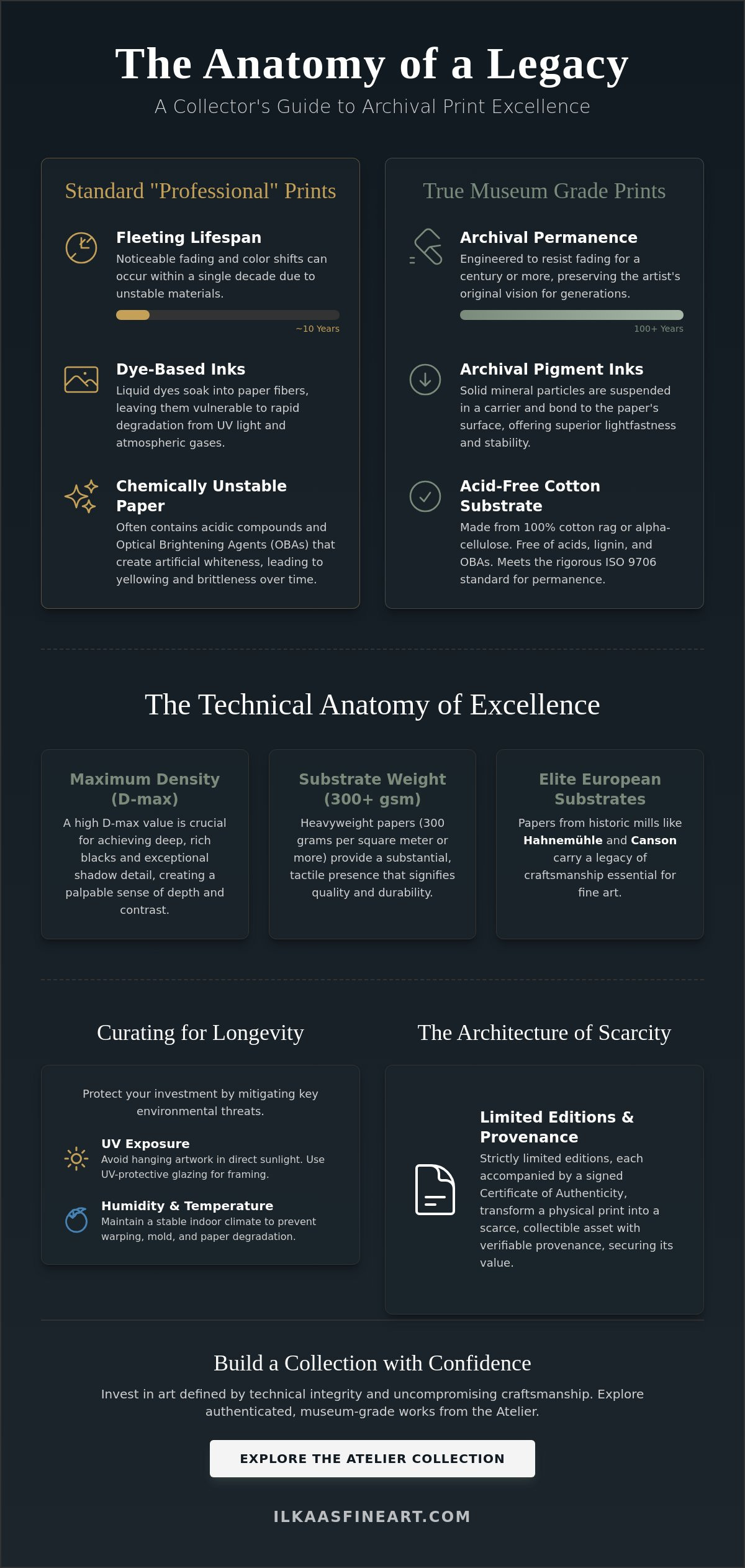
The label "professional" is frequently used in mass-market printing to describe high-resolution output. It doesn't, however, guarantee archival integrity. Many professional labs utilize substrates infused with Optical Brightening Agents (OBAs). These chemicals create an artificial brilliance that eventually decays, causing the paper to yellow and the highlights to lose their clarity. True museum grade photography prints utilize OBA-free, 100% cotton rag or alpha-cellulose papers. These materials are chemically stable and physically robust. Museum-grade prints are defined as those meeting ISO 9706 standards for permanence.
Within the atelier, technical execution and artistic vision become inseparable. Every choice, from ink density to the texture of the substrate, serves the goal of preservation. By adhering to these strict curatorial nuances, the artist protects the collector’s investment. It's a silent dialogue between the creator and the future; a promise that the work will remain as vibrant in fifty years as it is today. This intersection of chemistry and craft ensures that the artist’s original vision remains untarnished by the passage of time.
The Technical Anatomy of Archival Pigment Prints
The physical integrity of an archival work depends on the molecular stability of its components. Standard prints often rely on dye-based inks; these are essentially liquids that soak into fibers and remain susceptible to rapid oxidation. In contrast, museum grade photography prints utilize pigment inks composed of solid mineral particles suspended in a carrier fluid. These particles don't merely stain the paper. They rest upon the surface and within the top layers of the substrate, creating a physical bond that resists the degrading effects of light and atmosphere. This science ensures that the tonal range captured by the artist remains static for decades.
A critical metric in this process is the D-max, or maximum density. This value represents the deepest, richest black a specific ink and paper combination can achieve. In high-end curation, a high D-max is essential for maintaining shadow detail and providing the contrast necessary for a three-dimensional feel. When the ink droplets meet the paper fibers, the interaction must be precise. If the paper is too absorbent, the ink spreads and the image loses sharpness. If it's too resistant, the ink won't adhere properly. Achieving the perfect balance is a hallmark of the Archival Pigment Prints found in a dedicated atelier.
Elite Substrates: Hahnemühle and Canson
The choice of paper is as significant as the image itself. European mills like Hahnemühle and Canson have produced fine art papers for centuries, and their modern photographic substrates carry this heritage. For a print to be considered archival, it must be acid-free and lignin-free, typically composed of 100% cotton rag or high-grade alpha-cellulose. Texture and weight play vital roles here. A substrate with a weight of 300gsm or higher provides a tactile presence that lighter, consumer-grade papers lack. The "tooth" or surface texture of the paper must match the artist's vision, whether it's a smooth matte for minimalist landscapes or a textured rag for high-contrast architectural studies.
Pigment Ink Technology and Color Fidelity
Modern pigment technology has vastly expanded the available color gamut. Large-format printers used for fine art now utilize ten to twelve distinct ink colors, allowing for incredibly smooth tonal transitions. This is particularly noticeable in the subtle gradations of a sky or the delicate textures of skin. Because these pigments are derived from minerals, they possess an inherent resistance to UV degradation. As noted in this Christie's collecting guide, understanding these technical specifications is vital for anyone looking to acquire prints that will hold their value and aesthetic beauty on the secondary market. This technical rigor transforms a simple photograph into a permanent piece of history.
Limited Editions and the Architecture of Scarcity
Technical mastery provides the foundation for longevity, yet the market value of a photograph is often dictated by its rarity. While the material standards discussed previously ensure the physical survival of the work, the editioning process establishes its status as a collectible asset. Editioning is the deliberate restriction of supply, a curatorial choice that transforms a reproducible image into a finite object of value. For the serious collector, understanding the architecture of scarcity is as vital as recognizing the quality of the substrate.
The anatomy of a numbered print is straightforward yet significant. A notation such as 1/10 indicates the first print in a total run of ten. Once this limit is reached, no further Limited Edition Prints of that specific size and medium are produced. This finality is what separates investment-grade art from mass-market reproductions. Within this structure, one often finds Artist Proofs, or APs. These are traditionally reserved for the artist’s personal use or archival records; they usually represent an additional 10% of the total edition size and carry a unique prestige due to their intimate connection to the creator's process.
Establishing Provenance and Authenticity
A photograph without documentation is a liability. The Certificate of Authenticity (CoA) serves as the definitive record of a work’s origin and technical specifications. A museum-grade CoA should detail the artist’s name, the edition number, the exact materials used, and the date of production. It must bear the artist’s original signature or a verified gallery stamp to be considered valid. Maintaining these records is essential for future appraisal and resale, as they provide the verifiable history required by auction houses and serious institutions. Adhering to strict archival preservation standards for both the print and its documentation ensures the work’s integrity remains unquestioned by future curators.
Investment Grade Photography vs. Mass Market
Rarity is the primary driver of value on the secondary market. Mass-market posters are often produced as open editions, meaning an unlimited number can be printed until the market is saturated. These items possess decorative value but rarely appreciate. In contrast, authenticated museum grade photography prints follow a specific lifecycle. As an edition nears "sold out" status, the price typically increases to reflect the diminishing supply. This trajectory rewards early collectors and reinforces the work’s position as a stable asset. By selecting works with clear editioning and robust provenance, a collector moves beyond mere acquisition and into the realm of true stewardship.
Curating for Longevity: Selection and Placement
Acquisition is merely the beginning of a dialogue between the collector and the work. To curate with intentionality, one must evaluate a photograph through two distinct lenses: the evocative power of the composition and the technical integrity of the medium. A true masterpiece remains silent if its physical form begins to fail. Selecting museum grade photography prints requires a commitment to stewardship that extends far beyond the initial purchase. It involves understanding how a work interacts with its environment and ensuring its placement honors both the artist’s vision and the print’s longevity.
Environmental factors are the primary adversaries of archival stability. Light, while necessary for appreciation, is also a catalyst for decay. UV radiation can break down chemical bonds in pigments over time, leading to a loss of tonal depth. Temperature and humidity fluctuations are equally significant; they cause paper fibers to expand and contract, which may result in warping or cockling. Integrating fine art into a cohesive interior design requires a balance between aesthetic impact and protective positioning. Avoid placing valued works in direct sunlight or near unconditioned air sources to ensure the image remains as vibrant as the day it was pulled from the press.
Museum Standard Framing and Matting
Conservation framing is a technical necessity, not an optional embellishment. While standard professional mounting might suffice for temporary displays, it often utilizes acidic materials that eventually migrate into the print. True museum-standard framing requires 100% cotton rag mat boards, which provide a chemically neutral environment. UV-protective glazing, particularly museum glass, is essential for filtering out up to 99% of harmful rays while maintaining exceptional clarity. Mounting should always be reversible; techniques such as Japanese paper hinging allow the print to remain untouched by permanent adhesives, preserving its value for future generations.
Building a Photography Portfolio in Columbus
For those building a collection within the Ohio region, the process of sourcing rare works is often a collaborative effort. Leveraging local art advisory services allows collectors to navigate the nuances of provenance and editioning with confidence. Visiting a physical gallery remains a vital part of the experience, as the subtle texture of a 300gsm cotton rag cannot be fully appreciated through a screen. Ilkaa's Fine Art Gallery & Atelier provides bespoke curatorial advisory for Columbus-based collectors looking to refine their private acquisitions. This intimate approach ensures that every piece added to a portfolio meets the highest standards of craft and heritage. To begin your journey into investment-grade acquisitions, Explore the Atelier Collection and discover works defined by archival excellence.
The Atelier Experience: Authenticated Works at Ilkaa's Fine Art Gallery & Atelier
The journey of collecting concludes not with a mere transaction, but with a relationship rooted in stewardship. At Ilkaa's Fine Art Gallery & Atelier, the technical standards of museum grade photography prints find their sanctuary within a space that mirrors their complexity. Located in the historic Joseph-Cherrington House in Columbus, the gallery offers an environment where time feels suspended. Here, the physical presence of the work is paramount. It's a setting designed for quiet reflection, allowing the textures and tonal depths of archival pigment prints to reveal themselves under intentional light. The transition from a digital file to a physical object is a sacred process within these walls. Unlike automated labs that prioritize volume, our atelier focuses on the individual integrity of each work.
A Legacy of Craft in Columbus
The Joseph-Cherrington House serves as more than a backdrop; it's a testament to architectural heritage. This historic Columbus landmark provides a unique context for the appreciation of contemporary fine art. In an era of digital saturation, the physical gallery offers a necessary grounding for the senses. High-standard acquisitions within this space support a local art scene that values technical mastery over mass production. The dialogue between the historic architecture and the modern precision of the prints creates a bridge between past and present. It's an invitation to engage with the medium of film and the craft of the print in its most refined form. This local focus ensures that Columbus remains a hub for serious collectors who value the tactile nature of the medium.
The Ilkaa's Fine Art Gallery & Atelier Commitment
The curatorial oversight of Ilkaa Amalia and photographer Millie Franz ensures that every work meets a rigorous standard of excellence. The Atelier Collection represents the pinnacle of this effort, focusing on technical mastery and rare archives. Each piece is an Archival Pigment Print, produced on substrates that ensure a century of stability. Building a collection is a collaborative journey. It begins with a first viewing and extends through personalized advisory to the final installation in a private residence. We believe in an intentional approach to collecting, where provenance and preservation are never compromised. Every decision is deliberate; every material is vetted. This methodical pace ensures that the final work is not just a reproduction, but a significant artistic contribution to your home. To discover works that embody these standards, Explore our Atelier Collection for museum-grade works that honor the artistic legacy.
Securing an Artistic Legacy
The pursuit of excellence in collecting is a deliberate commitment to the preservation of vision. We have navigated the technical thresholds of pigment stability and the curatorial necessity of strict editioning that define the true value of a photograph. Authentic museum grade photography prints are not merely images; they are physical testaments to craft, requiring precise chemistry and curatorial rigor to survive the passage of time. By prioritizing archival excellence and authenticated provenance, you ensure your collection remains a lasting heritage rather than a fleeting acquisition.
The stewardship of fine art is a journey best undertaken with expert guidance in an environment that respects the medium’s heritage. At Ilkaa's Fine Art Gallery & Atelier, we provide the technical expertise and curatorial advisory necessary to build an intentional portfolio. Our authenticated Limited Editions are housed within the historic Joseph-Cherrington House, where each work is curated by internationally respected experts. This dedicated focus on permanence allows you to acquire with absolute confidence, knowing each piece is protected by the highest standards of the medium.
We invite you to Browse the Curated Collection at Ilkaa's Fine Art Gallery & Atelier to discover works that honor the legacy of classical photography. Begin your journey toward a collection defined by technical mastery and timeless elegance.
Frequently Asked Questions
What is the difference between an archival print and a Giclée print?
Giclée refers to a high-resolution inkjet printing process using pigment-based inks, while archival denotes a specific standard of chemical permanence. A print is only truly archival if it combines this pigment technology with acid-free, lignin-free substrates. While the terms are often used together, archival specifically describes the work's resistance to yellowing and decay over time. True museum grade photography prints must meet both criteria to ensure long-term stability.
How long will a museum-grade photography print last before fading?
A museum-grade print is expected to last 100 years or more under standard indoor display conditions without noticeable fading. This longevity is achieved through the molecular stability of mineral pigments and the purity of cotton rag papers. When kept in dark, climate-controlled storage, these works can maintain their integrity for over two centuries. Environmental stewardship remains vital; excessive UV exposure or high humidity can significantly shorten this archival window.
Are museum-grade prints a better investment than standard prints?
Investment-grade photography relies on the intersection of rarity and physical permanence. Standard prints are often mass-produced on unstable materials that degrade, eventually destroying their market value. Museum-grade works are typically released as limited editions with verifiable provenance, making them desirable to institutions and private collectors alike. Choosing archival quality ensures the work remains a tradable asset rather than a temporary decorative object that loses its clarity.
What specific paper brands are considered museum grade?
Hahnemühle and Canson Infinity are the preeminent mills recognized for producing museum-grade substrates. These brands offer 100% cotton rag and alpha-cellulose papers that are chemically neutral and physically robust. Other respected options include Arches and certain specialized lines from Epson. These papers are chosen because they lack optical brightening agents, which prevents the highlights of museum grade photography prints from yellowing as they age in a collection.
Do I need special glass for framing archival photography?
UV-protective glazing is a necessity for any fine art photograph intended for display. Museum glass or specialized acrylic filters out approximately 99% of ultraviolet radiation, which is the primary catalyst for pigment degradation. Standard glass provides negligible protection and can lead to rapid fading of delicate tonal transitions. It's also vital to use acid-free spacers or matting to ensure the print surface never makes direct contact with the glazing.
How can I verify if a print is truly limited edition?
Verification is established through a Certificate of Authenticity and the artist's physical signature on the work. The documentation must clearly state the edition number, the total number of prints produced, and the technical specifications of the medium. Serious galleries maintain meticulous ledgers to track these editions and prevent over-printing. A clear chain of provenance, supported by gallery records, is the only way to guarantee the work’s scarcity on the secondary market.
What is the best way to clean the surface of a fine art print?
The surface of a pigment-based print should never be touched with liquids, solvents, or cleaning cloths. The delicate layer of mineral particles is susceptible to smearing and abrasion if handled improperly. If dust settles on an unframed print, use a soft hake brush or a clean air blower to gently clear the surface. For framed works, clean the exterior glass with a microfiber cloth, taking care that no moisture reaches the frame's interior.
Does Ilkaa’s Fine Art Gallery offer shipping for museum-grade prints?
Ilkaa’s Fine Art Gallery provides bespoke shipping solutions tailored to the requirements of archival works. We utilize custom, moisture-resistant packaging and coordinate with professional art couriers to ensure every acquisition is protected during transit. Each shipment is fully insured and tracked to maintain the integrity of the work from our atelier to your residence. This white-glove service ensures that your investment arrives in the pristine condition required for a serious collection.
Disclaimer
Information is provided for general editorial and educational purposes. Artwork availability, pricing, dimensions, framing, edition details, exhibition information, and event schedules are subject to change. Please contact Ilkaa’s Fine Art Gallery & Atelier for the most current information.
© 2026 Ilkaa’s Fine Art Gallery & Atelier. Article text, gallery photographs, graphics, and other original gallery content may not be copied, reproduced, republished, distributed, modified, or used for commercial purposes without prior written permission. Copyright in individual artworks, artist photographs, and other third-party materials remains with the respective artists, photographers, estates, or rights holders. Brief quotations and links may be used with appropriate attribution where permitted by law.