
True rarity in a photograph isn't a marketing claim; it's a measurable standard of restricted production and archival integrity. For the discerning collector, the search for rare photography prints for sale often leads to a crowded marketplace where open editions masquerade as fine art. You recognize that a true piece of history requires more than a striking image. It demands a commitment to technical mastery and a documented provenance that ensures the work remains a stable pillar of your collection.
You deserve the confidence that comes from owning a piece of a defined artistic legacy. This guide will clarify the essential markers of value, from the chemistry of archival pigment prints to the strict boundaries of limited edition series. We'll examine how to source works through a refined curatorial lens, ensuring your acquisitions resist the passage of time. By understanding these subtle distinctions, you can move beyond the fear of overvaluation and begin building a cohesive portfolio rooted in high-level craftsmanship.
Key Takeaways
- Distinguish restricted physical production from open editions to ensure your collection maintains its exclusivity and artistic integrity.
- Evaluate the technical markers of archival pigment prints, focusing on the chemistry of museum-grade papers and light-fast inks.
- Navigate the landscape of rare photography prints for sale by prioritizing the expert curation of a private gallery over algorithmic marketplaces.
- View fine art photography as a tangible asset, utilizing professional art advisory to identify works with significant investment potential.
- Appreciate the impact of historical context and the curator's hand when acquiring legacy works from an established atelier.
Defining Rarity in Fine Art Photography
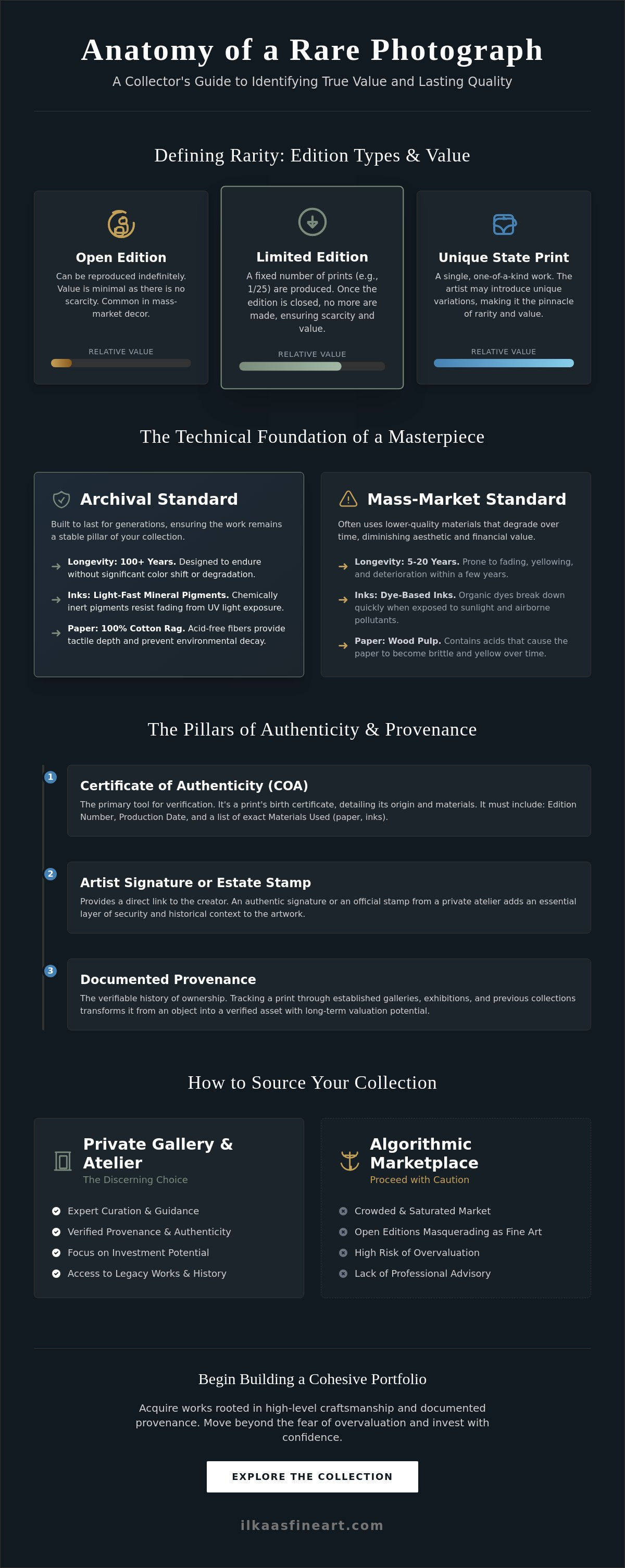
Rarity in fine art photography is defined by the intentional restriction of physical production. It isn't a byproduct of age alone. Instead, it's a deliberate choice made by the artist and curator to preserve the work's exclusivity. When browsing rare photography prints for sale, discerning collectors look past the image itself. They seek the structural boundaries that separate a museum-grade acquisition from a mass-market reproduction. Unlike open edition prints, which can be reproduced indefinitely, rare works exist within a finite ecosystem that prioritizes quality over volume.
The history of paper-based photography began with the first commercial process, which established the foundational relationship between chemistry and value. In the modern era, rarity is maintained through the strict adherence to edition sizes and the technical precision of the printing process. A curator acts as the guardian of this significance. They provide the necessary context to validate why a specific image holds a position of importance within an artistic legacy. Their expertise bridges the gap between a simple visual record and a piece of cultural history.
Limited Editions vs. Unique State Prints
The standard numbering system, such as 1/10 or 1/25, provides a transparent record of a print's scarcity. Once an edition is closed, no further prints are made at that scale or on that specific medium. This finite nature creates a natural premium in the secondary market. A unique state print represents the pinnacle of rarity. These are works where the artist has introduced specific variations, perhaps through darkroom chemistry or hand-applied textures, ensuring no two pieces are identical. Smaller editions command higher value because they represent a more intimate connection to the artist's original vision.
The Importance of Authenticated Art Prints
Provenance is the documented history of a work's life. A Certificate of Authenticity (COA) is the primary tool for this verification. It must detail the edition number, the exact materials used, and the date of production. Beyond the COA, the presence of an artist's signature or an estate stamp from a private atelier provides an essential layer of security. Tracking ownership through established galleries or exhibitions adds to the print's narrative weight. It transforms a physical object into a verified asset with long-term valuation potential. Authenticity isn't just about the signature; it's about the chain of custody that protects your investment.
The Technical Markers of a Rare Print
Technical mastery is the silent partner of rarity. While an image may be evocative, its permanence depends on the precision of the medium. The market for rare photography prints for sale is often saturated with terms like "giclee," a word that has become a catch-all for digital inkjet printing. True archival pigment prints exist on a different plane. They're the result of a deliberate marriage between light-fast mineral pigments and chemically stable substrates. Unlike dye-based inks that fade when exposed to UV light, mineral pigments are inert. This technical rigor ensures the work isn't a transient image but a physical object designed to endure for generations.
The physical presence of film-based works holds a specific gravity in a digital-first world. There's a tactile quality to a print that originated from a physical negative. It carries a sense of heritage and a connection to the chemical origins of the craft. When a work is produced with this level of intentionality, the technical execution becomes as rare as the subject matter itself. Every choice, from the specific weight of the paper to the temperature of the studio, contributes to the final value of the piece.
Archival Standards and Museum Quality
Museum-grade prints must meet exacting criteria to be considered investment-grade. Longevity is the primary metric. High-quality pigment prints are rated to last over 100 years without significant color shift or degradation when stored in proper conditions. This stability is achieved through the use of acid-free, 100% cotton rag papers. These fibers provide a tactile depth and structural integrity that wood-pulp alternatives can't match. By adhering to these standards, a collector protects their acquisition from the environmental decay that plagues mass-market posters. The investment potential of a photograph is inextricably linked to its physical survival.
The Atelier Process: From Negative to Wall
The creation of a rare print is a collaborative ritual between the artist and the master printer. In the digital age, the physical production process is a vital part of the artwork's story. It involves a series of refinements, proofs, and adjustments that can't be replicated by automated systems. This process is most refined within an atelier, where every variable from ink density to drying time is meticulously controlled. The atelier serves as a guardian of high standards and artistic integrity. Technical mastery in this environment increases rarity by limiting production to works that meet a curator's uncompromising eye. For those seeking rare photography prints for sale that embody this standard, the curated selections in The Atelier Collection offer a bridge to artistic excellence.
Sourcing Rare Prints: Marketplace vs. Gallery Atelier
Marketplace algorithms prioritize volume. They favor the accessible over the exceptional. For the serious collector, the search for rare photography prints for sale requires a departure from these digital corridors. High-value works rarely surface on mass-market platforms. They're held within the quiet confines of private gallery collections, protected by curators who understand the nuances of provenance and technical execution. This expert curation serves as a filter. It separates ephemeral trends from works of enduring significance. A curator’s hand provides the historical context. This context gives a print its weight and defines its place within a broader artistic narrative.
The distinction between discovery and acquisition is often blurred in online spaces. While a marketplace offers a broad view, it lacks the depth of a private atelier. True rarity is found where the production is slow and the standards are uncompromising. Choosing a gallery environment ensures that the work has been vetted for both its aesthetic merit and its physical longevity. It's the difference between buying an image and investing in a legacy.
The Pitfalls of Mass-Market Photography Sites
Big sites often use "limited edition" as a marketing label rather than a marker of scarcity. An edition of 500 or 1,000 prints might technically be limited, but it lacks the rarity required for long-term appreciation. These environments favor high-volume sales. This focus often dilutes the work's value through over-saturation in the marketplace. Transparency regarding printing standards is frequently absent on these platforms. Without a clear understanding of what to look for in terms of substrate acidity or pigment stability, a buyer risks acquiring a print that will degrade within a decade. The absence of a physical atelier means the connection between the creator and the final object is often severed by automated fulfillment centers.
The Gallery Advantage: Intimacy and Intentionality
A relationship with a dedicated curator offers access that no algorithm can provide. It's a partnership rooted in shared discernment and a mutual respect for the medium. Through these networks, collectors gain entry to "off-market" works and early releases that never reach the public eye. These private holdings often contain the most significant pieces of an artist's portfolio. A physical gallery space further refines this experience. It allows for a slow, contemplative engagement with the print's texture, scale, and light. This environment fosters a deeper understanding of the artist's intent. It builds the collector's eye, turning the act of buying into a process of discovery. The Atelier Collection embodies this philosophy of intentionality. It represents a curated selection of unique photographic works, each meeting the most stringent archival and artistic standards. By sourcing through an established atelier, you move beyond the transactional nature of the marketplace and into a world of genuine artistic legacy.
Building a Photography Collection with Investment Potential
Photography is a tangible asset. In a diversified portfolio, fine art photography offers a unique intersection of cultural significance and financial stability. The global art market grew by 4% year-over-year in 2025, reaching an estimated $59.6 billion. Within this landscape, the prints and multiples category achieved record growth, generating $526 million from nearly 200,000 lots sold. When evaluating rare photography prints for sale, the focus shifts from mere acquisition to the strategic assembly of a portfolio. A sophisticated collector understands that the most valuable rare photography prints for sale are those with documented exhibition histories and technical excellence.
A cohesive collection requires a narrative. It isn't enough to own disparate images; the works should speak to one another through shared themes, techniques, or historical periods. This deliberate curation transforms a group of objects into a legacy. It reflects a deep understanding of the medium's evolution and a commitment to preserving its highest standards. By focusing on works with institutional recognition, you ensure your collection remains relevant within the broader art world.
Art Advisory and Curation for Collectors
Professional art advisory serves as a bridge between aesthetic preference and long-term goals. An expert curator helps you identify works that align with your personal vision while maintaining investment-grade quality. This process involves a meticulous review of an artist's career trajectory and technical rigor. For corporate art placements, professional curation adds significant value by projecting a brand's commitment to culture and craftsmanship. Building a portfolio from scratch requires patience. It's a slow, methodical process of selecting works that will withstand market fluctuations and environmental passage.
Identifying "Blue Chip" vs. Emerging Photography
Market value is often signaled by institutional milestones. Museum acquisitions and representation by established galleries are primary indicators of an artist's rising status. In 2025, while the middle market remained cautious, the photography auction market saw average prices rise by 20% with sell-through rates reaching a decade high. These statistics highlight the resilience of high-end, authenticated works. Historical archives retain value because they provide an immutable link to the cultural and technical evolution of the medium. Emerging artists who favor "quiet, thought-provoking minimalism" are currently seeing increased interest from discerning collectors. To begin your journey with investment-grade works, explore the curated selections at Ilkaa’s Fine Art Gallery & Atelier.
Acquiring Rare Photography in Columbus, Ohio
The search for rare photography prints for sale often begins in the digital sphere but finds its true resolution in a physical space. In Columbus, the intersection of historic architecture and contemporary vision provides a unique environment for the discerning collector. The Joseph-Cherrington House serves as more than a mere backdrop; it's a historic setting that mirrors the heritage and permanence of the works it contains. Within these walls, the act of viewing becomes a contemplative ritual. It allows for a level of discernment that a screen cannot replicate, where the play of natural light reveals the subtle textures of an archival pigment print.
For those seeking rare photography prints for sale in the Midwest, Columbus offers a sophisticated sanctuary. Ilkaa’s Fine Art Gallery & Atelier acts as a local bridge to international art. By maintaining a presence in the heart of Ohio, the gallery offers collectors access to world-class photographic archives without the need for distant travel. This proximity fosters a more intimate relationship between the curator and the collector. Transactions in Columbus are subject to a combined sales tax rate of 8.00%, a standard consideration for those acquiring tangible personal property in Franklin County. This local expertise ensures that every acquisition is handled with professional precision and an understanding of regional standards.
The Columbus Art Scene and Photography
The local gallery scene in Columbus supports serious collectors through a network of specialized institutions. From the artist-owned spaces in the Short North Arts District to the academic rigor of the Schumacher Gallery at Capital University, the city maintains a deep reverence for the photographic medium. In early 2026, the Schumacher Gallery hosted significant exhibitions such as "Backstage Hollywood: The Photographs of Bob Willoughby," highlighting the city's commitment to historic archives. Visiting a historic house art gallery offers a unique experience where local heritage meets global artistic narratives. This setting encourages a slow, methodical engagement with the work. It builds a sense of continuity between the history of the city and the timeless nature of the limited edition prints on display.
Your Invitation to the Atelier
A private consultation offers the most refined way to explore the possibilities of your collection. These viewings are conducted with a sense of calm and order, allowing the subject matter to breathe. It's an opportunity to examine the technical mastery of the Atelier Collection in person, feeling the weight of the cotton rag substrates and observing the depth of the mineral pigments. To schedule a private viewing or to discuss a personalized acquisition strategy, we invite you to connect with our curatorial team. Take the first step toward owning a piece of artistic legacy and Experience the Atelier Collection.
Cultivating a Legacy of Visual Craft
Building a collection of fine art photography is an exercise in discernment. It's a journey that moves from the digital surface to the physical depth of archival pigment prints. You've seen that true value lies in the intersection of restricted production and technical mastery. By prioritizing museum-grade archival standards and documented provenance, you protect both the artistic integrity and the financial stability of your acquisitions. Rare photography prints for sale represent more than just images; they're tangible assets that anchor a diversified portfolio in history and craft.
The path to a cohesive collection is most clearly found through expert guidance. Within the historic Joseph-Cherrington House, every work is meticulously curated by Ilkaa Amalia and Millie Franz to ensure it meets the highest standards of the medium. This intentional environment offers a sanctuary for the serious collector, bridging the gap between historical archives and contemporary vision. We invite you to browse our curated selection of rare photographic works and begin your own pursuit of artistic excellence. Your collection is a reflection of your appreciation for the enduring power of light and time.
Frequently Asked Questions
What makes a photography print considered "rare"?
Rarity is defined by the intentional restriction of a work's physical production. A print is considered rare when it belongs to a strictly limited edition or exists as a unique state where individual variations make it one of a kind. Technical exclusivity, such as specialized darkroom processes or the use of historic papers, also contributes to a work's scarcity and long-term value.
How do limited edition prints differ from open editions?
Limited edition prints are produced in a finite, pre-determined quantity that is never exceeded. This restriction ensures the work maintains its value within the secondary market. Open editions can be reproduced indefinitely, often as mass-market posters, which lack the investment potential and archival integrity of a numbered series. True rarity requires a closed edition with a documented chain of custody.
Are archival pigment prints better than standard digital prints?
Archival pigment prints are superior in both longevity and depth because they utilize mineral-based pigments rather than standard dyes. These pigments are chemically inert and resist fading for over 100 years when paired with acid-free, 100% cotton rag substrates. Standard digital prints often rely on unstable chemistry that can shift or degrade within a single decade, compromising the artist's original vision.
How can I verify the authenticity of a rare photography print?
Verification requires a formal Certificate of Authenticity (COA) that details the edition number, materials used, and date of production. Collectors should also look for a physical signature from the artist or an estate stamp from a private atelier. When searching for rare photography prints for sale, a documented ownership history, or provenance, provides the ultimate assurance of a work's legitimacy.
Why should I work with an art advisor when buying photography?
An art advisor acts as a knowledgeable bridge between the collector and the complex fine art market. They provide the curatorial lens necessary to identify works with growing institutional recognition and technical rigor. This professional guidance is essential when vetting rare photography prints for sale, as it helps you avoid the pitfalls of overvalued open editions and ensures your collection remains a stable tangible asset.
What is the significance of an artist proof (AP) in a limited edition?
Artist proofs are a small number of prints set aside for the creator's personal use, existing outside the main numbered edition. They're identical in quality to the standard edition but carry a sense of intimacy and historical importance. Because they're even more restricted in number, artist proofs are often highly sought after by serious enthusiasts and can command a premium in gallery settings.
Does the location of the gallery matter for collectors?
A gallery's environment reflects its underlying philosophy and reverence for the medium. Historic settings, such as the Joseph-Cherrington House, provide a contemplative atmosphere that encourages a slower, more methodical engagement with the art. This intentionality mirrors the slow process of high-level craftsmanship, allowing collectors to experience the work in a space that honors its heritage and physical presence.
How should I care for and preserve rare photographic prints at home?
Preservation requires a stable environment with controlled humidity and protection from UV light. Prints should be framed using acid-free mounting materials and museum-grade glazing to prevent environmental decay. Avoid hanging rare works in direct sunlight or areas prone to temperature fluctuations. These steps ensure the chemical stability of the pigment and paper is maintained for generations.
Disclaimer
Information is provided for general editorial and educational purposes. Artwork availability, pricing, dimensions, framing, edition details, exhibition information, and event schedules are subject to change. Please contact Ilkaa’s Fine Art Gallery & Atelier for the most current information.
© 2026 Ilkaa’s Fine Art Gallery & Atelier. Article text, gallery photographs, graphics, and other original gallery content may not be copied, reproduced, republished, distributed, modified, or used for commercial purposes without prior written permission. Copyright in individual artworks, artist photographs, and other third-party materials remains with the respective artists, photographers, estates, or rights holders. Brief quotations and links may be used with appropriate attribution where permitted by law.