
A limited edition print isn't merely a reproduction; it's a legally binding contract of scarcity and archival integrity between the artist and the collector. For many, the initial question of what is a limited edition print often carries a hint of trepidation. You might wonder if you're acquiring a cornerstone for a serious collection or simply a high-quality photocopy. This uncertainty is natural in a market where the distinction between museum-grade craft and mass-market production can feel opaque.
We recognize that building a legacy through art requires more than just an aesthetic eye. It demands a deep understanding of provenance, technical mastery, and the physical longevity of the medium. This guide will clarify the mechanics of art editions, from the nuances of artist proofs to the rigors of archival pigment printing. You'll gain the clarity needed to evaluate a print’s investment potential and identify the hallmarks of true museum-grade quality. We will explore the technical standards of the atelier and the evolving regulatory landscape that protects your acquisition, ensuring your collection remains as enduring as the work itself.
Key Takeaways
- Understand how the contract of scarcity ensures that a fixed number of impressions remains the definitive record of an artist's vision.
- Identify the visual hallmarks of professional curation, including the placement of signatures and numbering sequences that define what is a limited edition print.
- Contrast the ephemeral nature of open editions with the enduring value of investment-grade works designed for the secondary market.
- Examine the technical standards of Archival Pigment Prints and why museum-grade materials are essential for maintaining a collection's integrity.
- Explore the benefits of art advisory services within a private atelier to ensure your acquisitions align with historical and artistic standards.
The Essence of the Limited Edition: A Definition of Scarcity
Art is an encounter with the finite. At its core, understanding what is a limited edition print requires looking beyond the ink on the paper to the commitment of exclusivity it represents. It's a rejection of the infinite reproduction permitted by modern technology. A limited edition is a fixed set of identical impressions, each authorized by the artist and numbered to ensure the total quantity never exceeds a predetermined limit. This isn't just a copy; it's a curated asset produced under the artist's direct supervision to maintain the highest aesthetic standards.
This arrangement functions as a contract of scarcity. Once the final impression is pulled and the edition is closed, the artist agrees that no further copies will ever be produced in that specific format. This retirement of the image archive is what protects the collector's investment from dilution. A Certificate of Authenticity (COA) serves as the legal backbone of this promise. It documents the work's provenance, the total edition size, and the technical specifications of the medium. Collectors must distinguish between the image itself and the physical asset. While the visual composition exists as a concept, the limited edition is a tangible, high-value object with its own market trajectory and historical weight.
The Anatomy of an Edition
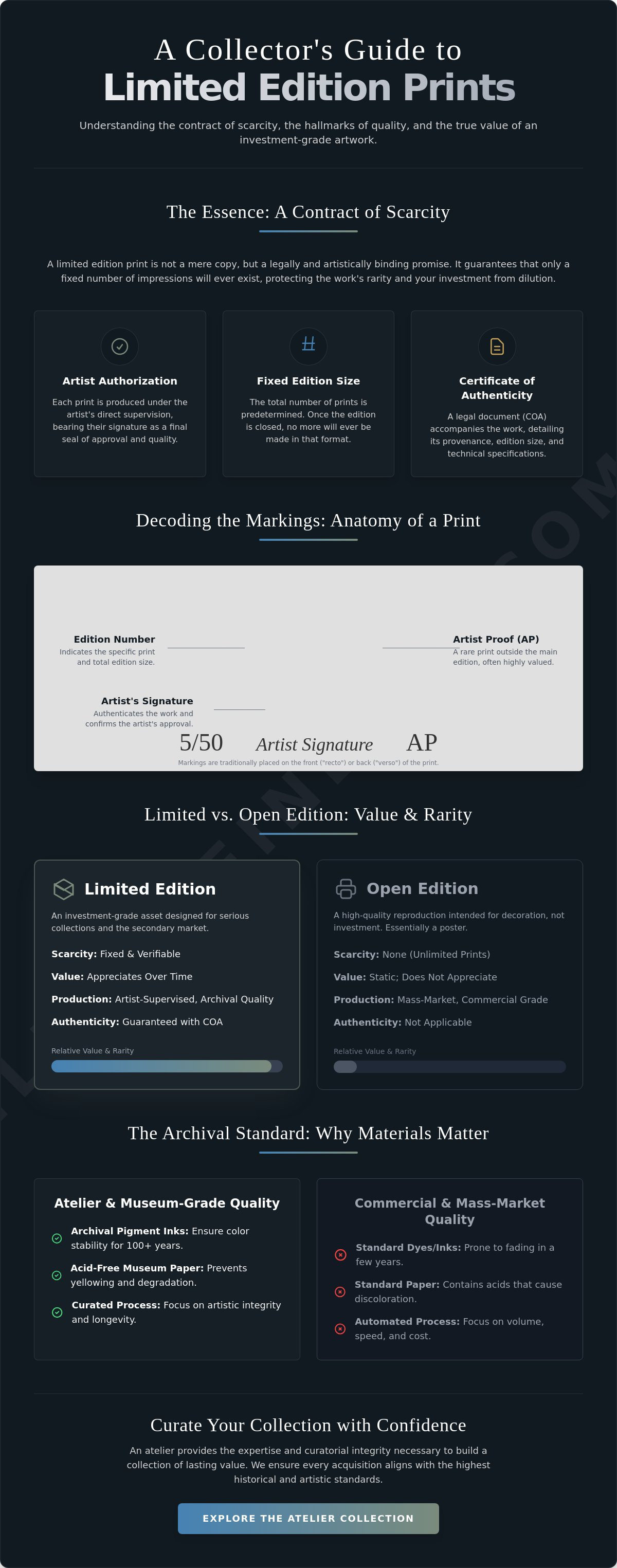
The fraction found in the margin of a print, such as 5/50, provides immediate transparency and visually defines what is a limited edition print for the discerning eye. The denominator indicates the total number of prints in the series, while the numerator identifies the specific individual piece. The artist’s signature acts as a final seal of approval, certifying that the work meets their exacting standards. In the historical tradition of an Edition (printmaking), smaller edition sizes typically command higher market values. Rarity isn't just a marketing term; it's a structural component of the work's worth.
The Role of the Gallery and Atelier
Curatorial integrity is the foundation of a serious collection. A commercial print shop prioritizes volume and speed, often sacrificing the archival nuances required for investment-grade art. In contrast, a fine art atelier serves as a guardian of the artistic process. At Ilkaa's Fine Art Gallery & Atelier, we maintain a strict commitment to restricted, high-value photographic works. Our focus remains on the tactile quality of the medium and the preservation of the artist’s original intent. This ensures that every piece in The Atelier Collection remains a cornerstone of heritage and craft.
Decoding the Print: Numbers, Signatures, and Proofs
The mark of the artist is a tactile confirmation of value. When examining what is a limited edition print, the most immediate indicators are the handwritten notations found within the margins of the paper. These visual cues serve as the collector's map to the work's origin and standing. Traditionally, the signature and edition number are placed "recto," or on the front of the print, typically in the lower margin. This provides an immediate verification of the artist's hand. However, many modern practitioners prefer "verso" signing, placing these details on the back to allow the image to exist without textual distraction. According to Tate's definition of an edition, this numbering system is the primary method of tracking these assets through time and across collections.
Once the designated number of impressions is reached, the artist initiates a formal retirement process. The master file or negative is effectively closed, ensuring that the market's understanding of what is a limited edition print remains anchored in absolute scarcity. In rare instances, an artist may produce a "Unique State" print, which is a one-of-a-kind variation where the impression has been manually altered, rendering it fundamentally distinct from the rest of the edition. To appreciate how these standards manifest in a curated environment, one might explore the selections within The Atelier Collection.
Understanding Artist Proofs (AP)
Artist Proofs exist as a separate category, often marked with the initials "AP" instead of a fraction. Historically, these were the artist's personal working copies, used to monitor the quality of the print run or kept for their private archive. Because they are produced outside the main edition and are inherently fewer in number, they carry a sense of intimacy and extreme rarity. Collectors often pay a premium for APs, as they represent a direct link to the artist's studio practice and personal heritage.
The Certificate of Authenticity
A physical print is only half of the acquisition; the Certificate of Authenticity (COA) is its shadow and its shield. A valid COA must include the artist's name, the title of the work, the specific edition number, and the date of production. In the modern photography market, these documents have evolved from simple paper slips to sophisticated records, sometimes including digital signatures or holographic seals. The COA is as vital as the print itself for future resale, providing the definitive proof of provenance required by galleries and auction houses worldwide.
Limited vs. Open Edition: Assessing Value and Rarity
The distinction between an open edition and a limited series is a fundamental choice between decor and legacy. Open editions are produced without a cap on quantity. They're designed for accessibility and wide distribution. In contrast, the question of what is a limited edition print is answered by its deliberate restriction. This boundary transforms a visual image into a finite resource. For the collector, this scarcity is the engine of value. It's the difference between a transient reproduction and a permanent asset.
Limited supply naturally fosters a secondary market. When an edition sells out, the only way to acquire a piece is through another collector or an auction house. This dynamic creates a lifecycle for the work that extends far beyond the initial gallery sale. There's a profound psychological weight to possessing a rare fragment of photographic history. It's a connection to a specific, unrepeatable moment of creation. When building a portfolio, balancing the price-to-rarity ratio is essential. A smaller edition size often justifies a higher entry point because the path to future scarcity is shorter. Rarity isn't just a number; it's a safeguard for the collector's commitment to the work.
The Investment Perspective
Galleries often employ tiered pricing to reflect this diminishing supply. As a series nears its end, the cost of the remaining impressions typically rises. This reflects the increasing rarity of the remaining inventory. Tracking the provenance of a specific print number becomes a vital exercise in transparency. It ensures that the lineage of the asset is documented and preserved. Knowing what is a limited edition print in the context of its specific edition number allows for a more precise valuation of its standing within the artist's body of work.
When to Choose an Open Edition
Open editions have their place in high-traffic or purely decorative environments. They offer aesthetic value without the pressure of preservation or market appreciation. However, Ilkaa's Fine Art Gallery & Atelier focuses exclusively on high-value, numbered works to maintain the highest standards of the medium. We prioritize Archival Pigment Prints over mass-produced posters. This commitment ensures that every acquisition in The Atelier Collection is built for longevity. The chemistry of archival inks and museum-grade papers is reserved for those who view art as a permanent heritage, not a temporary fixture.
The Archival Standard: Why Museum-Grade Production Defines Value
The digital medium is often misunderstood as a realm of infinite, identical copies. This misconception ignores the vast technical chasm between a commercial reproduction and a museum-grade asset. When we define what is a limited edition print, we aren't just discussing the number on the paper; we're discussing the chemical permanence of the object itself. Standard inkjet printing relies on dye-based inks, which are susceptible to oxidation and UV degradation. These prints are transient. They're designed for short-term consumption rather than long-term preservation.
True archival production utilizes mineral-based pigments. These are solid particles that remain suspended on the surface of the paper rather than soaking into the fibers. This stability is the foundation of lightfastness. In a controlled environment, the lifespan of a pigment print exceeds 100 years, ensuring the work survives as a legacy for future generations. This technical rigor is what transforms a photographic image into a cornerstone of a serious art collection. It's a commitment to the physical medium that mirrors the permanence of traditional oil painting or sculpture.
The Science of Archival Pigment
The substrate is as vital as the pigment. We exclusively use 100% cotton rag papers that are acid-free and pH neutral. Many mass-market papers contain wood pulp and optical brightening agents that eventually cause yellowing and brittleness. By selecting papers free from these impurities, the archival standard prevents the slow decay that often plagues lesser reproductions. This focus on material purity is essential for maintaining the work's integrity over decades. It ensures that the highlights remain crisp and the shadows retain their depth through the passage of time.
The Atelier Collection Standards
Terminology matters in the acquisition process. "Giclée" is frequently used as a generic marketing term, yet it lacks a precise technical definition. In contrast, "Archival Pigment" signifies a specific, measurable standard of quality. The Atelier Collection at Ilkaa's Fine Art Gallery & Atelier adheres to these benchmarks through a disciplined studio practice. We engage in exhaustive color matching and proofing with internationally respected photographers to ensure every impression is a definitive record of their intent. For those seeking to build a collection rooted in technical mastery, we invite you to view our latest Limited Edition Prints.
Curating Your Collection: The Atelier Experience in Columbus
The final stage of collecting is the transition from theory to presence. While understanding the technical definition of what is a limited edition print provides a necessary foundation, the true value of art is felt within a physical, intentional space. The Joseph-Cherrington House in Columbus serves as this sanctuary. It's a place where the quietude of the gallery mirrors the contemplative nature of the works themselves. Here, the collector moves beyond the screen to experience the tactile depth of an Archival Pigment Print in an environment designed for reflection.
Art advisory services act as a bridge in this environment. Selecting a piece for a serious collection requires more than an emotional response; it requires a strategic understanding of how a specific edition fits within a broader portfolio. Seeing fine art photography in person allows for an appreciation of scale and texture that digital previews cannot replicate. The subtle gradations of light and the specific weight of the paper become visible, reinforcing the print's status as a unique asset. This physical encounter is essential for those who value the heritage and physical medium of film.
Local Expertise in Columbus, Ohio
Building a cohesive photography portfolio is a deliberate process. Our presence in Columbus allows us to offer personalized guidance that respects the collector's long-term vision. Visiting a local gallery provides the opportunity to discuss provenance and editioning directly with experts who understand the nuances of the medium. Ilkaa’s Fine Art remains deeply committed to the Columbus art community, fostering an environment where technical mastery and artistic legacy are celebrated through carefully curated exhibitions. This local connection ensures that your acquisition is supported by a community of high-level craftsmanship.
Next Steps for the New Collector
The path to ownership is one of refinement and clarity. For those ready to advance their collection, we invite you to explore The Atelier Collection for rare and unique works that define the pinnacle of the medium. You may inquire about specific edition numbers or the availability of rare artist proofs that exist outside the standard run. Each inquiry is handled with the discretion and expertise expected of a traditional institution. To begin this journey, you may schedule a private viewing at our Columbus gallery. This personal consultation ensures that your understanding of what is a limited edition print is matched by a physical encounter with the work itself.
Building a Legacy of Artistic Integrity
Acquiring fine art is a journey of discernment and technical appreciation. It’s about recognizing the profound difference between a transient reproduction and a heritage asset. By understanding the contract of scarcity and the rigorous archival standards of pigment chemistry, you ensure your collection maintains its value and physical integrity for decades. This knowledge transforms the question of what is a limited edition print from a point of confusion into a clear standard for investment-grade photography. You’re now equipped to identify the hallmarks of true museum quality, from the nuances of artist proofs to the permanence of cotton rag substrates.
We invite you to experience these standards firsthand within the quiet elegance of the historic Joseph-Cherrington House. Our atelier features works from internationally respected photographers, all meticulously produced to museum-grade archival standards. Explore our curated collection of Limited Edition Prints to discover a piece that speaks to your personal legacy. Every acquisition is a commitment to the artistic process and the enduring power of the medium. We look forward to helping you select a work that will anchor your collection for generations to come.
Frequently Asked Questions
What is the difference between a limited edition and an artist proof?
An artist proof (AP) is an impression produced outside the standard numbered series, traditionally reserved for the artist’s personal archive or quality control. While a limited edition follows a strict fractional numbering system, an AP is marked with the initials "AP." Because they are significantly fewer in number, artist proofs often carry a higher market value due to their perceived intimacy and extreme rarity within the artist's body of work.
How do I know if a limited edition print is authentic?
Verification of authenticity relies on three primary pillars: the artist’s handwritten signature, the edition numbering, and a valid Certificate of Authenticity. These elements must be consistent with the artist’s established studio practice and gallery records. When considering what is a limited edition print, a reputable atelier will always provide a transparent record of provenance that documents the work's origin and specific technical specifications.
Does the number of the print (e.g., 1/50 vs. 50/50) affect its value?
In modern pigment printing, the specific number within an edition does not reflect a difference in technical quality. Every impression is produced to the same exacting museum standard. While some collectors prefer lower numbers for perceived prestige or historical priority, the total edition size is a far more significant driver of value. The scarcity of the entire series matters more than the individual sequence number on the paper.
Can an artist print more copies after a limited edition sells out?
A limited edition is a binding commitment that the artist won't produce further copies of the image in that specific format once the series is closed. Printing additional copies would violate the contract of scarcity and damage the artist’s reputation along with the work's market value. This permanent retirement of the master file or negative is what protects the collector's long-term investment and ensures the work's rarity.
What makes a print "museum-grade" or "archival"?
A print earns the "museum-grade" designation through the use of mineral-based pigment inks and acid-free, 100% cotton rag papers. Unlike standard inkjets that use fugitive dyes, Archival Pigment Prints are chemically stable and resistant to UV degradation. This technical standard ensures the work remains lightfast and free from yellowing for over a century, meeting the rigorous preservation requirements of global art institutions and private collectors.
Why are signed limited edition prints more expensive than unsigned ones?
The artist’s signature acts as a definitive seal of approval and a primary layer of authentication. It transforms a high-quality reproduction into an authorized work of art. Signed prints command a premium because they represent a direct physical connection to the creator’s hand. This manual verification is essential for establishing the work’s standing in the secondary market and provides the necessary security for serious art acquisitions.
How should I store or display a limited edition print to preserve its value?
Preserving a print’s value requires protection from environmental stressors like direct sunlight, extreme humidity, and acidic materials. Use UV-protective glass and acid-free mounting boards to prevent chemical migration and fading over time. Displaying the work in a climate-controlled environment ensures the longevity of the fibers and pigments. Proper archival framing is an essential investment in the work’s future heritage and market standing.
What is a Certificate of Authenticity and why do I need one?
A Certificate of Authenticity is a legal document that provides definitive proof of a work's provenance and technical details. It includes the artist’s name, the title, the specific edition number, and the date of production. This document is vital for answering the question of what is a limited edition print for future buyers or auction houses. Without this record, proving the legitimacy of a print during a resale becomes significantly more difficult.
Disclaimer
Information is provided for general editorial and educational purposes. Artwork availability, pricing, dimensions, framing, edition details, exhibition information, and event schedules are subject to change. Please contact Ilkaa’s Fine Art Gallery & Atelier for the most current information.
© 2026 Ilkaa’s Fine Art Gallery & Atelier. Article text, gallery photographs, graphics, and other original gallery content may not be copied, reproduced, republished, distributed, modified, or used for commercial purposes without prior written permission. Copyright in individual artworks, artist photographs, and other third-party materials remains with the respective artists, photographers, estates, or rights holders. Brief quotations and links may be used with appropriate attribution where permitted by law.