
In a world saturated by fleeting digital projections, why does a single physical print command millions at auction? While billions of images vanish into the ether of social feeds, the fine art photography market reached a valuation of $18.5 billion in 2025. This paradox highlights a fundamental truth. True value isn't found in the image alone, but in the physical object's scarcity and technical integrity.
You likely feel the weight of digital oversaturation, making it difficult to distinguish between a beautiful decorative piece and an investment-grade work that will endure for generations. This analysis clarifies what makes fine art photography valuable by detailing the interplay of rarity, archival science, and provenance that defines a high-value tangible asset. We'll examine how verified scarcity and museum-grade standards protect your acquisitions. You'll gain a clear framework for evaluating works, providing the confidence needed to curate a collection that honors both artistic legacy and long-term value.
Key Takeaways
- Distinguish between ephemeral decorative prints and investment-grade works that serve as a tangible hedge against digital saturation.
- Identify what makes fine art photography valuable by analyzing the intersection of limited editioning, documented provenance, and archival permanence.
- Master a collector’s framework for verifying artist signatures and archival certifications to ensure the technical integrity of your assets.
- Recognize the role of the boutique atelier as an essential gatekeeper for technical mastery and artistic legacy in the current market.
- Understand how a historic gallery environment and the atelier experience contribute to the enduring cultural weight of a curated collection.
Defining Investment-Grade Photography in 2026
The distinction between a decorative image and a collectible asset lies in the intention of its creation. While mass-market prints serve as ephemeral decor, investment-grade photography functions as a vessel for historical and cultural significance. In 2026, collectors increasingly look beyond the aesthetic surface. They seek works that possess a documented lineage and technical permanence. Understanding What is Fine Art Photography? requires recognizing it as a medium where the artist's vision is executed through precise, archival methods rather than commercial convenience.
This year marks a definitive shift in market psychology. As AI-generated imagery and digital replicas saturate our visual environment, the value of the physical object has surged. Physicality acts as a hedge against the infinite reproducibility of the digital realm. Fine art photography is now a recognized low-correlation asset class; its value often remains steady even during periods of traditional market volatility. Beyond financial metrics, collectors experience a hedonic return. This is the profound psychological satisfaction of living with museum-grade art that captures a specific, unrepeatable moment in time.
The Scarcity Principle in a Digital World
In a landscape where algorithms can generate flawless images, human intentionality has become the new gold standard. This "Human Hand" premium rewards the artist's specific choices in the darkroom or the digital atelier. The primary value of a work is anchored in the original negative or master file, which dictates the strict limits of its physical manifestation. Investment-grade photography is a work with verified provenance and restricted physical existence. By adhering to these constraints, Limited Edition Prints maintain their status as rare artifacts rather than mass commodities.
Historical Performance and Market Maturity
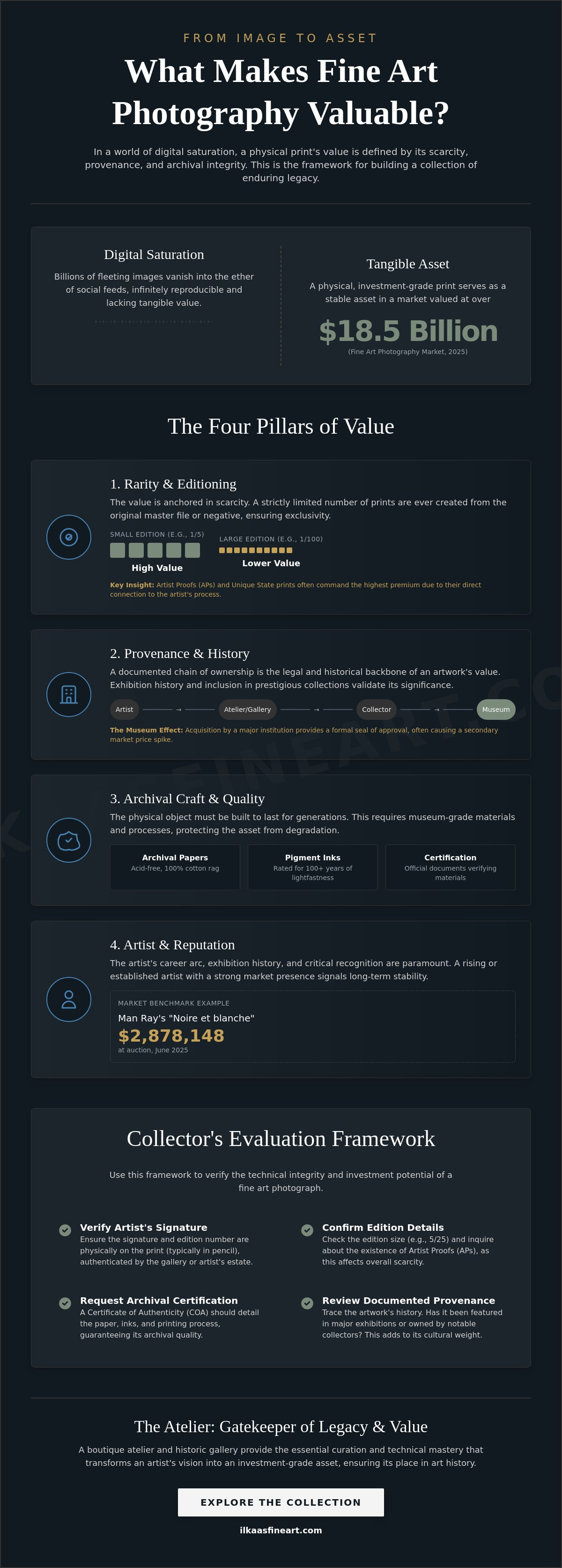
The photography market has demonstrated remarkable resilience and growth at premier institutions. Major auction houses like Sotheby's continue to see significant benchmarks; for instance, Man Ray's "Noire et blanche" fetched $2,878,148 in June 2025. This performance signals a maturing market where photography is no longer the "affordable" alternative to painting, but a primary focus for serious investors.
The "Museum Effect" remains a critical driver of what makes fine art photography valuable today. When a major institution acquires a photographer's work for its permanent collection, it provides a formal seal of approval that often causes a secondary market price spike. Because photography allows for a more accessible entry point than traditional oils while offering similar archival longevity, it frequently outperforms paintings in emerging collector markets. This balance of accessibility and prestige makes the medium an essential component of a diversified contemporary collection.
The Four Pillars of Value: Rarity, Provenance, and Craft
The architecture of art valuation rests upon four distinct yet intersecting pillars. These elements collectively answer what makes fine art photography valuable in a market that rewards precision over volume. Rarity ensures exclusivity, while provenance provides the legal and historical foundation for that rarity. When combined with the artist’s professional reputation and the physical craft of the print, a photograph transcends its visual appeal to become a durable asset.
The Mathematics of Limited Editions
Editioning is a mathematical exercise in scarcity. A print numbered 1/5 inherently commands a higher price ceiling than one from an edition of 100 because the supply is strictly curtailed. The common belief that 1/25 is more valuable than 24/25 is largely a collector's preference rather than a market rule. The true premium often lies with Artist Proofs or Unique State prints. These represent the artist’s personal involvement in the proofing process. For those seeking the pinnacle of exclusivity, Limited Edition Prints from a respected atelier offer the most secure path to value retention.
A documented chain of ownership is the spine of any serious collection. Without a clear history, even the most striking image loses its investment potential. This transparency is vital in the growing fine art photography market, where institutional recognition and a robust exhibition history validate the artist’s career arc. Market maturity is driven by these paper trails that link a work to significant galleries or prestigious previous owners. Curation by established institutions acts as a multiplier for an artist's reputation, signaling long-term stability to the collector.
Archival Pigment Prints vs. Mass Production
Physical integrity is the final, essential pillar. The chemistry of the medium determines what makes fine art photography valuable over decades of display. Archival pigment prints, created with mineral-based pigments on acid-free cotton rag, offer a level of stability that mass-produced silver halide or inkjet prints cannot match. Adhering to ISO 9706 archival standards ensures that the paper possesses the chemical balance to resist environmental degradation. Archival quality is the 'insurance policy' of the art investor, guaranteeing a 100+ year lifespan. This technical mastery ensures that the asset you acquire today remains a legacy for the next century.
Market Resilience: Why Photography is a Stable Asset
Fine art photography occupies a unique position within the broader collector's market. It functions as a tangible hedge against the fluctuations of traditional financial instruments. While stock market volatility often prompts a flight to safety, hard assets like photography offer a stable repository for capital. This stability is largely driven by the "Human Premium." As digital creation becomes effortless, the deliberate, time-intensive nature of traditional film and darkroom techniques gains new financial weight. Collectors now recognize that the artist’s physical labor and technical mastery are central to what makes fine art photography valuable in an increasingly automated world.
Boutique ateliers have emerged as the primary gatekeepers for this value. These specialized spaces move beyond the volume-heavy model of traditional galleries. They focus on the intimacy of the artistic process, ensuring that every piece in The Atelier Collection meets rigorous standards of curation. By acting as a bridge between the creator and the investor, these institutions provide the security of expert verification in an uncertain market.
Portfolio Diversification with Tangible Assets
Strategic investors treat fine art photography with the same rigor as vintage watches or rare automotive assets. These are low-correlation assets; their value doesn't mirror the daily swings of the S&P 500. A portfolio of high-end prints serves as a portable store of wealth, easily moved yet physically substantial. In the 2026 economic landscape, this blend of aesthetic enjoyment and capital preservation is indispensable. Photography offers a unique advantage here. It provides the prestige of fine art with a technical transparency that makes valuation more objective than other contemporary mediums.
The Cultural ROI of Supporting the Living Artist
Supporting the living artist through primary market acquisitions is more than a philanthropic gesture. It's a strategic move to establish an artist’s legacy from the root. Contemporary works that offer poignant social commentary often secure long-term relevance. This cultural weight translates directly to price appreciation in the secondary market. Regional hubs are playing a pivotal role in this trajectory. The Columbus art scene, for instance, is currently mirroring global trends in photography collecting.
The grand opening of Ilkaa’s Fine Art Gallery & Atelier in May 2026 exemplifies how local institutions elevate regional talent to national prominence. These hubs provide a curated environment where collectors can engage with the physical medium of film. By focusing on what makes fine art photography valuable-the intersection of craft and narrative-these galleries ensure that the art remains a vibrant, evolving asset class. Investing in these regional centers allows collectors to acquire museum-grade work before it reaches the peak of international auction prices.
A Collector’s Framework: How to Evaluate a Print
Acquiring fine art photography requires a transition from emotional appreciation to technical scrutiny. While the initial draw is often aesthetic, the long-term viability of the piece as an asset depends on a rigorous evaluation process. This framework provides the necessary checkpoints to determine what makes fine art photography valuable and ensures your collection is built on a foundation of verified quality. Every acquisition should be viewed through the lens of technical mastery and documented history.
- Step 1: Verify the Editioning and Signature. Confirm the total edition size and the specific number of the print. A handwritten signature, whether on the margin or the reverse, serves as the artist’s final endorsement of the work’s integrity.
- Step 2: Inspect the Physical Medium. Ensure the work is produced as an Archival Pigment Print on acid-free cotton rag. The tactile quality and chemical stability of the paper are primary indicators of a work intended for museum-grade longevity.
- Step 3: Analyze the Curatorial Footprint. Review the artist’s exhibition history and institutional awards. A robust record of gallery shows and museum acquisitions signals market maturity and future demand.
- Step 4: Review the Certificate of Authenticity (COA). This document provides the legal clarity required for future resale. It must contain specific technical data that matches the physical print.
- Step 5: Assess the Gallery’s Reputation. A reputable gallery acts as a professional advisor. Their long-term commitment to an artist’s career provides a layer of protection for your investment.
The Critical Role of the Certificate of Authenticity
The COA is the bridge between the physical print and its provenance. It must include the edition number, date of creation, paper type, and the artist’s signature. In the 2026 market, digital COAs backed by blockchain have become the standard for verifying provenance, offering an immutable record of ownership. Industry professionals often observe that a lost certificate can reduce a print's resale value by as much as 50 percent, as it severs the verified link to the artist’s hand. Maintaining this documentation is as vital as protecting the print itself.
Preservation as Value Maintenance
Once a print is acquired, its value is maintained through meticulous preservation. Environmental controls are non-negotiable; humidity and direct light are the primary enemies of archival paper. Professional framing is a strategic investment rather than a secondary expense. Utilizing UV-protective glazing and acid-free mounting materials creates a sealed environment that prevents yellowing or degradation. By adhering to these museum standards, you ensure the asset retains its technical perfection for decades. To begin your journey with works that meet these exacting standards, you may browse our curated Atelier Collection.
The Atelier Experience: Heritage and Value at Ilkaa’s
Ilkaa’s Fine Art Gallery & Atelier serves as a vital bridge between the artist’s private studio and the collector’s personal environment. Following its grand opening on May 16, 2026, the gallery has established itself as a sanctuary for those who value technical mastery. Unlike generic online platforms, this physical space provides a curated context that elevates the medium. The choice of the Joseph-Cherrington House in Columbus, Ohio, is intentional. A historic setting provides a sense of continuity and heritage. It reinforces the idea that the art within is a lasting legacy.
The environment where you first encounter a work dictates its perceived cultural weight. This historic context is a subtle yet powerful factor in what makes fine art photography valuable. By presenting modern works within a structure that has endured since the 19th century, the gallery suggests that these prints are destined for a similar longevity. It's a rejection of the disposable nature of digital media. It favors the tactile reality of the physical print.
Museum-Grade Production Standards
Millie Franz and Ilkaa Amalia oversee every stage of the production process to ensure that each piece meets the highest archival rigor. Their focus remains on technical perfection and chemical stability. You can explore the Atelier Collection for investment-grade examples of this craft. These prints represent the pinnacle of photographic excellence, utilizing mineral pigments and acid-free papers that protect the collector’s interest through material permanence. Every work is treated as a unique artifact, curated to maintain its integrity for over a century.
Private Consultations in Columbus
In an era of automated transactions, the intimate viewing experience remains the ultimate luxury. The physical gallery allows collectors to observe the play of light across the texture of an Archival Pigment Print, a detail lost on a screen. Our advisory services help both private and corporate collectors build cohesive portfolios that reflect their personal aesthetic and investment goals. We act as guardians of artistic integrity, ensuring that each acquisition fits into a broader narrative of quality and heritage. Schedule a private viewing at the Joseph-Cherrington House or browse our limited editions.
Cultivating an Enduring Artistic Legacy
The 2026 art market rewards collectors who prioritize technical permanence and documented scarcity. As digital imagery becomes increasingly ubiquitous, the physical print serves as a vital anchor for cultural and financial value. Understanding what makes fine art photography valuable involves a commitment to archival integrity and a deep appreciation for the artist’s hand. By focusing on verified provenance and museum-grade materials, you protect the longevity of your assets while fostering a deeper connection to the medium.
Ilkaa’s Fine Art Gallery & Atelier acts as a guardian of these standards. Situated in the historic Joseph-Cherrington House, we offer expert art advisory for private collectors seeking to build a meaningful portfolio. Our Atelier Collection features limited edition prints produced to the most exacting specifications, ensuring your investment remains a source of pride for generations. We invite you to experience the quiet power of high-level craftsmanship in person or through our digital archives.
The journey of a collector is one of discovery and refinement. We're here to ensure your vision is met with the highest standards of artistic excellence.
Frequently Asked Questions
Is photography considered a blue-chip investment like painting?
Photography is increasingly recognized as a stable, blue-chip asset class that often mirrors the performance of traditional paintings in prestigious auction houses. Its value is anchored in institutional recognition and historical significance. Collectors favor the medium for its technical transparency and accessibility, offering a sophisticated entry point into the art market with a proven potential for long-term capital appreciation.
What is the difference between an open edition and a limited edition?
Limited editions are strictly capped at a predetermined number of prints, ensuring verified scarcity and exclusivity for the collector. Open editions are reproduced indefinitely, which typically classifies them as decorative rather than investment-grade. This distinction is a primary factor in what makes fine art photography valuable, as it protects the work from market dilution and maintains its status as a rare artifact.
How does the size of an edition affect the photograph's value?
Edition size acts as a direct lever for market valuation. A print from an edition of five inherently commands a higher price ceiling than one from an edition of fifty because the physical supply is more constrained. Smaller editions suggest a higher degree of rarity, making them more attractive to serious investors who prioritize exclusivity and high-caliber craftsmanship in their private collections.
What are archival pigment prints and why are they valuable?
Archival pigment prints utilize mineral-based pigments applied to acid-free cotton rag paper, ensuring a chemical stability that lasts over a century. Their value stems from this material permanence, which resists the fading and yellowing common in mass-produced processes. They represent the technical gold standard for collectors who view their acquisitions as enduring tangible assets rather than ephemeral decor.
How can I verify the provenance of a photograph I want to purchase?
Verification requires a thorough review of the Certificate of Authenticity and the documented chain of ownership. A reputable gallery provides a paper trail linking the work directly to the artist’s atelier or significant previous collections. In the current market, digital records and blockchain verification are also becoming essential tools for ensuring the legal clarity and historical integrity of an acquisition.
Does the number in a limited edition (e.g., 1/10) matter for its value?
The specific number within an edition, such as 1/10, generally doesn't dictate a higher financial value than 9/10. While some collectors have a personal preference for the first or last print in a series, the market focuses on the total edition limit. The artist's signature and the print's physical condition are far more critical indicators of worth than the sequence number.
How do I care for my fine art photography to ensure it holds its value?
Maintaining value requires protecting the print from direct sunlight, high humidity, and extreme temperature fluctuations. Utilizing UV-protective glazing and acid-free mounting materials prevents chemical degradation and physical warping over time. Professional framing serves as a necessary preservation layer, ensuring the photograph remains in museum-grade condition for decades of display and potential resale.
Where can I buy investment-grade photography in Columbus, Ohio?
Investment-grade works are available at Ilkaa’s Fine Art Gallery & Atelier, located within the historic Joseph-Cherrington House. This boutique setting specializes in Limited Edition Prints and the exclusive Atelier Collection, providing a curated experience for discerning collectors. Our advisory services offer personalized guidance for those seeking to understand what makes fine art photography valuable within a sophisticated local context.
Disclaimer
Information is provided for general editorial and educational purposes. Artwork availability, pricing, dimensions, framing, edition details, exhibition information, and event schedules are subject to change. Please contact Ilkaa’s Fine Art Gallery & Atelier for the most current information.
© 2026 Ilkaa’s Fine Art Gallery & Atelier. Article text, gallery photographs, graphics, and other original gallery content may not be copied, reproduced, republished, distributed, modified, or used for commercial purposes without prior written permission. Copyright in individual artworks, artist photographs, and other third-party materials remains with the respective artists, photographers, estates, or rights holders. Brief quotations and links may be used with appropriate attribution where permitted by law.